TL;DR: A Texas property management firm saved $900,000 by choosing flat roof coating over replacement for 15 buildings. Coating costs one-fifth the price ($2-5 vs $8-14 per square foot), extends roof life by 10-20 years, cuts energy costs by $6,000+ per building annually, and eliminates operational disruption.
- Cost comparison: Coating runs $2-5 per square foot versus $8-14 for replacement
- Life extension: Adds 10-20 years to existing roof lifespan
- Energy savings: Cuts cooling costs by $6,000+ per building each year through reflective technology
- Renewable solution: Roofs get recoated every 10-15 years for $1-2 per square foot
- Zero disruption: Buildings stay fully operational during coating application
I’ve watched property managers make the same expensive mistake for years.
A roof starts leaking. They panic. They call for a replacement quote. Then they write a check that drains their capital budget for the next three years.
Here’s what I learned after ten years in commercial roofing: most flat roofs don’t need replacement. They need restoration.
Why This Texas Property Manager Was Facing $900,000 in Roof Costs
Three years ago, I met a property management firm in Texas with 15 strip malls. Their roofs were draining their budget.
They were stuck in what I call the reactive repair cycle. A leak appears. They patch it. Another leak. Another patch. Their roofs lasted only 17 years before needing full replacement.
The finance director showed me their five-year projection. Three full roof replacements in the next 24 months. The estimated cost: $900,000.
I suggested something different.
What Is the Alternative to Flat Roof Replacement?
Instead of replacing those roofs, I recommended a proactive maintenance plan built around coating.
Here’s what we put in place:
- Bi-annual inspections to catch small problems before they got expensive
- A scheduled coating program to restore each roof to like-new condition
- A 15-year maintenance roadmap to eliminate surprise capital costs
The client was skeptical. They asked what everyone asks: “How does coating compare to replacement?”
I showed them the numbers.
What happened: Proactive coating stopped the reactive repair cycle and prevented costly emergency replacements.
How Much Does Roof Coating Cost vs. Replacement?
A complete flat roof replacement runs $8 to $14 per square foot. For a 20,000-square-foot warehouse, you’re looking at $160,000 to $280,000.
A professional coating system runs $2 to $5 per square foot. Same 20,000-square-foot roof: $40,000 to $100,000.
You’re spending one-fifth the cost.
The savings don’t stop there.
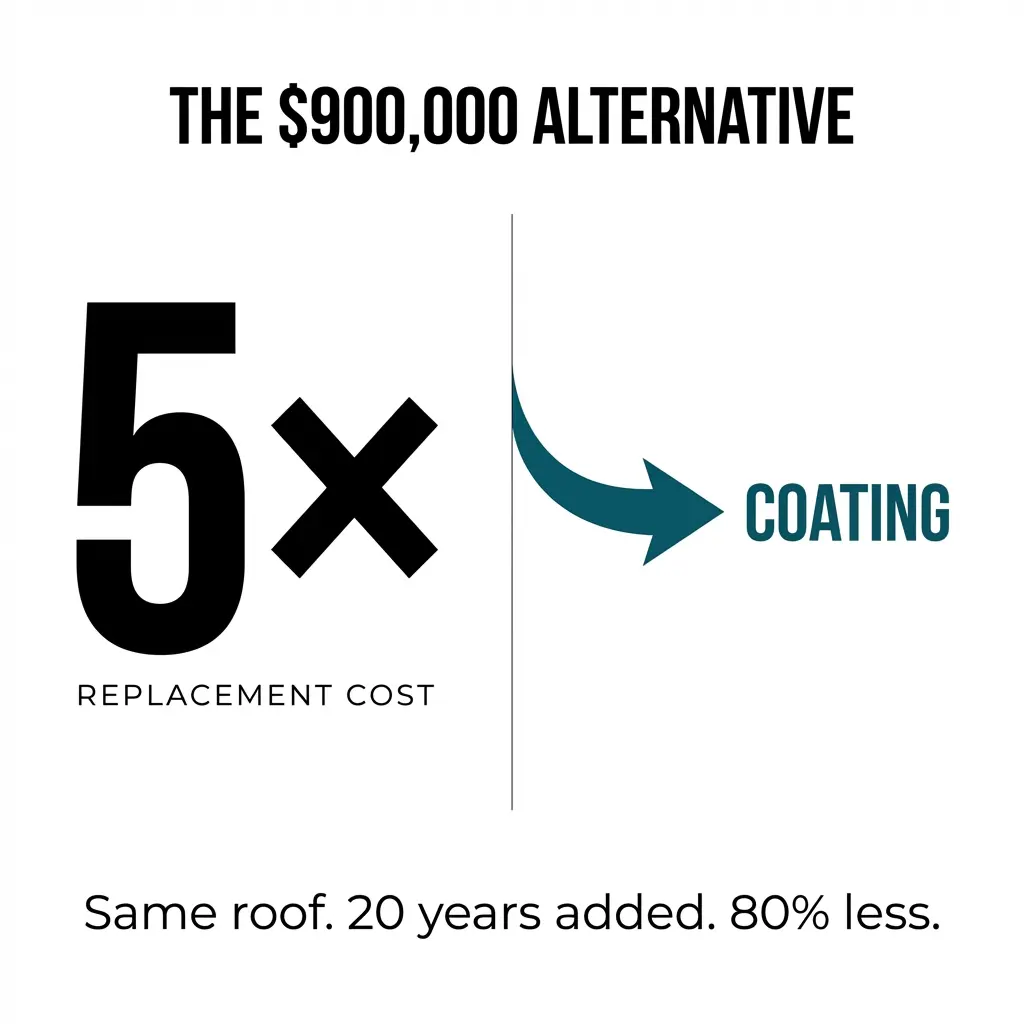
Roof coatings extend the life of your existing roof by 10 to 20 years. If your roof had 10 years left, coating gives you 20 to 30 years total. You’ve doubled its lifespan for 20% of replacement cost.
The Texas client did the math. Three replacements at $280,000 each versus coating 15 roofs at $60,000 average.
Replacement cost: $840,000
Coating cost: $900,000 total savings over five years
They approved the plan. The math was undeniable.
What this means: Roof coating delivers 80% cost savings versus replacement while extending roof lifespan by 10-20 years.
What Results Did the Coating Strategy Deliver?
We started with their worst-performing properties. The roofs leaking most often. The ones draining their maintenance budget.
Within the first year, emergency repair calls dropped by 60%.
By year three, they were down 80%.
The operational benefits surprised them more than the cost savings.
What Are the Hidden Costs of Roof Replacement?
When you replace a commercial roof, you create chaos:
- Dumpsters in the parking lot
- Debris falling
- Noise disrupting tenants
- Weather exposure during construction
Retail tenants complain. Office workers lose focus. Warehouse operations slow down.
I’ve seen businesses lose customers because of roof replacement disruption.
Coating eliminates all of this.
The application process is fast. Buildings stay fully operational. Tenants barely notice. No dumpsters, no debris, no interior disruption.
For the Texas properties, this meant no lost rent, no tenant complaints, no operational slowdowns. The finance director told me later: “We didn’t factor in those soft costs when weighing replacement. They would’ve been significant.”
The truth: Coating eliminates business disruption, tenant complaints, and revenue loss from replacement.
How Much Can Roof Coating Save on Energy Costs?
Six months after we coated the first five properties, the client called me.
Their utility bills had dropped.
Light-colored roof coatings reflect 85-90% of solar radiation. This “cool roof” effect drops roof surface temperatures by 50-80°F on summer days. Reflective surfaces prevent heat absorption.
Lower roof temperature means lower cooling costs. The connection is direct.
For their portfolio, the energy savings averaged $6,000 per building annually. Across 15 properties: $90,000 per year.
The coating investment paid for itself in energy savings alone within four years. Then kept delivering savings for another 10 to 15 years.
Energy payback: Reflective roof coatings generate $6,000+ in annual energy savings per building, creating a 4-year ROI before any roofing cost savings.
Why Is Roof Coating Renewable Unlike Replacement?
Here’s what most property managers miss about coating. It’s renewable.
When you replace a roof, you’re resetting the clock. In 20 years, you’ll need another complete tear-off and replacement at full cost.
When you coat a roof, you recoat it indefinitely. This is the difference.
Plan for recoating every 10 to 15 years. Each recoating cycle costs less than the original installation. Typically $1 to $2 per square foot. It adds another 10 to 15 years of service life.
This creates the lowest lifecycle cost of any commercial roofing strategy.
The Texas client is now in year three of their coating program. They’ve avoided three full replacements. Their roofs perform better than they have in a decade. Their capital budget is healthy.
They’re planning their first recoating cycle for 2028.
Lifecycle advantage: Recoating every 10-15 years at $1-2 per square foot creates the lowest lifecycle cost of any commercial roofing strategy.
When Does Roof Coating Not Work?
I need to be clear: coating isn’t always the answer.
If your roof has severe structural damage, coating won’t fix it. Coating restores surfaces, not structure. If the substrate is deteriorated beyond repair, you need replacement. If there’s extensive ponding water with no drainage, you have bigger problems to solve first.
A proper roof assessment tells you whether coating is viable. I recommend a professional inspection before any decision.
In my experience, 70% of roofs owners think need replacement are good candidates for coating.
They need someone to show them the alternative.
What I’ve found: 70% of roofs owners think need replacement are viable coating candidates after proper assessment.
How Do You Decide Between Coating and Replacement?
When I evaluate a flat roof, I ask three questions:
Is the substrate structurally sound? If the underlying roof deck and insulation are intact, coating works.
Is the existing membrane adhered properly? Loose or damaged membranes need more repair before coating.
How much life extension do you need? If you need 20+ years, replacement makes sense. If you need 10 to 15 years, coating is the better investment.
For the Texas properties, all three answers pointed to coating.
The result: $900,000 saved, 15 roofs performing like new, and a maintenance strategy that will keep working for the next 15 years.
Decision framework: Structurally sound roofs with properly adhered membranes needing 10-15 years of life extension are ideal coating candidates.
What Should You Do If You’re Considering Roof Replacement?
If you’re facing a roof replacement decision, take a step back. Evaluate coating first.
Get a proper assessment. Ask about coating options. Run the numbers on lifecycle cost, not upfront expense. Initial cost doesn’t reflect long-term value.
Factor in the operational impact. Add energy savings. Look at your capital budget over the next decade.
The Texas case isn’t unique. I’ve seen similar results across dozens of properties. Coating works when you apply it strategically.
You don’t need to spend five times more to get a roof that lasts half as long.
You need to understand your options.
Sometimes, the smartest investment is the one with the lowest cost.
Frequently Asked Questions About Roof Coating vs. Replacement
How long does roof coating last compared to replacement?
Roof coating adds 10-20 years to your existing roof’s lifespan. Replacement lasts 20-25 years. The difference: coating is renewable. You recoat every 10-15 years indefinitely for $1-2 per square foot. Replacement needs another full tear-off at full cost.
Can any flat roof be coated instead of replaced?
No. Coating works for 70% of roofs owners think need replacing. Your roof needs a structurally sound substrate, properly adhered membrane, and minimal ponding water. Severe structural damage needs replacement. Coating restores surfaces, not structure.
What is the cost difference between coating and replacement per square foot?
Replacement runs $8-14 per square foot. Coating runs $2-5 per square foot. Coating delivers 60-80% cost savings versus replacement. It extends roof life by 10-20 years.
Does roof coating really reduce energy costs?
Yes. Reflective roof coatings drop roof surface temperatures by 50-80°F. They reflect 85-90% of solar radiation. This cuts cooling costs by an average of $6,000 per building annually. In the case study, 15 buildings saved $90,000 per year in energy costs.
How disruptive is coating application compared to roof replacement?
Coating application is minimally disruptive. Buildings stay fully operational. No dumpsters, no falling debris, no weather exposure. Tenants barely notice the work. Replacement creates noise, disruption, tenant complaints, and potential revenue loss.
How often do you need to recoat a roof?
Plan to recoat every 10-15 years. Each recoating cycle runs $1-2 per square foot and adds another 10-15 years of service life. This renewable approach creates the lowest lifecycle cost of any commercial roofing strategy.
What happens during a roof coating assessment?
A professional inspection evaluates three factors: substrate structural integrity, membrane adhesion quality, and drainage performance. This assessment determines whether your roof is a viable coating candidate or needs more extensive repair or replacement.
Why do property managers choose replacement over coating?
Most property managers don’t know coating is an option. When a roof leaks, the default response is replacement. After seeing the cost comparison and lifecycle analysis, most see coating delivers better financial returns for structurally sound roofs.
Key Takeaways
- Coating costs 80% less than replacement: $2-5 per square foot versus $8-14, delivering big upfront savings
- Extends roof life by 10-20 years: Doubles the lifespan of existing roofs at one-fifth the replacement cost
- Renewable every 10-15 years: Recoating runs $1-2 per square foot and creates the lowest lifecycle cost strategy
- Energy savings pay for coating: Reflective coatings save $6,000+ per building annually, achieving ROI in 4 years through energy savings alone
- Zero business disruption: Buildings stay operational during coating application, eliminating tenant complaints and revenue loss
- 70% of roofs qualify: Most roofs thought to need replacement are viable coating candidates after proper assessment
- Decision framework matters: Structurally sound roofs with adhered membranes needing 10-15 years of life extension are ideal for coating
To upload drawings, specs and plans please go to the form on our contact page.
Get in Touch