
Commercial Flat Roof Coating & Waterproofing in Texas

Flat-roof coating, leak repairs and waterproofing for existing commercial buildings. Compare restoration with replacement for your roof.

Repairing and coating an existing flat roof

Flat roof waterproofing on an existing commercial building means finding where water gets in, repairing the membrane and its details, and, where the roof is sound enough, protecting it with a liquid-applied coating. Total Cladding and Roofing works on flat and low-slope roofs over warehouses, workshops, retail premises, offices and other commercial buildings in Texas, from single leaks to roof-wide restoration.

Whether a coating is the right answer depends on the existing membrane, how well a new coating will bond to it, how the roof drains and whether the insulation underneath is dry. We explain the repairs needed first, then whether a coating, a new membrane over the old one or a replacement suits the roof.

Request a flat roof review or call (210) 775-0995.

The Technical Library holds the data sheets for products used in this work, including Ure-A-Max (American WeatherStar), 289 White Roof Sealant (Henry), Gravel BUR Acrylic (Kool Coats), Acrylic Reinforced Coating System Concrete (Metacrylics), Sikalastic-624 WP Fluid-Applied Membrane Waterproofing and NDFR-2P-XE — New-construction reinforced roof system (Western Colloid).
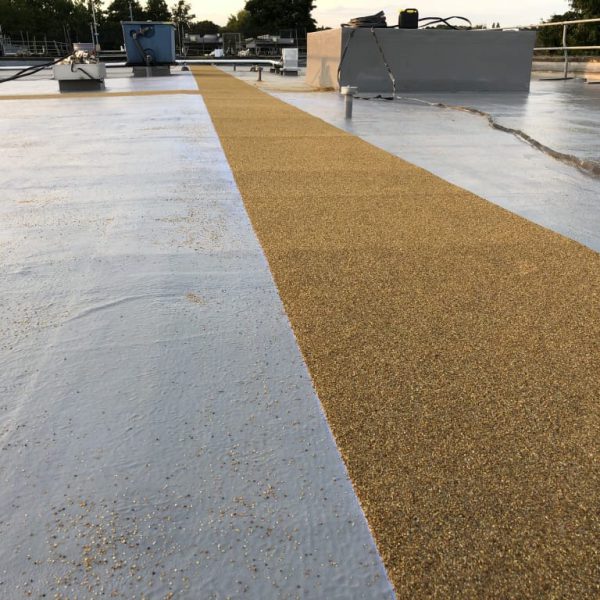

Flat roof with coated details and a marked access walkway

Finding where water enters

Water can travel a long way under a membrane before it appears indoors. We relate the reported leak to the roof’s details and drainage, then inspect the suspected area. Previous patches, blocked drains and later equipment installations often explain why a leak keeps returning.

A recurring leak across several rooms calls for a roof-wide review rather than another isolated patch. Tell us which areas are affected, whether the problem follows heavy rain or standing water, and what repairs have already been tried. That history separates defects in the roof covering from water coming in at walls, parapets or equipment.

Membranes found on Texas commercial flat roofs

Each membrane ages differently and needs its own repair materials and coating primer.

  • TPO: the most common single-ply on newer buildings. Leaks are usually at heat-welded seams, flashings and edges.
  • PVC: also heat-welded. Older PVC can become brittle and shrink as it ages, which pulls at edges and penetrations.
  • EPDM: a rubber membrane with taped or glued seams. Seam separation and shrinkage at the perimeter are the usual problems.
  • Modified bitumen: asphalt-based sheets, often with a granule surface. Look for granule loss, blistering and open laps.
  • Built-up roofing: layers of felt and asphalt, often under gravel. Cracking, blisters and ponding are typical as it ages.

Appearance alone can be misleading, particularly where a roof has already been coated. Product records and a small inspection cut help establish what the new materials must bond to.

Wet insulation and unsound surfaces

New waterproofing cannot remove moisture trapped beneath the surface. Loose membrane, blisters, saturated insulation or a damaged deck need removal or further investigation before anything is coated. An infrared scan of the roof, carried out in the evening after a sunny day, shows where wet insulation is holding heat. Core samples then confirm what the scan suggests.

Wet areas can turn an apparently simple coating job into a part-replacement. The proposal should explain how suspect areas will be checked, how wet material will be cut out and replaced, and how that work will be priced if it grows once the roof is opened.

Waterproofing systems we install

Most flat roof projects combine several of these, scoped area by area.

Local membrane repairs

Repair seams, punctures and splits with materials compatible with the existing membrane, where the surrounding roof can take a sound patch.

Flashings and penetrations

Rebuild leaking junctions at curbs, pipes, walls, parapets and edges, the details where most flat roof leaks start.

Liquid-applied restoration systems

Clean, prime and coat an eligible roof with a complete manufacturer system, reinforced at seams and details. See liquid-applied roofing.

Drainage repairs

Clear and repair drains, scuppers and gutters, and deal with the cause of standing water rather than coating around it.

Standing water and drainage

Water still lying on a roof 48 hours after rain is commonly treated as ponding. It speeds up aging of the membrane and coating, adds weight to the deck, and finds any weak seam. Silicone coatings tolerate standing water better than acrylics, but no coating makes poor drainage acceptable.

Ponding is usually caused by blocked or badly placed drains, a deck that has sagged between supports, or a roof built with too little slope. Clearing and resetting drains is a repair. Adding tapered insulation or crickets to move water toward the drains is normally done as part of a new membrane, when the roof is built back up.

Coating, a new membrane over the old, or replacement?

A coating keeps the existing membrane and depends on its condition. A sound roof with localized problems can be cleaned, repaired at its details and coated with a compatible system. Widespread damage, poor attachment or extensive wet insulation favor a new membrane.

A new membrane can sometimes be laid over the old roof (a recover), but the building code limits when. A new roof covering is not allowed over a roof that is water-soaked or deteriorated, or over two or more existing roof coverings. Moisture and the number of existing layers therefore decide whether a recover is possible or whether the old roof has to come off. A recover also needs its own check of the deck, fastening and the extra height at edges and curbs.

If the building has both flat areas and metal roofs, the proposal should treat each roof on its own merits rather than specify one coating for everything. See flat roofing systems for replacement options.

Wind, hail and roof edges

Wind uplift is strongest at roof corners and edges, which is why loose edge metal is a common starting point for storm damage. Replacement edge metal and copings are available tested to the ANSI/SPRI ES-1 standard, and a new membrane is attached to match a tested assembly for the building’s wind loads.

Hail is a regular risk across much of Texas. Some low-slope assemblies carry FM Approvals hail classifications, and a cover board under the membrane improves resistance when a roof is replaced. After a hailstorm, a roof that looks intact can still have fractured membrane or crushed insulation, which an inspection finds before the next rain does.

Reflective roofs and Texas heat

White membranes and reflective coatings keep the roof surface far cooler in summer than dark ones, reducing heat passing into the building below. Reflectance and emittance values for many roof products are published through the Cool Roof Rating Council, including aged values, which show how much reflectivity remains after a few years of weathering.

Details around rooftop equipment

A leak beside an HVAC unit can come from the roof flashing or from the equipment itself. We review the roof connection and say where a mechanical contractor is needed. New roofing also changes the flashing height available around a curb.

Tell us about planned HVAC changes. A new unit, walkway or pipe penetration can damage recently finished waterproofing, and coordinating the work avoids cutting through a new roof and paying twice for the same detail.

Access, weather and occupied areas

Cleaning and coating need dry weather and surface temperatures within the manufacturer’s limits, and coatings need time to cure before rain. In a Texas summer that often means starting early in the day. Air intakes, nearby vehicles and work above occupied rooms affect protection and the application method, so we plan around them before work starts.

Comparing waterproofing prices

Look at the preparation and repairs included before comparing the coating or membrane cost. Wet areas, removal of loose material, drain work, edge details and access make a large difference. Ask for the roof area, preparation, repairs, system, thickness and exclusions to be clear in each proposal, and read any warranty for its stated terms; a product name alone does not establish coverage.

Talk to our team

Request a flat roof waterproofing review

Request a flat roof review with the property address and the leak or roof concern. If you know the membrane or a previous coating, send that with any photographs. You do not need to know the membrane brand before contacting us.

Request a Flat Roof Coating Estimate

Frequently asked questions

Flat Roof Coating And Waterproofing FAQs

Can any commercial roof be coated?

No. The surface must be compatible and sound, with moisture and existing defects addressed before the proposed coating is applied.

Will coating repair holes or loose panels?

No. Damaged metal, failed connections and other defects need their own repairs before coating.

Can a new coating go over an old coating?

Only where the old finish is suitable to remain. Adhesion, contamination and compatibility checks help establish the preparation required.

Is silicone always better than acrylic?

No. Product choice depends on the substrate, exposure, application conditions and future maintenance. Compare the specified system for your roof.

Does ponding-water resistance mean drainage can be ignored?

No. A coating does not increase drain capacity or correct the roof's fall. Persistent standing water still needs investigation.

Why do two coating quotes differ so much?

Preparation, repairs, primer, detail reinforcement and finished thickness can vary substantially. Compare those items as well as roof area.

Can the coating be applied in any weather?

No. Roof temperature, surface moisture, rain and curing conditions must fall within the selected product's limits.

Will a reflective coating reduce our energy bills?

It may reduce solar heat absorbed by the roof. Actual building savings depend on insulation, climate, HVAC use and other conditions.

Is an extra 10 or 20 years guaranteed?

No general lifespan promise applies to every roof. Review the actual proposed work and the terms of any applicable written warranty.

What information is useful before a coating survey?

The address, known roof material, existing coating name and current defects. Old product records and photographs help if available.

UK refurbishment experience, a Texas office

Refurbishment specialists

Our business grew through roof and cladding refurbishment in the UK. That experience shapes the work we now offer from our Texas office.

Repair what can be retained

We investigate the roof problem and explain what can be repaired, restored or replaced, so you can decide how to invest in the building.

Roofing and cladding together

We can coordinate roof, insulation, wall panel and drainage work, including the connections where separate repairs can leave problems behind.

A plan for your working building

We agree access, work areas and protection with your site team, including any restrictions needed while the roof is opened.

Roofing and cladding systems

Roofing systems and materials for Texas facilities

Rustoleum Logo
Sika Logo
Kingspan Logo
Morin Logo
American WeatherStar Logo
GAF Logo
TAMKO Logo
PAC-CLAD Logo
1

Tell us about the building

Start with the address and the roof or cladding problem. Photographs are helpful if you already have them.

2

Arrange a site visit

We review the affected areas and discuss how you use the building and what you want the work to achieve.

3

Review the quotation

Your quotation explains the proposed repairs or refurbishment, the areas included and the price.

4

Agree the work plan

We discuss timing, access, deliveries and protection with your site contact before work begins.

5

Complete the work

We carry out the agreed work and discuss any changes needed if opening the roof reveals additional damage.

6

Handover

We review the completed work and provide the care information and documents included in your project.