
Sikalastic-624 WP Fluid-Applied Membrane Waterproofing
- Manufacturer
- Sika
- Product
- Sikalastic-624 WP Fluid-Applied Membrane Waterproofing
- Status
- Current
- Market
- United States
- Latest revision
- Version 01.10
- Last verified
- September 20, 2026
System overview
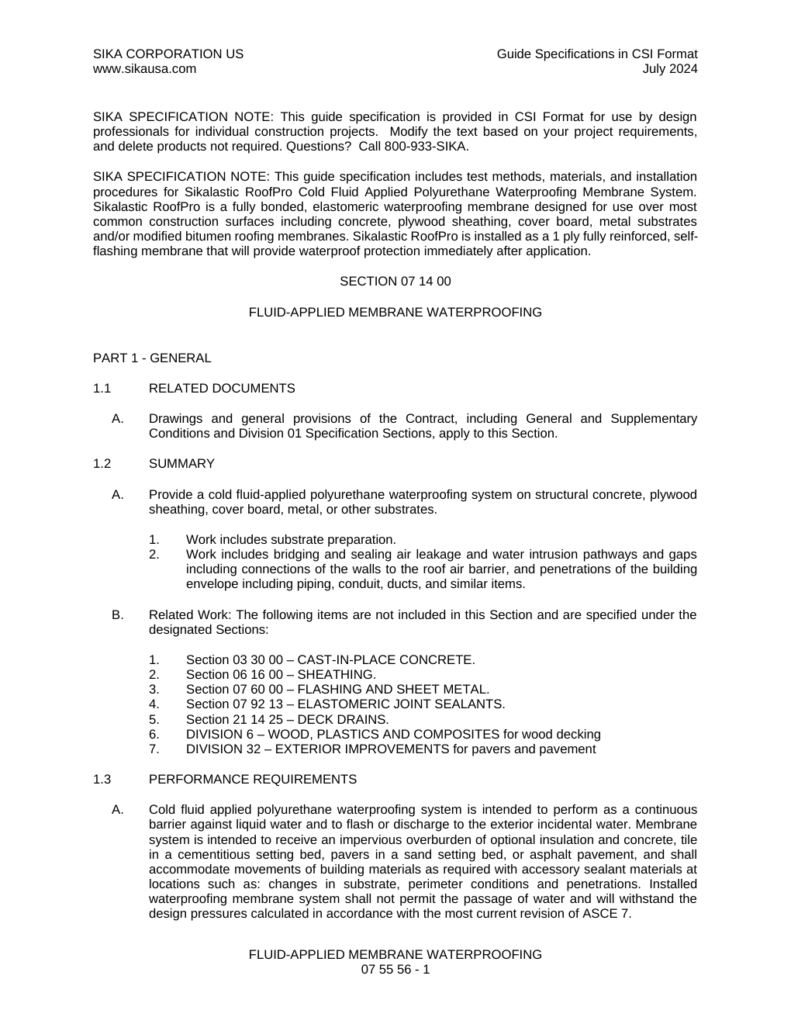
Sikalastic-624 WP Fluid-Applied Membrane Waterproofing is the waterproofing build of the Sikalastic RoofPro WP family. It is CSI Section 07 14 00, Fluid-Applied Membrane Waterproofing, a cold fluid-applied polyurethane waterproofing system on structural concrete, plywood sheathing, cover board, metal or other substrates. Its system class is a polyurethane roofing and waterproofing system.
Sikalastic RoofPro is a fully bonded elastomeric waterproofing membrane for concrete, plywood sheathing, cover board, metal substrates and modified bitumen roofing membranes, installed as a 1 ply, fully reinforced, self-flashing layer. Work in this section includes substrate preparation and the sealing of air leakage and water intrusion pathways at wall-to-roof air barrier connections and penetrations by piping, conduit and ducts.
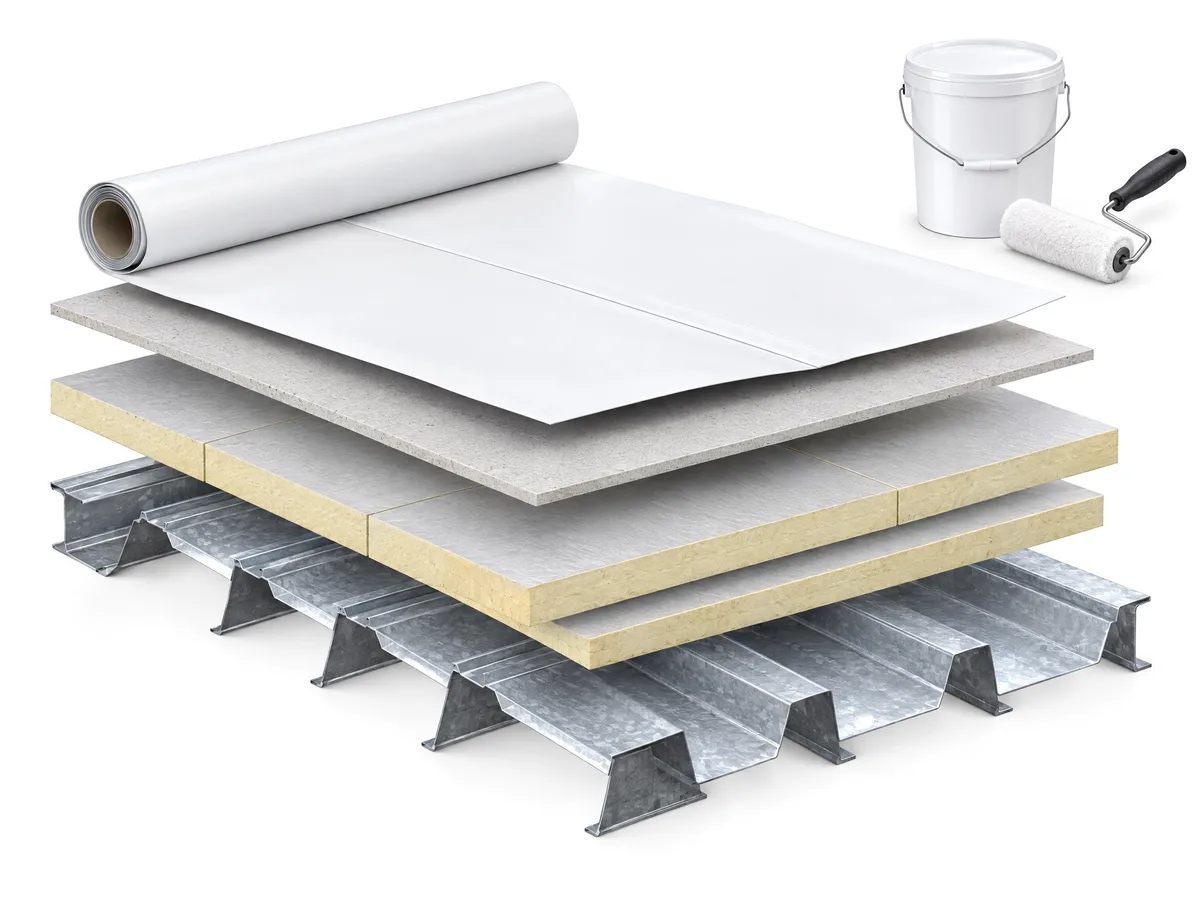
The membrane is a continuous barrier against liquid water. It receives an impervious overburden of optional insulation and concrete, tile in a cementitious setting bed, pavers in a sand setting bed, or asphalt pavement. Related work is placed in cast-in-place concrete (03 30 00), sheathing (06 16 00), flashing and sheet metal (07 60 00), joint sealants (07 92 13), deck drains (21 14 25), wood decking (Division 6) and pavers and pavement (Division 32). Reinforced with fleece or fiberglass mat, it serves as a liquid waterproofing membrane for decks and plazas.
Membrane resin and film requirements
The resin is Sikalastic-624 WP, applied by brush, roller or spray. It is a one component, low-VOC elastomeric polyurethane that meets ASTM D7311-07 for liquid applied, single component, moisture-triggered aliphatic polyurethanes. The properties set for it are:
- Viscosity: 5 to 20 Pa.s (ASTM D2196).
- Volume solids: 71 % minimum (ASTM D2697).
- Weight solids: 78 % minimum (ASTM D1644).
- Sag resistance: no sag at 700 micrometers (0.028 in.).
- Tensile strength: 1.86 MPa (270 lb/in2) minimum, and elongation 200 % minimum (ASTM D412).
- Weathering: no cracking or checking after 5000 hours (ASTM G 154).
- Water vapor transmission: 8.5 g/m2/day maximum (ASTM E96).
- Tear resistance: 5.8 kN/m (33 lbf/in) minimum.
- Hardness: 82 durometer units plus or minus 5 (ASTM D2240).
- Static puncture resistance: 20.7 kg (45.5 lbs) minimum (ASTM D5602).
Resistance covers gasoline, paraffin, fuel oil, mineral spirits, acid rain, detergents and moderate solutions of acids and alkalis, while some low molecular weight alcohols soften it. It is non-flammable. Colors are White and Pearl Gray, the shelf life is 9 months, and the density is 10.8 lb./gal.
Data sheets and technical documents
Current manufacturer system specifications, application guidelines and component data sheets matched to this assembly.
Current files
Archived files
No older reviewed revisions are archived for this product yet.
Waterproofing system builds
Each build uses a Sikalastic 624 WP base layer, a reinforcement and one or two top layers, in wet film thickness.
- WP 15 with Reemat: 45 mils at 35 sf/gal, then 30 mils at 53 sf/gal.
- WP 15 with Fleece 120: 45 mils at 35 sf/gal, then 25 mils at 64 sf/gal.
- WP 20 with Reemat: 45 mils at 35 sf/gal, then 40 mils at 40 sf/gal.
- WP 20 with Fleece 140: 50 mils at 32 sf/gal, then 35 mils at 45 sf/gal.
- WP 25 with Reemat: 45 mils at 35 sf/gal, then two 30 mil layers at 53 sf/gal each.
- WP 25 with Fleece 170: 65 mils at 24 sf/gal, then 40 mils at 40 sf/gal.
Reemat is a conformable random strand fiberglass mat, and Fleece is a needle-punched polyester fleece. Local reinforcement at cracks, expansion joints and dissimilar-material transitions is Sika Flexitape Heavy nylon mesh or Sika Joint Tape SA.
Surface preparation and detailing
Concrete is allowed to cure at least 28 days, with a compressive strength of 20.7 MPa (3000 psi) and a tensile bond strength of 1.4 MPa (200 psi). It is finished by wood float or steel pan, or by power float if laitance is avoided, and cementitious surfaces are abrasive blasted or scarified to CSP 2-4 under ICRI guidelines. Plywood decks are APA-rated, at least 1/2 in. thick, with non-rusting fasteners, panel ends spaced 1/8 to 3/16 in. and tongue-and-groove or blocked edges. Existing Sikalastic membrane and Sikaplan or Sarnafil membranes are cleaned with a pressure washer at about 140 bar (2000 psi).
The deck is clean, smooth and sloped to drains, with penetrations secured to solid blocking. Cracks and voids greater than 0.040 in. are routed and caulked with polyurethane sealant. Non-structural cracks to 1/16 in. need no detail. Cracks from 1/16 to 1/4 in. get Sikaflex sealant and a 40–45 mil resin layer with 3 in. Flexitape Heavy. Cracks and joints from 1/4 to 1 in. get a bond breaker and 6 in. tape, with the reinforcement overlapping 2 in. on each side. Joints above 1 in. are expansion joints.
Application
Sikalastic-624 WP is applied with a 1/2 in. nap phenolic resin core roller, or by squeegee or spray with backrolling. In the 25 year build the first top layer cures 12 hours at 70 °F and 50 % R.H., or until tack free, before the second top layer. Added resin layers with aggregate go on within 7 days; otherwise the surface is cleaned and primed with Sika Concrete Primer Lo-VOC or Sika Reactivation Primer. With Fleece, two-thirds of the resin is rolled first, the fleece is laid in with 3 in. side and 6 in. end overlaps, and the final third is applied at once.
The membrane is applied at ambient temperatures above 41 °F (5 °C), on surfaces 5 °F above the dew point and free of water, frost and ice. Application proceeds when rain is imminent. Storage before use is above 55 °F (12.6 °C) for at least 24 hours.
Overburden application
The resin sits under many overburden types, and the layers above it vary:
- Protected membrane assemblies: Sika drainage mat over the membrane, then extruded polystyrene insulation. No aggregated surfacing is needed.
- Concrete pavers on pedestal supports: drainage mat over the membrane.
- Tile in cementitious thin-set: a complete aggregate broadcast, with a supplemental 15 wet mils of resin followed by kiln-dried sand in 16-30 or 20-40 sizes, loaded to refusal at about 40-50 lbs./100 sf. Miami Dade NOA specifies 16-30 or 20-40 aggregate. Loose sand is removed once cured and the surface is left unsealed.
- Tile in a cementitious setting bed, typically 1-1/2 to 3 in. thick and sloped for drainage: drainage mat over the membrane, spot-adhered with Sikaflex 11 FC.
Drainage mats are Sika Drainage Mat 420 for ballast (light traffic up to 15,000 psf), Mat 720 for fresh concrete or grout (light traffic up to 18,000 psf), Mat 1000 for heavy traffic up to 30,000 psf, and Mat GRS for vegetated assemblies. Aggregated surfacing is required wherever direct foot traffic occurs, using quartz sand of at least 6.5 Mohs hardness in 16–30 or 20–40 mesh.
Limits and approvals
The approvals are Miami Dade, ASTM C836, ASTM E-108 and the Florida Building Code. Static puncture resistance exceeds 55 lbf for Reemat and Fleece 140 builds, and tensile strength is 2450 psi with Reemat and 1100 psi with Fleece 140 in a Sikalastic 20 build.
Use limits include a 28 day minimum concrete age, no thinning with solvents, a dry unfrosted substrate and no application where moisture vapor transmission occurs during cure. Application during falling temperature reduces pinholing on outgassing substrates. The resin is not for indoor use, for continuous immersion or over ceramic tile. On-grade concrete decks and unvented metal pans are not covered without deck evaluation. White resin requires UV-filter sunglasses during application.
Installing this in San Antonio or Austin?
We install protective coatings for metal roofs and cladding on commercial and industrial buildings from our Bulverde office.
Related products
 Illustration
SMAA-1P-7xE — All-acrylic reinforced roof system
Gravel BUR Acrylic
Illustration DDAA-1P-6xE — New-construction reinforced roof system
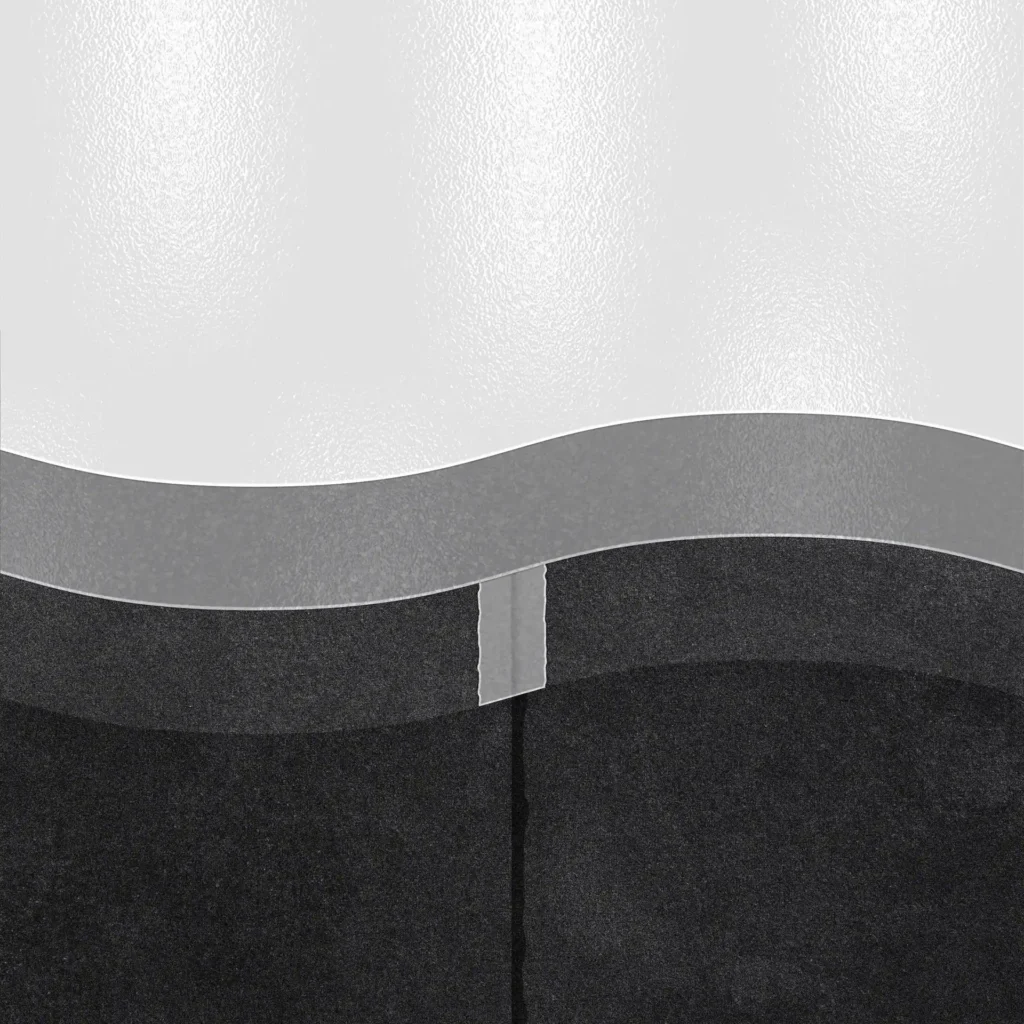
Ure-A-Max
Illustration Sikalastic-644 Lo-VOC Fluid-Applied Protected Membrane Roofing
Illustration Sikalastic-621 Metal Roof Recover
Contribution history
Published changes remain in this permanent record. Corrections create a new entry instead of deleting earlier history.
- September 21, 2026 at 8:48 amLibrary Record
Sikalastic-624 WP Fluid-Applied Membrane Waterproofing — initial source record
Created the system record and matched the current manufacturer system specification, application guidance and component data sheets.
By Tom · Verified Primary Source
Sources: Official Sika Sikalastic-624 WP Fluid-Applied Membrane Waterproofing system page