
Commercial Roofing in San Marcos, TX

Roofs and walls built for rain on the Balcones Escarpment

I-35 midpoint roofing

Roofs that shed hard rain

Total Cladding and Roofing handles commercial roofing and cladding in San Marcos for the warehouses, plants, retail centers and offices that sit on I-35 halfway between San Antonio and Austin. Our work here starts with water: how fast it leaves the roof, where it goes at the eave and what happens when a downpour outruns the drains.

Our 20+ years of commercial roofing go into a European way of designing a building’s skin, where panels, insulation, connections and drainage details are settled together. On a San Marcos building, slope, gutters and outlets belong in the design from the first survey.
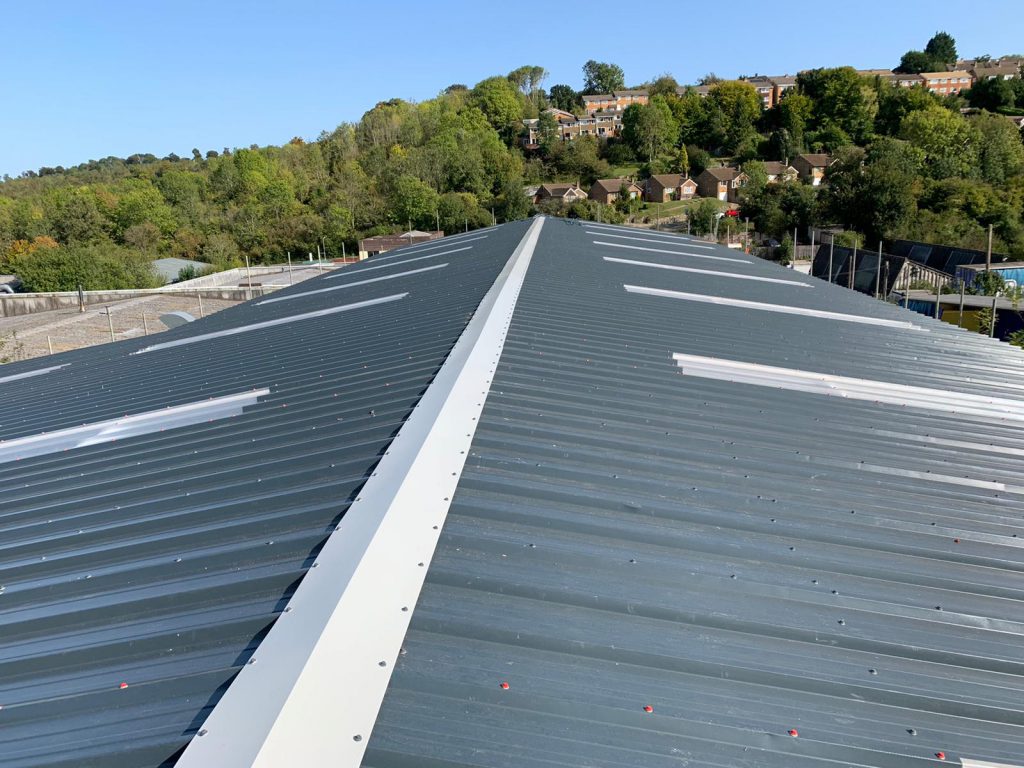

Gray insulated metal roof panels with a central ridge cap and translucent skylights
TCR group project example. Insulated panel roof from the TCR group's UK project work.

A town on the Balcones Escarpment

San Marcos sits on the Balcones Escarpment, the fault line where the Hill Country rises to the west and the Blackland Prairie opens to the east. The San Marcos River rises from springs inside the city, and the Blanco River joins it nearby. City limits run from Hays County into Caldwell and Guadalupe counties.

Hays County lies inside Flash Flood Alley, the Central Texas band where warm Gulf air rides up the escarpment, cools and turns into heavy rain. Downpours that outrun ordinary gutters are a regular part of the year here, so a roof has to move a lot of water quickly.

Industrial and commercial buildings off I-35

Most commercial buildings in San Marcos face I-35 or sit a short drive off it. Industrial and warehouse buildings cluster off McCarty Lane and along SH 123 as it heads south toward Seguin, and large retail centers sit beside the interstate. SH 21 heads northeast toward Bastrop, and SH 80 runs southeast to meet SH 130.

The building stock is mixed. Older metal buildings with exposed-fastener roofs stand near newer dock-high warehouses, and flat roofs on block and tilt-wall buildings have often been patched around ponding for years.

Slope and drainage decide the roof

On a San Marcos survey, we look at water first. We map where it ponds, check whether gutters and downspouts can keep up with a cloudburst, and look for overflow scuppers that were never fitted. Stained ceiling tiles under a flat roof often trace back to a drain that is too small or set too high.

When a flat roof holds water after every storm, we recommend one of two routes. A tapered insulation layer under new TPO moves water to the drains and keeps the roof low. A framed metal retrofit adds real pitch, so rain runs off to new gutters sized for the storms this part of Hays County gets. Rooftop equipment, parapets and how the building is used decide which one fits, and our metal roof retrofit work around Austin explains the framed-slope method in detail.

Roof and wall systems for San Marcos buildings

Retrofit That Adds Pitch

Metal roof retrofit frames a new pitched metal roof over a failing metal or flat roof, with no tear-off. On a ponding roof in San Marcos it turns standing water into runoff and adds insulation in the new cavity.

TPO Laid to the Drains

TPO roofing for low-slope warehouses, retail and offices: new roofs, replacement and recover, with tapered insulation laid to the drains and heat-welded seams that stay watertight where rain gathers at a curb or parapet.

R-Panel Detailed for Runoff

R-panel roofs and walls re-sheet tired metal buildings with our own specification R-panel systems or with MBCI and Morin panels, as a certified installer for both brands, detailing laps, trims and gutters for heavy runoff.

Insulated Panels Against Driven Rain

Insulated metal panels in Kingspan or AWIP systems give plants and conditioned warehouses a continuous insulated skin on roof and walls, with factory-formed side joints that keep wind-driven rain out at the panel seams.

Coatings come after drainage

Not every rusting roof needs new panels. Our protective coatings service restores sound metal roofs and walls: we clean, treat rust at laps and cut edges, seal fasteners and apply a restoration coating from Sika or American WeatherStar, two brands that have certified us as an installer. When panels are perforated, we recommend re-sheeting or a retrofit instead.

A coating does nothing for a roof that cannot drain. If water stands on a metal roof for days, we correct the slope or the outlets before any coating goes on.

Between San Antonio and Austin

San Marcos sits between our two metro areas. It belongs to our commercial roofing work in the Austin area, and owners with sites farther south can compare our San Antonio commercial roofing page.

From our office in Bulverde, San Marcos is a typical drive of under an hour. We plan survey visits ahead, so one trip covers the roof, the walls, the drainage and a meeting with your site team.

Nearby, we cover commercial roofing in Kyle, the next town north on I-35, and commercial roofing in New Braunfels to the south.

Hail, heat and occupied buildings

Rain is not the only test. Spring storms bring hail and strong wind to San Marcos, and every summer puts long hours of strong sun on the roof. We choose panel gauge with hail in mind, fix metal so it can move with daily heat, and use white TPO to hold down heat gain.

Most buildings stay open while we work. We agree access, work zones, crane positions and deliveries with your site team, and each section of roof is closed in before the next is opened, with the forecast checked every morning.

Request a San Marcos survey

Send the address, roof and wall photos, any drawings and a note on where water collects after rain. We will tell you whether slope, drainage, a coating or a full new roof is the answer, and why. Our Technical Library holds the manufacturers’ data sheets for every panel and membrane we specify.

Talk to our team

Discuss your San Marcos building

Call (210) 775-0995 or send the address, photos and a note on where water collects through our project inquiry form.

Request a project quote

Frequently asked questions

Commercial Roofing in San Marcos, TX FAQs

Which buildings and services do you cover in San Marcos?

Commercial and industrial buildings only, from warehouses off McCarty Lane to retail and office buildings beside I-35. On them we retrofit metal roofs, install TPO, R-panel roofs and walls and insulated metal panels, and coat weathered metal roofs and walls.

Our flat roof ponds after every storm. What do you recommend?

We find out why first: a sagging deck, blocked or undersized drains, or too little slope. Tapered insulation under a new TPO roof cures most ponding. When the roof has failed more than once, a framed metal retrofit that adds pitch is usually the better answer for the building.

Can you add slope to a flat roof without tearing it off?

Yes, if the building's structure can take the extra load. We build light-gauge framing over the existing roof, fastened through to the structure, and cover it in metal panels. The old roof stays in place while we work, and the new pitch carries rain to gutters sized for it.

How do you size gutters and drains for San Marcos storms?

We work from the roof area each gutter and drain serves and the intense rain this part of Hays County gets, then add overflow scuppers so one blocked outlet cannot flood the roof. Where a roof edge cannot take a larger gutter, we add downspouts instead.

Is San Marcos closer to you than Austin?

Yes. San Marcos falls within our Austin-area work, but from our Bulverde office it is a shorter drive than central Austin. We book surveys ahead so a single visit covers the roof, the walls and the drainage.

We found you by searching for commercial roofers near me. Do you cover the area around San Marcos?

Yes. Along with San Marcos, we work in Kyle to the north and New Braunfels to the south, and on buildings along SH 123 and SH 80. Send the address with a few photos so we can check the building is in our area.

Can a coating stop rust on our metal building?

Yes, while the panels are still solid. We clean the roof, treat rust at laps, fasteners and cut edges, then apply a restoration coating. If rust has eaten through the panels or water stands on the roof for days, we recommend re-sheeting, a retrofit or a drainage fix first.

Will a TPO warehouse roof drain properly in San Marcos rain?

Yes, once the insulation under it is tapered to the drains. A white TPO membrane with heat-welded seams suits a low-slope warehouse roof, and the taper keeps rain moving instead of sitting. If the roof has no drainage plan at all, we design that before we specify the membrane.

Can a store or plant stay open while the roof is done?

Yes, in almost every case. We plan work zones, crane lifts, delivery times and protection with your site team, close each roof section before opening the next and check the weather daily, so stores, offices and production lines keep running below us.

What do you need from us to prepare a quote?

The building address, current photos, any drawings, and a note on where water gathers or gets in after rain. Call (210) 775-0995 or email info@totalcladdingandroofing.com, and we will set a date to survey the building.

UK refurbishment experience, a Texas office

Metal roof retrofit

A new metal roof above a suitable existing covering, with subframing, insulation and details considered together.

TPO roofing

New TPO roof systems, TPO roof replacement and TPO recover for warehouses, retail, offices and industrial buildings.

R-panel and insulated panels

R-panel roofing and wall cladding, and insulated metal panels for roofs and walls on new builds and refurbishments.

Protective metal coatings

Preparation, rust and cut-edge treatment, and compatible protective finishes for metal roofs and cladding.

Roofing and cladding systems

Roofing systems and materials for Texas facilities

Rustoleum Logo
Sika Logo
Kingspan Logo
Morin Logo
American WeatherStar Logo
GAF Logo
TAMKO Logo
PAC-CLAD Logo
1

Tell us about the building

Start with the address and the roof or cladding problem. Photographs are helpful if you already have them.

2

Arrange a site visit

We review the affected areas and discuss how you use the building and what you want the work to achieve.

3

Review the quotation

Your quotation explains the proposed metal roof or cladding work, the areas included and the price.

4

Agree the work plan

We discuss timing, access, deliveries and protection with your site contact before work begins.

5

Complete the work

We carry out the agreed work and discuss any changes needed if opening the roof reveals additional damage.

6

Handover

We review the completed work and provide the care information and documents included in your project.