Commercial TPO Roofing Systems in Texas

Condition-based TPO installation, recover, replacement, repair, and maintenance planning for low-slope commercial and industrial roofs.

Request TPO Roof Assessment

Commercial low-slope roofing systems

TPO is an assembly, not just a white membrane

TPO is a heat-weldable single-ply membrane used in low-slope roof assemblies. The membrane is only one part of the system: deck condition, insulation, cover board, attachment, perimeter securement, flashing, drainage, and workmanship all influence performance.

Total Cladding and Roofing helps commercial and industrial property teams evaluate TPO installation, recover, replacement, repair, and maintenance options. Recommendations begin with the existing roof and facility requirements rather than assuming TPO is the right answer for every building.

TPO Roofing Texas | Total Cladding and Roofing Texas

What a TPO roof assembly includes

A responsible scope should identify every layer and interface that affects the roof. Depending on the building and design, a TPO assembly may include:

  • The structural deck and any required deck repair or preparation
  • Air or vapor-control layers where the building and climate analysis require them
  • Thermal insulation arranged to meet the project design and drainage plan
  • A compatible cover board or separation layer
  • TPO membrane with the specified thickness, reinforcement, color, and attachment method
  • Heat-welded field seams and compatible flashing at walls, curbs, drains, edges, and penetrations
  • Perimeter and corner attachment designed for the applicable wind pressures
  • Walk pads, drainage components, and protection at service or traffic areas

The final assembly should be coordinated with the manufacturer requirements, project specifications, code, structural conditions, and any warranty requirements that actually apply to the property.

When TPO may be a practical option

TPO is commonly considered for warehouses, distribution facilities, retail buildings, offices, manufacturing properties, schools, and other commercial low-slope roofs. Suitability depends on more than building type. A roof assessment should consider:

  • Deck type, condition, and load capacity
  • Existing roof layers and whether trapped moisture is present
  • Drainage, slope, ponding areas, and overflow provisions
  • Wind design, roof height, exposure, edge zones, and attachment requirements
  • Rooftop equipment, penetrations, service traffic, and future solar or mechanical work
  • Interior humidity, temperature, and air-pressure conditions
  • Grease, oils, chemicals, exhaust, or other exposures that may affect material selection
  • Construction access, occupied operations, shutdown limits, and phasing

Where chemical exposure, unusual temperatures, heavy traffic, or a complex existing assembly is involved, TPO should be compared with other compatible systems rather than selected from a generic product list.

Details and quality controls that matter

Single-ply roof problems often develop at transitions and penetrations rather than in the uninterrupted field membrane. A TPO scope and quality plan should address:

  • Trial welds and equipment settings appropriate to daily weather and membrane conditions
  • Continuous heat-welded seams with probing and corrective work where required
  • Prefabricated or properly formed corners, pipe boots, curb flashing, and wall transitions
  • Termination bars, counterflashing, roof edges, and metal interfaces
  • Drain, scupper, gutter, and overflow details
  • Protection from construction traffic and coordination with mechanical, electrical, solar, and other trades
  • Daily weather records, work-area photographs, inspection points, punch work, and closeout documents

Manufacturer details are system-specific. The approved details and project documents should control the work rather than a generic detail copied from another roof.

TPO installation and attachment methods

TPO systems can be mechanically attached, adhered, or installed with other manufacturer-approved attachment methods. The appropriate design depends on the deck, insulation package, wind pressures, membrane and fastener layout, substrate compatibility, project requirements, and approved assembly.

Mechanically attached systems

Membrane sheets are secured with fasteners and plates in a designed pattern, with adjacent sheets heat-welded over the attachment line. Fastener selection, pullout resistance, deck engagement, spacing, and enhanced perimeter and corner zones must follow the project design.

Adhered systems

The membrane is bonded to a compatible substrate using the specified adhesive or factory-applied system. Substrate condition, adhesive coverage, temperature, drying or flash-off time, and avoiding wrinkles or trapped air are important field controls.

Recover installations

A recover places a new approved assembly over an eligible existing roof. It may reduce tear-off, but only after moisture, existing layers, deck capacity, attachment, code limits, drainage, transitions, and manufacturer requirements are evaluated. Saturated or unsound roof areas should not simply be concealed.

TPO Detail Coordination

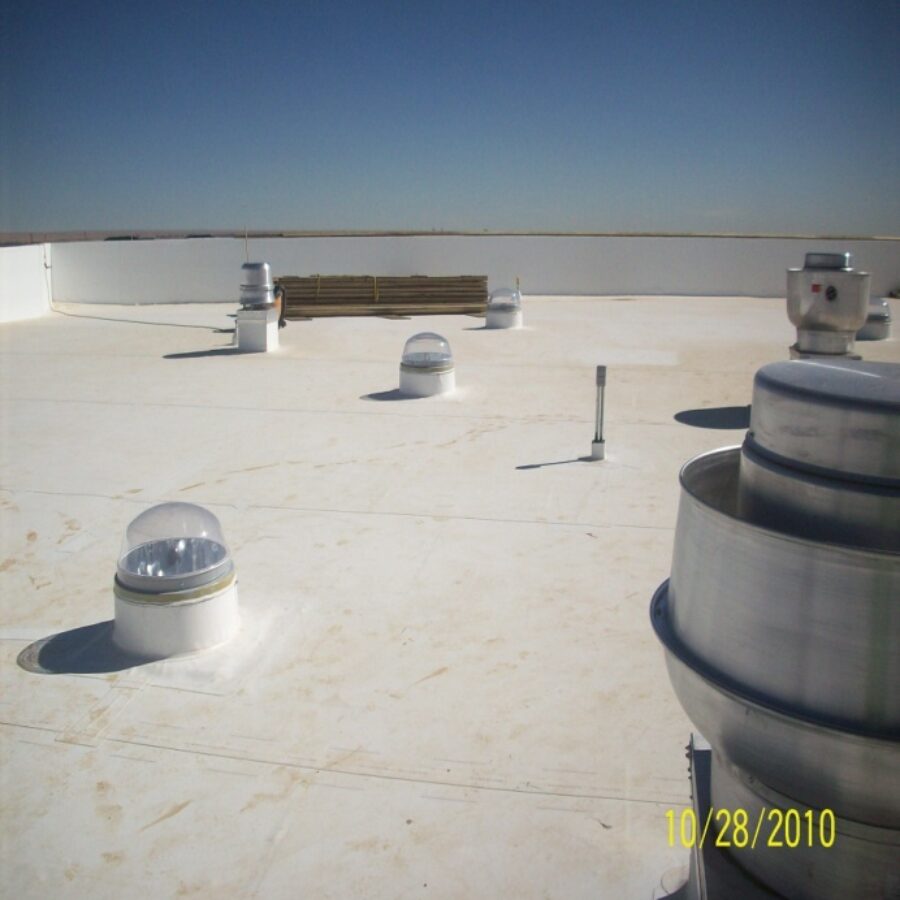
Seams, flashings, penetrations, perimeters, drains, transitions, and rooftop equipment are coordinated with the selected TPO attachment method.

Reflective TPO and Texas heat

Light-colored TPO membranes can reduce solar heat absorption at the roof surface. Actual building-energy impact varies with membrane color and rating, insulation, HVAC efficiency, building use, roof area, utility rates, climate, and other conditions. A reflective membrane should not be presented as a guaranteed percentage saving.

The U.S. Department of Energy guide to cool roofs explains the factors owners should consider. Energy goals should be evaluated alongside roof condition, condensation control, insulation, code, and total project scope.

Wind design and Texas coastal requirements

Roof height, building geometry, exposure, deck, edge conditions, and location affect wind pressures and attachment. Perimeter and corner zones commonly require different securement than the field of the roof, so the attachment plan must be developed for the specific building.

In designated Texas coastal catastrophe areas, many roof replacements and major repairs require windstorm inspection and certification. Requirements depend on property location and project scope. Owners and project teams should confirm the current process with the Texas Department of Insurance before construction starts.

TPO roof repair and maintenance

Maintenance should focus on observed conditions and the requirements of the installed system. A typical review may include seams and flashings, penetrations, drains and scuppers, roof edges, traffic areas, membrane damage, sealants used as secondary protection, and signs of movement or moisture entry.

Repairs should use compatible materials and methods. Interior leak evidence does not always sit below the entry point, so investigation may need to trace flashing, equipment, wall, drainage, or membrane conditions before a repair is selected. See our commercial roof repair planning and roof asset management pages.

Repair, recover, or replace a TPO roof?

Localized repair

Repair may be appropriate when defects are limited, surrounding membrane and insulation remain serviceable, and the cause can be corrected with compatible details.

Recover

Recover may be considered when the existing assembly is eligible, sufficiently dry and sound, and the new design can satisfy attachment, drainage, height, code, and compatibility requirements.

Replacement

Replacement is generally the more responsible path when deterioration or moisture is widespread, the deck needs substantial work, existing layers are incompatible, transitions cannot be resolved, or project requirements cannot be met by repair or recover.

A documented commercial roof inspection helps define which path deserves detailed pricing.

Comparing TPO with other low-slope systems

TPO, PVC, EPDM, modified bitumen, built-up roofing, and liquid-applied systems solve different project constraints. TPO should be compared on the complete proposed assembly, not on membrane price alone.

  • PVC roofing is another heat-welded thermoplastic system and may be evaluated where particular chemical or grease exposures are part of the project.
  • EPDM roofing is a thermoset membrane with different seam, flashing, and attachment characteristics.
  • Modified bitumen and built-up systems use asphaltic layers and may suit projects that call for different redundancy, surfacing, or detailing.

System selection should account for the existing roof, exposure, operational needs, maintainability, design life, warranty terms, and the owner’s capital plan.

Planning TPO work around an active facility

Before work begins, the project team should define access, loading, material storage, weather limits, temporary protection, daily dry-in, interior-sensitive areas, work hours, rooftop equipment coordination, inspection points, and closeout expectations. Warehouses, plants, schools, retail properties, and offices each require a different phasing conversation.

Explore building-specific considerations on our commercial roofing by industry hub. For the broader repair, maintenance, restoration, recover, and replacement framework, visit our Texas commercial roofing services hub.

Commercial TPO roofing in San Antonio and across Texas

Total Cladding and Roofing is based in San Antonio and evaluates commercial and industrial projects across Texas. Service feasibility, system requirements, logistics, and scheduling are confirmed for each property. See our San Antonio commercial roofing information for local context.

Start with the property information

Request a TPO roof assessment

To discuss an existing TPO roof or a planned low-slope roofing project, contact Total Cladding and Roofing. Share the property address, building use, known roof information, current concerns, and any drawings, warranty documents, or inspection reports available.

Request TPO Roof Assessment

Frequently asked questions

TPO Commercial Roofing FAQs

When is TPO commercial roofing worth evaluating for a commercial building?

It is worth evaluating when a low-slope roof using a heat-welded thermoplastic membrane fits the roof geometry, use, substrate, performance requirements, details, access, and project objectives. Selection should follow the complete assembly rather than one product characteristic.

What existing-roof information is needed before selecting TPO commercial roofing?

Confirm the deck or supports, existing layers, insulation, moisture condition, attachment, slope, drainage, flashings, penetrations, roof edges, previous repairs, and operating constraints. Unknowns should be listed instead of buried in the proposal.

Which details most affect TPO commercial roofing performance?

The review should focus on membrane thickness, seams, attachment, insulation, cover board, flashings, penetrations, drainage, heat exposure, and repairability. Repeated details deserve the same attention as the field because a small unresolved interface can affect a much larger roof area.

Can localized damage in TPO commercial roofing be repaired?

Many localized conditions can be repaired when the material is correctly identified and the surrounding assembly remains serviceable. Repair feasibility changes with moisture, contamination, attachment, movement, access, and the availability of compatible materials.

How do deck and insulation conditions affect the system decision?

The deck or supports must provide a suitable base, while wet, damaged, compressed, or incompatible insulation can change removal quantities, attachment, drainage heights, thermal performance, and whether existing materials can remain.

What testing may be useful before specifying TPO commercial roofing?

Depending on the assembly, the team may consider moisture investigation, test cuts, adhesion testing, fastener pullout testing, seam probes, material identification, or specialist review. Each test should answer a defined design or scope question.

How do Texas heat, rain, hail, and wind affect TPO commercial roofing?

Weather exposure changes movement, aging, impact risk, drainage demand, attachment, edge conditions, and installation windows. The project should use address- and building-specific criteria rather than a statewide rule of thumb.

Can TPO commercial roofing work be phased over an occupied building?

Phasing may be possible when access, daily dry-in, interior protection, noise, odor, equipment, weather limits, and shutdowns are planned. The safe amount of roof opened per shift depends on the assembly and facility.

What maintenance should be planned for TPO commercial roofing?

Maintenance should follow the actual system and current project documents. Typical planning covers drainage, flashings, penetrations, seams or joints, surface condition, traffic damage, repairs, photographs, severe-weather reviews, and a clear action log.

How should TPO commercial roofing be compared with alternative roof systems?

Compare complete assemblies for suitability, preparation, removals, insulation, attachment, details, access, disruption, maintenance, inspections, schedule, and closeout—not only material price or a headline service-life figure.

We offer our services throughout Texas, with project scope and scheduling confirmed for each facility

Trained and Certified Team

Our technicians are fully trained in advanced coating systems, ensuring your roof is protected with the latest application techniques.

Professional From Start to Finish

We treat every project with care, precision, and respect—delivering clean, efficient service with minimal disruption to your business.

Premium Coating Systems

We only use trusted, industrial-grade coating products tested for performance in Texas heat, UV, and storms—no cheap shortcuts.

Detailed Roof Assessments

Our expert assessors provide honest evaluations, thermal photos (if available), and clear proposals—so you know exactly what your roof needs.

Trusted in Texas

Trusted across Texas for high-performance roof coatings, weatherproofing, and energy-efficient building protection

Rustoleum Logo
Sika Logo
Kingspan Logo
Morin Logo
American WeatherStar Logo
GAF Logo
TAMKO Logo
PAC-CLAD Logo
1

Get in touch

Take the first step to improving your building by contacting our professional team.

2

Arrange a site visit

Book a site visit with our team and we can fully assess your needs and listen to your requirements.

3

Receive your quote

We’ll then present you with a quote for all the work proposed so that you can see our recommendations and prices.

4

Plan your project

Work with our professional team to plan your project to meet your requirements.

5

Begin your project

Once approved, the work can begin to bring your roof or cladding up to standard.

6

Final Handover

Once your new roof or cladding is complete, we will do a final handover to bring the project to a close.