
Commercial Gutter Repair, Lining and Replacement in Texas

Box gutters, eave gutters, outlets and downspouts on existing commercial and industrial buildings: repaired, lined or replaced to carry Texas rain.

Gutters and roof drainage

Keeping water moving off the roof

Gutters and roof drains carry every gallon that lands on a commercial roof, and when they fail the water often ends up inside the building. Total Cladding and Roofing repairs, lines and replaces gutters, downspouts and roof drainage on existing commercial and industrial buildings in Texas, from leaking eave gutters on a metal building to the box gutters between the roof bays of a warehouse.

Many gutter problems can be fixed without replacing the gutter. Leaking joints can be resealed, and a corroded but sound box gutter can be lined with a new waterproof membrane. When a gutter has rusted through, is too small for the roof it drains, or is being replaced with the roof, a new gutter designed for the job is the better answer.

Request a gutter review or call (210) 775-0995.

The Technical Library holds the data sheets for products used in this work, including Downspouts (Kingspan), Industrial Downspout (Metal-Era), PAC-Tite Gutters and Downspouts (PAC-CLAD | Petersen), Seal-Tite Gold Industrial Gutter (Metal-Era), Seal-Tite Industrial Gutter (Metal-Era) and Seal-Tite LT Half Round Gutter (Metal-Era).
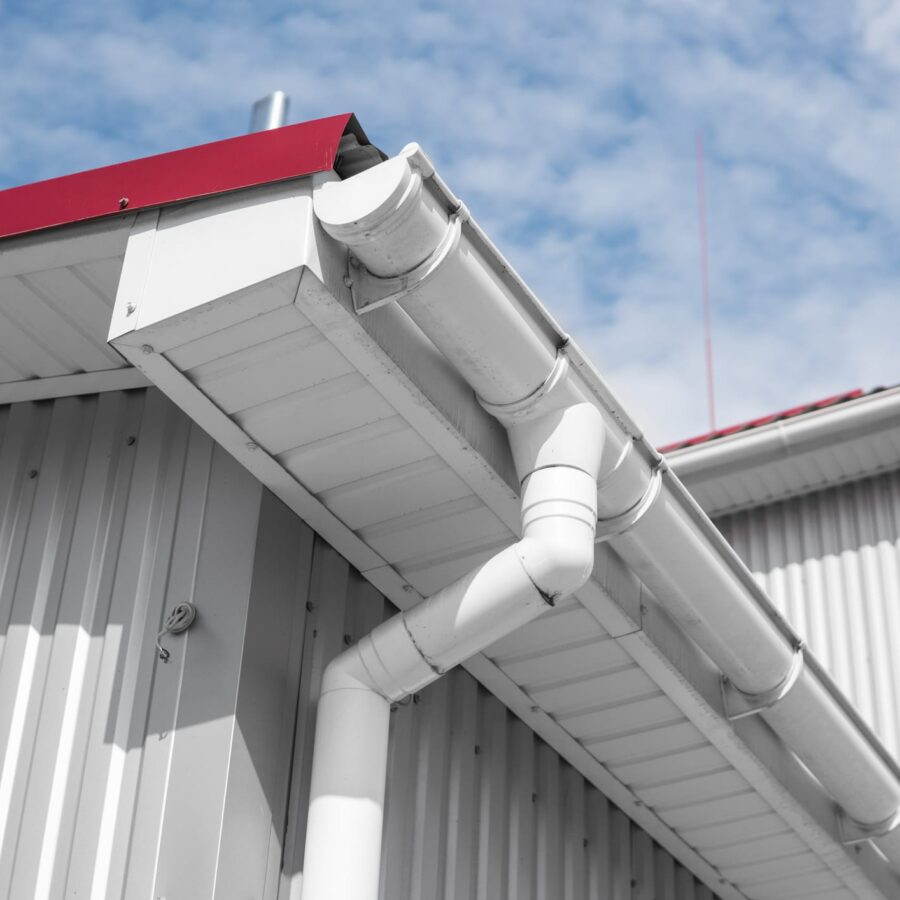

Gutter and downspout at a metal-clad building

Gutters on commercial buildings

Eave gutters

hang outside the roof edge. A leak usually shows on the wall or the ground rather than inside.

Box gutters

sit inside the roof line, often behind a parapet or along the eave of an industrial building. When one overflows or leaks, the water goes into the building.

Valley gutters

run between the bays of multi-span buildings and take water from two roofs at once.

Scuppers, conductor heads and downspouts

take the water from the gutter or flat roof down to the ground or the storm drain.

Why gutters overflow and leak

  • outlets blocked by leaves, debris, dead birds or loose roof materials;
  • joints and end caps where the sealant has failed;
  • rust at seams, laps and cut edges, eventually holing the gutter;
  • too few outlets, or a gutter too small for the roof area it drains;
  • gutters that have lost their fall, so water sits instead of running to the outlet;
  • loose or broken hangers that let the gutter sag;
  • hail, ladder and impact damage;
  • long runs without expansion joints, which open up as the metal heats and cools.

In heavy rain, an internal box gutter that cannot keep up overflows back over its edge into the building. That is why box gutters cause some of the most damaging leaks on commercial buildings, and why their outlets and overflow routes matter as much as the gutter itself.

Signs a gutter needs attention

  • water pouring over the gutter edge during rain instead of down the downspouts;
  • stains, rust streaks or algae on the walls below the gutter line;
  • drips or wet patches inside the building along an internal box gutter;
  • sagging sections, gaps at joints or plants growing in the gutter;
  • washed-out soil, puddles or damaged paving at the foot of downspouts.

Watching the gutters during a heavy storm tells you more than any dry-day inspection: overflow points, slow outlets and leaking joints all show up while the water is running.

Repair, line or replace

The right fix depends on the condition of the gutter and whether it is big enough for the water it has to carry.

Cleaning and joint repairs

Clear outlets and downspouts, then reseal joints, end caps and outlets on gutters that are sound and correctly sized.

Gutter lining

Line a corroded but structurally sound box or valley gutter with a membrane or a reinforced liquid-applied system, sealing every joint and rust spot without removing the gutter.

Replacement gutters

Fit new gutters where the old ones have rusted through, are undersized, or are being replaced with the roof, sized and detailed for the roof they serve.

Outlets, downspouts and overflows

Add or enlarge outlets, fit larger downspouts and add overflow scuppers where the gutter cannot shed water safely in a storm.

Lining an existing box gutter

A gutter lining turns a leaking, corroded gutter into a continuous waterproof trough without taking it out. The gutter is cleaned back to sound metal, rust is treated, and the lining is bonded or fixed inside it, running up the sides and sealed at the outlets. Because the lining is continuous, the old joints and seams no longer carry water.

Lining only works when the gutter itself is sound: the metal has to support the lining and the weight of water, and the gutter has to be large enough. A lining also slightly reduces the gutter’s internal size, which is checked against the roof area before it is chosen. Where the gutter has lost strength or is undersized, replacement is the honest answer.

Sizing gutters for Texas rain

A gutter and its outlets are sized from the roof area draining to each outlet and the design rainfall rate in the plumbing code for the building’s location. Design rates in much of Texas are high compared with most of the country, and gutters on older buildings were often sized for less, or for a smaller roof before an extension was added.

Where parapets or other construction would trap water on the roof if the main drains blocked, the building code also requires secondary drainage, through overflow scuppers or separate overflow drains. On a replacement or a major gutter project, that requirement is part of the design rather than an extra.

Materials and corrosion

Commercial gutters are usually galvanized or Galvalume steel, painted steel, aluminum or stainless steel. Different metals should not be mixed: aluminum and steel in contact with copper, or water running off copper onto steel, speeds up corrosion. Cut edges and laps are where steel gutters rust first, and they are treated or detailed so the cut steel is protected. See cut-edge corrosion repair.

Heat, expansion and long gutter runs

A long metal gutter grows and shrinks noticeably between a Texas summer afternoon and a winter night. Without expansion joints at the right spacing, that movement tears sealant out of joints and pulls fasteners loose, and the gutter starts leaking at the same places every year. Replacement gutters are detailed with expansion joints and slip connections for their length, and a lining system is chosen to move with the gutter underneath it.

Gutters, roof work and the walls below

It makes sense to renew or line gutters at the same time as roof work, because the eave details, flashings and roof edge are being opened anyway. A metal roof replacement or restoration should include the gutters in its scope, so the new roof does not drain into an old, leaking gutter.

At ground level, downspouts near loading docks and drive aisles need protecting from impact, and they should discharge away from the building or into the storm drain. Ground drainage beyond the downspouts is site work, which we identify separately from the roofing scope.

Keeping gutters working

Most overflows start with a blocked outlet. Gutters and outlets should be checked and cleared at least twice a year and after major storms, more often where trees overhang the roof. Leaf guards and outlet strainers help on eave gutters, but they still need clearing. Checking the gutters during routine roof maintenance catches failing joints and rust before they leak; see roof asset management.

What affects the cost

The length and type of gutter, its height and access, how much rust treatment is needed, whether it is repaired, lined or replaced, the number of outlets and downspouts, and any overflow work all affect the price. Internal box gutters above occupied space also need protection below while the work is done.

Talk to our team

Request a gutter and drainage review

Contact TCR with the property address, where water is overflowing or leaking, and photographs if you have them. We will inspect the gutters, outlets and roof drainage and tell you whether they can be repaired or lined, or need replacing.

Request a Gutter Review

Frequently asked questions

Commercial Gutter And Roof-drainage Systems FAQs

Why does the gutter overflow in heavy rain?

A blockage, damaged outlet, inadequate capacity or poor fall may be involved. The cause needs checking before replacing only the leaking joint.

Can a blocked drain make the roof leak?

Yes. Backed-up water can reach details not intended to remain submerged or increase leakage through an existing defect.

Does cleaning solve every drainage problem?

No. Cleaning removes debris, but corrosion, broken supports, poor falls or insufficient outlets may need repair or redesign.

Can leaking gutter joints be repaired?

Often, when the surrounding material is sound and a compatible repair is possible. Extensive corrosion can make replacement more practical.

Why is water still standing after the outlet is cleared?

The roof or gutter may not drain toward it effectively. Persistent standing water needs assessment of the flow path and levels.

Can larger downspouts solve an overflow?

Not automatically. The gutter, outlet and discharge path all need to work together; a larger downspout alone may not address the restriction.

Are internal box gutters different from external gutters?

Yes. Their location and connection to the roof affect access and the consequences of leakage. Repairs need details suited to the existing construction.

Can gutters be replaced with the roof?

Yes, where included in the project. Coordinating the new roof edge and gutter can avoid retaining an aging leak source.

What affects drainage repair cost?

Access, height, gutter length, outlets, supports and the extent of corrosion or associated roof work affect the price.

What information should I send?

The address and where water overflows or leaks. Photos taken safely during or after rain can help explain the problem.

UK refurbishment experience, a Texas office

Refurbishment specialists

Our business grew through roof and cladding refurbishment in the UK. That experience shapes the work we now offer from our Texas office.

Repair what can be retained

We investigate the roof problem and explain what can be repaired, restored or replaced, so you can decide how to invest in the building.

Roofing and cladding together

We can coordinate roof, insulation, wall panel and drainage work, including the connections where separate repairs can leave problems behind.

A plan for your working building

We agree access, work areas and protection with your site team, including any restrictions needed while the roof is opened.

Roofing and cladding systems

Roofing systems and materials for Texas facilities

Rustoleum Logo
Sika Logo
Kingspan Logo
Morin Logo
American WeatherStar Logo
GAF Logo
TAMKO Logo
PAC-CLAD Logo
1

Tell us about the building

Start with the address and the roof or cladding problem. Photographs are helpful if you already have them.

2

Arrange a site visit

We review the affected areas and discuss how you use the building and what you want the work to achieve.

3

Review the quotation

Your quotation explains the proposed repairs or refurbishment, the areas included and the price.

4

Agree the work plan

We discuss timing, access, deliveries and protection with your site contact before work begins.

5

Complete the work

We carry out the agreed work and discuss any changes needed if opening the roof reveals additional damage.

6

Handover

We review the completed work and provide the care information and documents included in your project.