
Table of Contents
- Why Industrial Wall Panel Maintenance Matters in 2026
- Metal Wall Panel Inspection Checklist: A Step-by-Step Routine
- Corrosion Prevention for Industrial Cladding
- Cleaning Industrial Wall Panels Without Damage
- Building a Commercial Building Envelope Maintenance Plan
- Troubleshooting Common Panel Damage and When to Call a Professional
- Frequently Asked Questions
Last Updated: September 14, 2026
Why Industrial Wall Panel Maintenance Matters in 2026
Industrial wall panel maintenance means routinely inspecting, cleaning, and repairing metal wall systems to preserve their finish and structural performance.
That distinction matters more than most property managers expect. The Metal Building Manufacturers Association and American Society of Civil Engineers both point to the same principle: small, consistent interventions cost far less than deferred repairs.
Below, we’ll show you how to build a routine that catches problems while they’re still cheap to fix.
The most expensive panel repair is almost always the one that started as a five-minute fix nobody scheduled.
Metal Wall Panel Inspection Checklist: A Step-by-Step Routine
A metal wall panel inspection checklist is a documented sequence of visual and hands-on checks at fixed intervals, typically quarterly, with monthly spot checks after storms or freeze-thaw cycles (Design Resources).
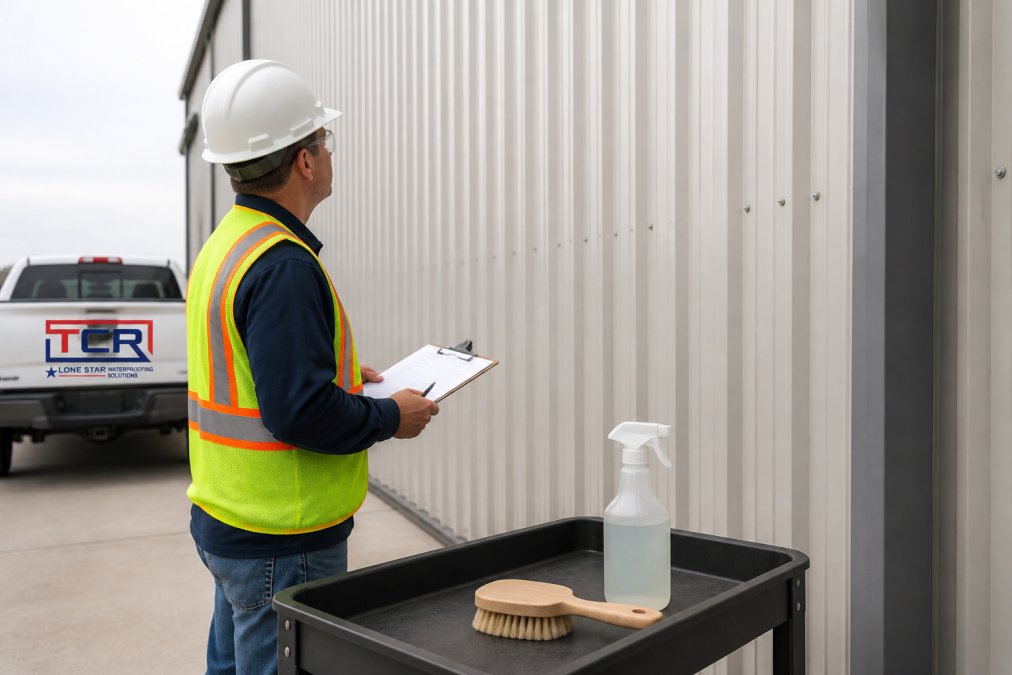
Work through these steps in order:
- Walk the full perimeter at ground level and note any staining, streaking, or discoloration on the panel face.
- Inspect every visible fastener for backing-out, missing washers, or rust bleeding at the head.
- Check sealant joints at panel laps, corners, and penetrations for cracking, shrinkage, or separation.
- Look for debris buildup in valleys, gutters, and against the base of panels.
- Photograph anything questionable before you touch it.
Fastener and Sealant Checks
Fastener integrity is where inspections earn their keep. A backed-out screw lets water behind the panel, causing corrosion you can’t see until it’s structural. Check torque on a sample each visit and replace any showing rust at the head.
Sealant has a service life, and when it fails, the panel lap becomes an open door. If sealant pulls away cleanly from the substrate, it’s done.
Documenting Findings With a Maintenance Log
A maintenance log is a simple record of what you inspected, found, and did about it. A spreadsheet with five columns works fine:
| Date | Location | Finding | Action Taken | Follow-Up Date |
|---|---|---|---|---|
| 03/12 | Bay 4, north wall | Two fasteners backing out | Replaced and sealed | 06/12 |
| 03/12 | Gutter, east run | Debris buildup | Cleared | 04/12 |
| 06/12 | Corner panel, SW | Sealant separation | Resealed | 09/12 |
The log turns a schedule into evidence: a two-year record of a recurring issue is far more persuasive than recollection when justifying a repair budget.
Corrosion Prevention for Industrial Cladding
Corrosion prevention for industrial cladding combines coating care, moisture control, and prompt repair. Oxidation starts at cut edges, scratches, and fastener heads, then spreads under the coating where you can’t see it. Salt air, chemical fallout, and standing moisture attack panels in completely different ways.
Galvanized steel relies on a zinc layer that sacrifices itself to protect the steel beneath, while aluminum forms its own oxide barrier. Both fail faster when the coating is breached, and the wrong touch-up product can react with the existing finish.
Match the Protocol to the Environment
Most facility managers run the same maintenance calendar regardless of location, the biggest reason corrosion gets ahead of them. A coastal facility and an inland chemical plant don’t fail the same way, and inspection frequency and cleaning chemistry should reflect that.
Coastal and salt-air environments. Airborne chloride collects in lap joints and fastener heads and accelerates galvanic corrosion wherever the coating is scratched or cut. These facilities need monthly spot checks on windward elevations, plus a fresh-water rinse after any significant onshore weather event. Fastener heads and cut edges deserve the closest look, since that’s where salt collects and the protective layer is thinnest.
Chemical-exposure environments. Facilities near chemical processing, fertilizer handling, or heavy exhaust deal with acidic or alkaline fallout rather than salt. The failure signature is coating chalking, color shift, and premature sealant degradation. Wash more often with a pH-appropriate detergent and shorten the sealant inspection interval. If you can smell the process on the panel face, the panel is being exposed.
High-humidity and freeze-thaw environments. Humidity drives mildew and keeps lap joints wet longer, where crevice corrosion starts, while freeze-thaw cycles work sealant joints and fastener gaskets open. Here, drainage and sealant inspection outrank cosmetic cleaning.
Industrial-interior and washdown environments. Food processing, pharmaceutical, and some manufacturing spaces wash down walls regularly, and that cleaning chemistry can be aggressive on the panel coating. Verify the washdown detergent is compatible with the panel finish, and inspect lower panels and base trim more often, since that’s where runoff concentrates.
Protective Coating and Surface Finish Care
Protective coating is the panel’s first line of defense. Wash the finish before inspecting it, because dirt hides early coating breakdown. Chalking, fading, or residue that wipes off on your hand means the coating is thinning.
Touch-up is where environmental awareness pays off. A product that works on an inland galvanized panel may not suit a coastal aluminum panel, and the wrong one can trap moisture or react with the finish. Match the touch-up to the substrate and original coating system, and treat any scratch reaching bare metal as urgent, bare metal in salt air or chemical exposure corrodes within days.
Walk the same four or five elevations every inspection and note which side of the building takes the prevailing weather. Corrosion almost always starts on the exposed face first, and tracking that pattern tells you where to spend your inspection time.
Do not assume a panel that looks clean is protected. Chloride and chemical films are often invisible, and the corrosion they cause shows up at the fastener heads and cut edges long before it shows on the panel face.
Cleaning Industrial Wall Panels Without Damage
Cleaning industrial wall panels without damage comes down to three rules: mild detergent, soft tools, and low pressure. What most guides skip is where the water goes once it leaves the panel, for many facility managers, that runoff is a compliance question, not just housekeeping.
Use warm water with mild detergent, a soft bristle brush, and rinse top down in sections so the panel doesn’t dry with residue on it. Match the detergent to the soil: road film and atmospheric dirt respond to a neutral pH cleaner, while mildew needs a mildewcide rather than more scrubbing.
Tools to avoid, without exception:
- Abrasive cleaners and scouring pads, which scratch the coating and create corrosion sites
- Wire brushes, which strip the finish down to bare metal
- High-pressure washing aimed directly at laps, sealant joints, or fastener heads
Pressure washing is the one most people get wrong. It’s fine for flat panel faces at moderate pressure and a safe distance, but not at sealant joints, where it drives water where you don’t want it.
Pressure washing a failed sealant joint doesn’t clean it, it floods it. The water goes behind the panel, sits against the substrate, and starts corrosion from the inside where no inspection will catch it until the panel is compromised.
Choosing Cleaners That Are Safe for the Panel and the Site
The cleaner must be safe for two things: the panel finish and the environment the runoff reaches.
For routine dirt, a neutral-pH detergent is the default because it won’t attack the coating or sealant. For persistent mildew, use a mildewcide formulated for metal roofing and cladding, household bleach can dull the finish and leave residue that feeds the next round of growth.
For facilities with stormwater obligations, the cleaner choice is also a discharge question. Many industrial sites operate under a stormwater pollution prevention plan, and wash water carrying detergent, mildewcide, or heavy soil loads may not be allowed to flow to a storm drain untreated. Biodegradable, phosphate-free detergents reduce the load, but controlling where the water goes is more reliable.
Managing Runoff and Wash Water
Runoff management is where a routine wash can become a compliance problem. The goal: keep wash water out of storm drains and off surfaces where it can stain or pool.
A few practical approaches that work on industrial sites:
- Block and collect. Use berms, temporary containment, or a vacuum recovery system to capture wash water at the base of the wall, then dispose of it according to your site’s wastewater plan.
- Work in sections. Clean and rinse a manageable area at a time so runoff is controlled rather than sheet-flowing across the whole site.
- Time the work. Avoid cleaning right before forecast rain, which will carry your wash water and loosened soil straight to the drainage system.
- Protect adjacent surfaces. Cover or pre-rinse landscaping, parking, and loading areas that could be stained by detergent or mildewcide runoff.
- Check the plan. Confirm what your site’s stormwater plan allows before you start, and document the cleaning in your maintenance log so the record is there if it is ever asked for.
Biodegradable cleaners help but aren’t a substitute for containment, they still carry soil, metal particles, and biological material you don’t want in a storm drain.
Clean the panel like the runoff is going somewhere, because it is. Choosing the right cleaner and controlling where the water goes protects the finish and keeps the wash off your compliance radar.
Building a Commercial Building Envelope Maintenance Plan
A commercial building envelope maintenance plan is a written schedule assigning every inspection, cleaning, and repair task a frequency and an owner. Without one, maintenance happens when someone complains, always more expensive.
Build yours in four steps:
- Inventory the envelope: panel types, panel substrate, roof systems, drainage, and penetrations.
- Set frequencies: quarterly inspections, annual cleaning, and post-storm checks after hail or high wind.
- Assign owners and budget lines to each task.
- Review the maintenance log annually and adjust frequencies based on what you actually found.
Environmental-Specific Protocols for Heat, Humidity, and Hail
Weathering isn’t uniform, and a plan ignoring local conditions will miss the failures that actually happen. In high heat, thermal movement works sealant joints harder, so inspect them more often. In humidity, mildew removal and drainage checks move up the list. After hail, check panel faces for denting and coating fracture, a strike that cracks the finish creates a corrosion site even if the panel looks intact.
Water runoff deserves its own line item: staining below a penetration or roof edge is a drainage problem presenting as a cosmetic one.
Photograph the same four or five panel locations every inspection, from the same angle. Comparing photos over two years shows coating breakdown and sealant movement long before it’s obvious in person.
Troubleshooting Common Panel Damage and When to Call a Professional
Troubleshooting panel damage starts with one question: is the problem the panel, or water getting to the panel? Most visible damage is a symptom, not the cause.
| Symptom | Likely Cause | Fix | Call a Professional When |
|---|---|---|---|
| Rust streaks below fasteners | Failed washer or backing-out | Replace fastener, reseal | Rust has spread behind the panel |
| Sealant cracking at laps | Normal sealant aging | Reseal the joint | Joints are failing across multiple elevations |
| Panel face denting | Hail or impact | Document and monitor | Coating is fractured or panels are deformed |
| Mildew on lower panels | Poor drainage or runoff | Clean and correct drainage | Water is entering the wall assembly |
| Oil-canning or waviness | Thermal movement or installation | Monitor | Panels are separating at laps |
Handle fastener replacement, sealant resealing, and routine cleaning in-house. Bring in a professional when damage involves the panel substrate, water is getting behind the cladding, or failures appear across multiple elevations at once, that pattern is usually systemic, and spot patching just moves the problem around.
Total Cladding and Roofing LLC provides inspections, leak repairs, coatings, restoration, and replacement for commercial and industrial properties, planning work around your site operations so a repair doesn’t become a shutdown. If your maintenance log keeps showing the same finding, consider a building investigation rather than another round of spot repairs.
Most facilities don’t fail from one dramatic event. They fail because a backed-out fastener, a cracked sealant joint, and a clogged gutter sat unaddressed through a few seasons. Total Cladding and Roofing LLC provides inspections, preventative maintenance, coatings, and panel restoration for commercial and industrial buildings, with refurbishment experience to extend service life rather than default to replacement. Get started with Total Cladding and Roofing LLC and build a maintenance plan that protects your building envelope for the long term.
Frequently Asked Questions
How often should industrial wall panels be inspected?
Inspect industrial wall panels at least twice a year, in spring and fall, plus after any severe weather such as hail or high winds. Facilities near salt water, heavy pollution, or chemical plants may need quarterly checks. A routine inspection catches loose fasteners, early corrosion, and sealant gaps before they allow water intrusion. Pair each inspection with a maintenance log entry so you can track changes over time and schedule repairs before small issues become expensive.
What are the common signs of deterioration in metal wall panels?
Watch for chalky or faded surface finish, rust streaks around fasteners, bubbling or peeling paint, dented panels, and gaps in sealant joints. Water stains on interior walls often point to hidden panel or flashing failures. Mildew growth and debris buildup along the base of panels also signal trouble. Any of these signs means moisture is likely reaching the panel substrate, which speeds corrosion and shortens the lifespan of the cladding.
How do you clean industrial exterior wall panels without damaging the finish?
Use a mild detergent mixed with water and a soft bristle brush or low-pressure washer. Work from the top down, rinse thoroughly, and avoid abrasive cleaners, wire brushes, and high-pressure settings that can strip protective coatings. For stubborn mildew, use a diluted bleach solution approved for metal, then rinse. Always wear safety gear and test any cleaning solution on a small hidden area first to confirm it will not harm the surface finish.
Can preventative maintenance prevent costly wall panel replacement?
Yes. Regular cleaning, fastener tightening, sealant repair, and touch-up painting stop small problems from turning into panel replacement. A commercial building envelope maintenance plan that includes annual inspections and prompt repairs extends the service life of metal wall panels and reduces long-term repair costs. Catching corrosion early is far cheaper than replacing entire panel sections, and it keeps the building envelope watertight and structurally sound.
To upload drawings, specs and plans please go to the form on our contact page.
Get in Touch