Quick Summary
The best warehouse cladding options for coastal environments are coated steel for sheltered walls, aluminum for heavy salt exposure, and stainless steel for the most critical locations. Specify the most exposed elevation first, since salt loading falls off gradually with distance from the shoreline. Compare total lifecycle cost, not just purchase price.
- Specify for the most exposed face of the building, not the average exposure.
- Aluminum resists corrosion naturally because it forms a protective oxide layer.
- Confirm fastener compatibility with panel metal to avoid galvanic corrosion.
- Fiber-cement panels do not rust and suit impact-prone lower walls near loading areas.
- Compare cladding options over a 20- to 30-year period using the same maintenance schedule.
Table of Contents
- Why Coastal Exposure Changes Warehouse Cladding Selection
- Understanding Coastal Exposure Zones and Distance From the Shoreline
- Coastal Metal Cladding Corrosion Resistance: Steel vs. Aluminum
- Composite Cladding and Fiber-Cement Options for Warehouse Walls
- Insulated Metal Panels for Coastal Warehouses: Performance and Compliance
- Lifecycle Cost, Maintenance and Total Cost of Ownership Compared
- Choosing Your Coastal Warehouse Cladding: Next Steps With Total Cladding and Roofing LLC
- Frequently Asked Questions
Why Coastal Exposure Changes Warehouse Cladding Selection
Warehouse walls near the coast face a harsher service life than the same walls inland, which is why choosing the right warehouse cladding options for coastal environments matters so much. Salt-laden air, humidity and wind-driven moisture attack metal finishes, fasteners and cut edges far faster than most specifications assume. For a large industrial building, the wrong cladding choice can mean premature corrosion, repeated maintenance and unplanned downtime.
Coastal exposure should be treated as the first design input, not an afterthought. Salt deposits settle on exterior panels and accumulate in seams and fixings, where they hold moisture against the metal. A panel that performs well in a dry inland city can show surface rust within a few seasons when it sits near the coast.
Two questions should shape the decision before any product is chosen: how close the building sits to the water, and how the warehouse will be used. A cold-storage facility, a manufacturing plant and an open-sided distribution shed each place different demands on the wall system. Choosing among the ASTM International corrosion testing standards that apply to coastal exposure is the starting point for a sound specification.
This guide compares common cladding options, their corrosion resistance, and the lifecycle costs that often matter more than the purchase price.
Understanding Coastal Exposure Zones and Distance From the Shoreline
Corrosion risk does not drop off at a single line. It falls gradually as distance from the shoreline increases, and it is shaped by wind direction, prevailing storms and local topography.
Buildings within roughly a few hundred yards of open water usually receive the heaviest salt loading. Sites further inland but still exposed to onshore winds can carry significant salt as well. A warehouse sheltered behind dunes or other buildings may see far less exposure than a neighbouring site on open ground.
Practical steps help classify a site:
- Measure the distance from the building to the shoreline or open water
- Note the direction of prevailing winds and storm approach
- Check whether the site is sheltered by other structures or vegetation
- Review any local records of rust or corrosion on existing metal structures nearby
Our advice is to specify for the most exposed face of the building, not the average. Many warehouses use the same cladding on every elevation, so a single weak face can drive early replacement. Where budgets allow, a higher-grade system on the seaward walls and a standard system elsewhere is a sensible compromise.
Coastal Metal Cladding Corrosion Resistance: Steel vs. Aluminum
Metal cladding is the most common choice for industrial buildings, and steel and aluminum are the two materials most often compared when weighing warehouse cladding options for coastal environments. Both can perform well in coastal conditions, but they behave differently.
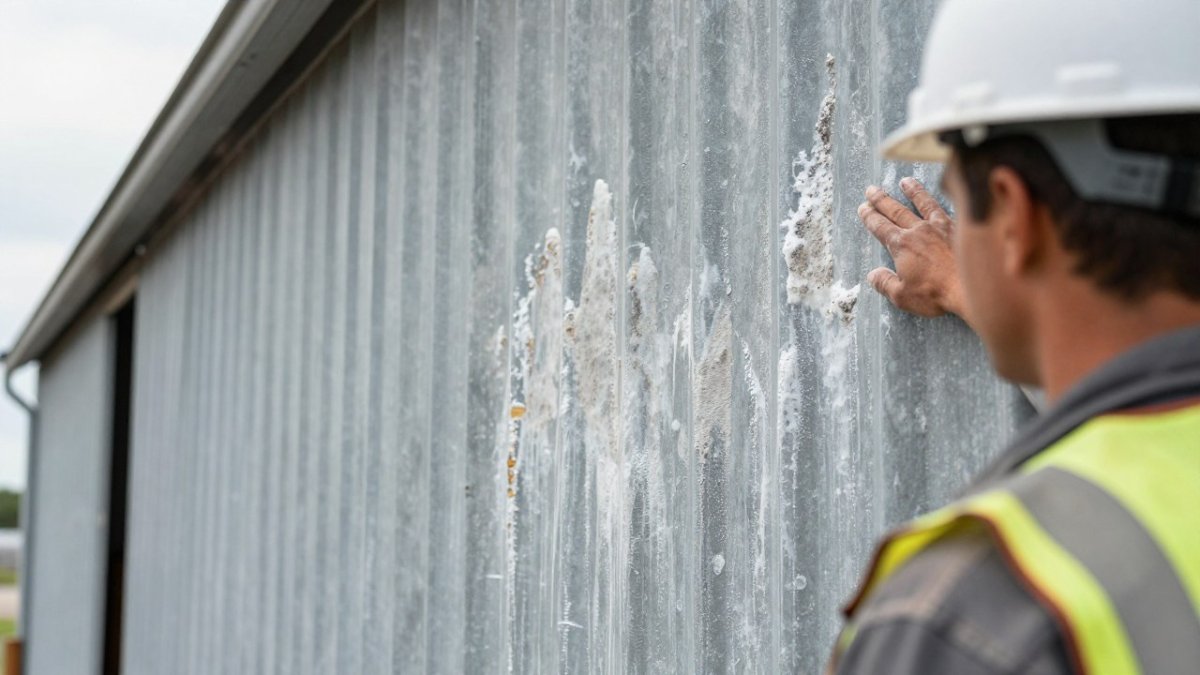
Steel panels are strong and cost less per square foot than most alternatives. Uncoated or poorly coated steel corrodes quickly in salt air, so the coating system is the key factor. Aluminum resists corrosion naturally because it forms a protective oxide layer, which makes it attractive for the most exposed walls.
| Material | Strengths | Weaknesses | Best For |
|---|---|---|---|
| Coated steel | Lower cost, high strength | Relies on coating integrity | Moderate exposure with good coating |
| Aluminum | Natural corrosion resistance | Higher cost, lower stiffness | Heavy salt exposure |
| Stainless steel | Excellent corrosion resistance | Highest cost | Critical or most exposed locations |
Aluminum is often worth the premium on the seaward face, while coated steel can be specified for sheltered elevations. Ask the supplier for salt-spray test data relevant to your coating system rather than relying on general claims.
Protective Coatings, Finishes and Fasteners for Salt-Laden Air
Coatings and fasteners are where many coastal failures begin. A panel can be sound while the cut edges, screw heads or lap joints corrode first.
Look for a coating system specified for marine or coastal exposure, applied to the manufacturer’s stated thickness. Inspect cut edges and fixing points during installation, because these areas are often left unprotected.
Fasteners should be corrosion-resistant and compatible with the panel metal. Mixing metals can trigger galvanic corrosion, so confirm compatibility before ordering (Galvanic Corrosion).
Composite Cladding and Fiber-Cement Options for Warehouse Walls
Non-metal cladding earns its place on a coastal warehouse when the wall needs to resist impact, hold a flat painted finish, or avoid the rust-staining that metal panels can develop at cut edges.
Fiber-cement panels are made from cement, sand, and cellulose fiber, so they do not rust and they resist moisture uptake better than wood or gypsum-based boards. On a warehouse, their main advantages are impact resistance at the lower wall (where forklifts, pallets, and loading traffic make contact) and a paintable surface that can be renewed.
Composite panels cover a wide range. Because coastal cladding choices depend on how materials withstand salt, sun, and moisture together, Tuesday Frias connects panel selection to the broader question of climate durability.
For a warehouse, the practical split is by elevation and by use. Lower walls facing loading docks and yard traffic are where fiber-cement or a heavy-duty composite earns its cost, because it takes impact without denting and can be repainted.
Watch out: fiber-cement and composite panels are often sold on appearance and fire rating alone, and the coastal question of how the panel drains and how its cut edges are sealed gets skipped. A panel that looks correct on the sample board can stain or delaminate within a few seasons if the cavity and flashing details are wrong.
Fire performance also matters more on a warehouse than on a house, because of storage contents and occupancy. Confirm the panel’s fire classification and how it is tested as an assembly, and check that the system you choose meets the code path your building official requires.
Insulated Metal Panels for Coastal Warehouses: Performance and Compliance
Insulated metal panels combine a metal skin with a rigid insulating core. They provide thermal performance and a fast installation, which suits warehouses that need to be enclosed quickly.
For coastal sites, the metal skin and the joint system are the critical elements. The panel’s coating must match the exposure, and the seals between panels must hold against wind-driven rain and salt. Check that the system meets the fire, energy and building codes that apply where the warehouse is built, and confirm the requirements with the local building department and any International Building Code, adopted by most US jurisdictions references your project uses.
Lifecycle Cost, Maintenance and Total Cost of Ownership Compared
The purchase price of cladding is the smallest number in a coastal warehouse’s wall budget. What drives total cost of ownership is how often the system needs to be cleaned, inspected, touched up, and eventually replaced, and those intervals are set by the coating and material, not by the panel’s thickness or color.
A workable way to compare options is to build a simple cost model over a 20- to 30-year service period, using the same categories for every material:
- Initial supply and installation, including fasteners, flashings, sealants, and the subframe or girt changes the panel requires
- Routine cleaning, typically one to two washes per year on seaward elevations in heavier salt zones, to remove deposits before they hold moisture against the coating
- Inspection and touch-up, focused on cut edges, fastener heads, lap joints, and the base of the wall where splash and debris collect
- Repair and partial replacement, which is where mixed-material facades and proprietary joint systems can become expensive because matching panels and trims may no longer be available
- Full replacement at end of service life, discounted back to present value so a dollar spent in year 20 is not compared directly to a dollar spent today
The ranking of options can change once maintenance is included. A lower-cost coated steel wall on a seaward face may need touch-up and fastener replacement within the first decade, while an aluminum or higher-grade coated system may carry a premium up front but need little beyond washing for much longer.
Maintenance capacity is part of the cost model, not a separate question. A warehouse owner with in-house maintenance staff and safe access to the walls can justify a system that needs periodic washing and touch-up. An owner who will not clean the walls should weight the model toward materials and coatings that tolerate neglect, because deferred cleaning accelerates corrosion and shortens service life.
Pricing depends on quantity, delivery, panel specification, access, and site conditions, so fixed figures are not meaningful across projects. Cut edge corrosion on metal roofs in San Antonio and Austin explains how that corrosion starts and when coating alone is not enough. Request itemized quotes that separate panels, fasteners, flashings, sealants, and installation, then run each option through the same service period and maintenance schedule.
When comparing lifecycle costs, use the same maintenance schedule for every material, set from the coating manufacturer’s recommendations for the exposure zone.
Good records make the model real. Keep a log of inspections, cleaning dates, coating touch-ups, and fastener replacements so that the next re-cladding decision rests on the building’s actual history rather than on a supplier’s projection.
Choosing Your Coastal Warehouse Cladding: Next Steps With Total Cladding and Roofing LLC
Start by classifying each elevation of the building by its exposure, then match each face to a cladding system suited to that level of salt and moisture. Confirm the coating, fasteners and joint details, and compare lifecycle costs across the options you shortlist.
Total Cladding and Roofing LLC works with property owners, developers and general contractors on new-build and existing commercial and industrial properties across Texas. We assess project requirements, explain suitable options and plan installation around site operations. Our team is a member of the Roofing Contractors Association of Texas (RCAT) and the Central Texas Roofing Contractors Association (CTRCA).
Last Updated: November 12, 2026
Frequently Asked Questions
What is the best type of cladding for a warehouse in a coastal environment?
For most coastal warehouses, a coated metal system or insulated metal panel with a marine-grade finish offers the strongest balance of corrosion resistance, durability and maintenance needs. Aluminum resists salt-laden air well and is lighter, while galvanized or stainless steel suits high-exposure sites when properly coated. Composite cladding can work on lower-exposure elevations, but the right choice depends on distance from the shoreline, wind exposure and the building’s insulation requirements. A site assessment is the most reliable way to confirm the specification.
Is aluminum or steel cladding better near the coast?
Aluminum generally performs better in salt-laden air because it forms a stable oxide layer, which makes it a common choice for the most exposed coastal facades. Steel offers higher strength and lower material cost but depends heavily on its coating system and cut-edge protection to avoid corrosion. In practice, the coating specification, fastener material and maintenance schedule often matter as much as the base metal. Total Cladding and Roofing LLC can review your site conditions and recommend the right option for your warehouse; contact us for a quote, as pricing depends on quantity, panel profile and delivery.
How often should coastal warehouse cladding be inspected?
Coastal warehouse cladding should be inspected at least twice a year, typically in spring and fall, and after major storms or hurricane season. Inspections should check coating condition, fastener corrosion, sealant joints, cut edges and drainage around panel laps. Keeping a written log helps facility managers spot early corrosion and plan repairs before they affect the building envelope. Maintenance intervals may shorten for properties within a short distance of the shoreline.
What coatings and fasteners help protect metal cladding from salt air?
Marine-grade or high-performance coating systems, such as those with a primer, intermediate coat and topcoat, provide the best protection for metal cladding in salt-laden air. Fasteners should be stainless steel or corrosion-resistant coated fasteners rated for coastal exposure, since mismatched metals can accelerate galvanic corrosion. Sealing cut edges and touch-up damaged coating promptly also extends service life. Confirm the coating and fastener specification against the manufacturer’s coastal exposure ratings before installation.

To upload drawings, specs and plans please go to the form on our contact page.
Get in Touch