
Table of Contents
- What a Commercial Roof Inspection Checklist Must Cover in 2026
- Roof Drainage, Ponding Water, and Structural Assessment
- Fastener Integrity, Corrosion, and Surface Damage
- Building a Commercial Roof Maintenance Schedule That Works
- Using a Roof Inspection Report Template for Documentation
- Technology Integration: Drones, Thermal Imaging, and Moisture Surveys
- Commercial Roof Inspection Cost 2026 and Safety Protocols
- Conclusion: Turning Inspections Into Long-Term Roof Performance
- Frequently Asked Questions
Last Updated: September 12, 2026
What a Commercial Roof Inspection Checklist Must Cover in 2026
A commercial roof inspection checklist is a structured document that guides facility teams through every critical component of a roofing system, from membrane integrity to drainage performance. This guide covers what a commercial roof inspection checklist 2026 needs to include, how often to inspect, and how to document findings for insurance and asset management.
Visual Roof Assessment and Membrane Integrity
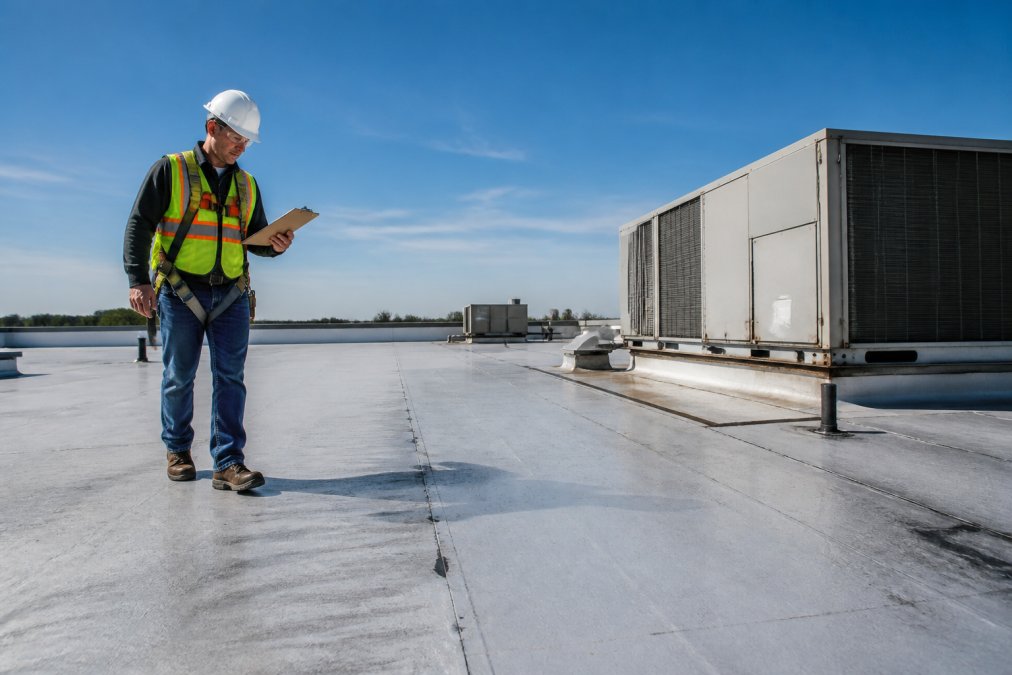
The visual assessment is the foundation of any roof inspection checklist. Inspectors walk the full roof surface looking for membrane integrity issues: punctures, tears, seam separation, and blistering. Pay attention to high-traffic areas around HVAC units and roof access points where foot traffic causes the most wear.
A common mistake is inspecting only from the roof edge or ladder. Surface-level checks miss the localized damage that becomes a leak six months later.
Flashing, Penetration, and Curb Inspection
Flashing failures cause more leaks than membrane failures. Your checklist must include every roof penetration, curb flashing, and parapet wall junction.
Key areas to inspect:
- Base flashings at walls and curbs
- Pipe boots and vent stacks
- HVAC unit mounting and equipment curbs
- Expansion joints and seam terminations
According to NRCA roof inspection guidance, roughly two-thirds of roof leaks originate at flashings and penetrations rather than the field membrane. That single fact should shape how you allocate inspection time.
Roof Drainage, Ponding Water, and Structural Assessment
Ponding water is the most reliable predictor of premature roof failure. Water standing on a roof more than 48 hours after rainfall signals a drainage problem that will eventually compromise the membrane and insulation (nrcan.gc.ca).
Walk the roof after a rain event to identify low spots. Check scuppers, downspouts, and internal drains for debris blocking flow. When ponding recurs in the same area, the deck itself may be deflecting, which points to a structural assessment rather than a simple drain cleaning.
Clearing a drain without checking the deck below it hides the real problem. Recurring ponding often means insulation displacement or deck deflection, and patching the symptom guarantees a larger repair later.
Fastener Integrity, Corrosion, and Surface Damage
Fastener back-out and corrosion are slow killers. On mechanically attached systems, fasteners work loose through thermal cycling and wind uplift. On metal roofs, corrosion at cut edges and fastener heads spreads beneath the coating.
Inspect for:
- Backed-out or missing fasteners
- Rust at fastener heads and panel edges
- Blistering and surface wear on the membrane
- Ballast displacement on ballasted systems
Left unaddressed, these small failures let water reach the insulation. Once insulation is saturated, R-value collapses and the roof’s thermal performance drops even before a leak appears inside the building.
Building a Commercial Roof Maintenance Schedule That Works
A commercial roof maintenance schedule turns one-time inspections into a lifecycle strategy. The schedule should combine routine visual checks with professional inspections timed to the seasons.
| Frequency | Who Performs It | What It Covers |
|---|---|---|
| Monthly | In-house facilities staff | Debris, drainage, obvious damage |
| Quarterly | Facilities team | Full visual walk, fastener checks |
| Twice yearly | Professional inspector | Comprehensive assessment, moisture survey |
| After major storms | Professional inspector | Hail, wind, and impact damage |
Inspection Frequency and Roof Lifecycle Planning
Inspection frequency should match the roof’s age and exposure. A new roof may need only semiannual checks, while a roof past the midpoint of its lifecycle needs quarterly attention. Track findings over time to build a roof lifecycle plan that forecasts replacement or refurbishment years in advance.
Using a Roof Inspection Report Template for Documentation
A roof inspection report template is only as valuable as the decisions it supports. Most guides stop at “record the issue and take a photo.” That is not enough when the report has to survive an insurance claim, a capital-planning review, or a change in facilities management. Build the template around three audiences: your maintenance team, your insurer, and your finance group.
What every report entry should capture
- Location, roof zone, grid coordinate, or GPS tag, plus a reference to the nearest penetration or unit so a crew can find it without a second site visit.
- Condition and severity, a consistent scale (for example, monitor / repair within 90 days / repair immediately) so entries are comparable across inspections and across buildings.
- Recommended action and estimated cost band, not a firm bid, but a range that lets finance rank projects.
- Photo evidence, dated, wide shot plus close-up, with the location marker visible.
- Inspector, date, and method, who inspected, when, and whether the finding came from a visual walk, a drone flight, or a thermal scan.
Insurance compliance documentation, the angle most checklists miss
Insurers and underwriters increasingly look for evidence of a documented preventive maintenance program when evaluating a property claim or renewing coverage. A report that only lists damage is weak evidence. A report that shows a history of scheduled inspections, findings, and completed repairs demonstrates active stewardship of the asset. To make your documentation insurance-ready:
- Keep a continuous inspection log, not isolated reports. A single report proves a roof was looked at once; a log proves a program.
- Record repairs with dates and photos so the timeline from finding to fix is visible.
- Note the inspection method and any moisture-survey results, since hidden moisture is a common claim dispute.
- Store reports in a format you can hand to an adjuster quickly, a claim is not the time to reconstruct records.
Before you file a claim, pull the last two to three inspection reports and the repair log. A documented pattern of maintenance and timely repair is the strongest support for a claim and for negotiating renewal terms.
Asset management and capital planning
For portfolio owners, the report is a capital-planning input, not just a maintenance record. Standardized severity ratings let you roll findings across dozens of buildings into a single ranked list of projects by year. That is how you move from reactive repair to a funded replacement schedule, and how you justify the budget to ownership before a roof fails.
A note on format
Whether you use a spreadsheet, a CMMS module, or a PDF template, the format matters less than consistency. The same fields, the same severity scale, and the same photo conventions across every inspection are what make the data usable. A beautiful one-off report that cannot be compared to last quarter’s is worth less than a plain report that can.
Technology Integration: Drones, Thermal Imaging, and Moisture Surveys
Modern inspections go beyond the naked eye. Drones capture high-resolution imagery of large roofs without putting inspectors at risk. Thermal imaging detects moisture trapped beneath the membrane, where saturated insulation shows as cooler areas. A moisture survey then confirms the extent of saturation with non-invasive testing.
These tools find problems that visual walks miss, particularly hidden moisture that hasn’t yet surfaced as a leak.
Thermal imaging plus a moisture survey locates saturated insulation before it causes interior damage, letting you target repairs instead of replacing an entire roof section.
Commercial Roof Inspection Cost 2026 and Safety Protocols
Commercial roof inspection cost in 2026 is driven by four variables, not a flat rate: roof square footage, access difficulty, inspection method, and reporting depth. Understanding how each one moves the number lets you compare quotes on equal footing instead of accepting the first bid.
What actually drives the price
- Square footage and roof complexity. A single flat membrane roof prices differently than a roof cut up by dozens of HVAC curbs, skylights, and parapet returns. More penetrations mean more flashing to inspect and more time on the roof.
- Access. A roof reached by an interior stairwell and a standard hatch is cheaper to inspect than one requiring a ladder assist, a swing stage, or a crane-suspended platform. Access logistics can rival the inspection itself as a line item.
- Method. A manual walk-through is the baseline. Adding a drone flight, an infrared thermal scan, or a core-cut moisture survey each adds scope and cost, because each requires separate equipment, a trained operator, and separate analysis time.
- Reporting depth. A one-page photo summary costs less to produce than a per-issue report with severity ratings, GPS-tagged photos, and a prioritized capital plan. If your insurer or asset manager needs the deeper report, say so up front so it is priced in.
How to compare quotes
Ask every bidder to itemize the same four categories above. A quote that lumps “inspection” into one number is impossible to benchmark. Request the deliverable sample, the actual report format, before you sign, because two inspectors can walk the same roof and hand you wildly different documents.
Safety protocols for roof access
Safety is not a checklist formality; it is the reason a professional inspection exists instead of a staff member climbing a ladder. Under federal workplace safety rules administered by the Occupational Safety and Health Administration (OSHA), employers must provide fall protection when workers are exposed to falls of six feet or more in general industry settings, and roofing work carries additional requirements (osha.gov). In practice, a compliant commercial roof inspection includes:
- Fall protection and harness system inspected and in place before roof access
- Roof access ladder or hatch secured and rated for the load
- Weather conditions checked, no inspections in high wind, lightning, or ice
- Two-person minimum for roof access, with a designated spotter
- Fragile deck areas (skylights, deteriorated decking, open penetrations) identified and marked
- Perimeter warning line or guardrail where the roof edge is unprotected
- Emergency egress and communication plan confirmed before ascending
A drone flight does not eliminate safety obligations, it shifts them. You still need a compliant launch area, airspace awareness, and a visual observer in many operations. Do not treat drone inspection as a way to skip fall-protection planning for the areas a drone cannot reach.
Budgeting the inspection into the roof lifecycle
Treat inspection cost as a fraction of the replacement cost it defers. A roof that is inspected and repaired on schedule typically reaches the upper end of its expected service life, while a neglected roof fails early and forces an unplanned capital expense. When you build the annual maintenance budget, fund the inspection line item first, it is the cheapest lever you have on total roof cost.
Conclusion: Turning Inspections Into Long-Term Roof Performance
A checklist only protects your building if it’s followed consistently and paired with real maintenance action. Total Cladding and Roofing LLC helps facility and property managers extend the service life of existing roofing systems through detailed building investigations, coordinated roof, insulation, and drainage work, and refurbishment strategies that minimize disruption to operations. Get started with Total Cladding and Roofing LLC and turn routine inspections into decades of reliable roof performance.
Frequently Asked Questions
What should be included in a commercial roof inspection checklist?
A complete checklist covers visual roof assessment, membrane integrity, flashing and penetration inspection, drainage systems, fastener integrity, and corrosion. It should also document surface damage like blistering and seam separation, roof deck condition, and parapet walls. Include sections for ponding water, scuppers, downspouts, and HVAC unit mounting. Each item needs a condition rating and photo evidence so the roof inspection report template produces a usable record for warranty compliance and asset management.
How often should a commercial roof be inspected?
Most commercial roofs need at least two inspections per year, typically in spring and fall. Buildings in Texas face hail, extreme heat, and humidity swings, so quarterly checks make sense for older roofs or those under warranty. After any major storm, schedule an inspection within days. A consistent commercial roof maintenance schedule catches small issues like flashing gaps or ballast displacement before they become emergency repairs that disrupt operations and inflate costs.
What is the 25% rule in commercial roofing and how does it affect repairs?
The 25% rule applies to roof replacement versus repair decisions under many building codes and insurance policies. If more than 25% of the roof area is damaged or needs replacement in a given year, some jurisdictions and insurers may require full roof replacement rather than patching. This affects budgeting significantly. Documenting damage with a roof inspection report template helps you track cumulative repair percentages and avoid surprise full-replacement mandates.
How do 2026 building codes impact commercial roof inspection requirements?
Building codes continue to tighten energy and safety standards for commercial roofs. Insulation R-value requirements, roof coating reflectivity, and structural load calculations for ballasted systems all factor into inspections. For insurance compliance, carriers increasingly want documented moisture surveys and thermal imaging results. Inspectors should verify that roof penetrations, curb flashings, and drainage systems meet current standards, and note any insulation displacement or R-value shortfalls that could affect coverage.
What will fail a roof inspection?
Common failures include active leaks, ponding water that persists 48 hours after rain, deteriorated flashing, rusted or backed-out fasteners, and widespread blistering or seam separation. Clogged scuppers and downspouts, damaged parapet walls, and improper HVAC unit mounting also trigger failures. Insurance inspectors look for signs of deferred maintenance and missing documentation. Keeping a current commercial roof maintenance schedule and repair log prevents most of these failures.
How much does a commercial roof inspection cost in 2026?
Commercial roof inspection cost 2026 varies by roof size, accessibility, and whether drone or thermal imaging is used. Pricing depends on building height, roof complexity, and travel distance. Simple visual inspections cost less than full moisture surveys with infrared scanning. Request a quote based on your specific facility details rather than relying on generic estimates.
To upload drawings, specs and plans please go to the form on our contact page.
Get in Touch