
Table of Contents
- Why Roof Refurbishment Beats Replacement for Most Manufacturing Plants
- How to Assess Your Industrial Roof Before Committing to Refurbishment
- Metal Roof Restoration: When It Works and What It Involves
- Building an Industrial Roof Maintenance Schedule That Prevents Surprises
- Cost of Industrial Roof Replacement vs. Refurbishment: The Financial Case
- OSHA Roofing Safety Requirements for Facility Managers and Contractors
- Phased Scheduling and Operational Continuity During Refurbishment
- Frequently Asked Questions
Last Updated: September 15, 2026
Why Roof Refurbishment Beats Replacement for Most Manufacturing Plants
Roof refurbishment for manufacturing plants restores an existing roof system to extend its service life rather than tearing it off and starting over. For most industrial facilities it costs less, takes less time, and avoids the disruption of a full replacement.
The math is straightforward: a building envelope with sound substrate integrity and dry insulation does not need demolition. It needs cleaning, seam and flashing repairs, and a new membrane or coating system.
This guide from Total Cladding and Roofing LLC covers the full decision process: assessing your roof, when metal roof restoration makes sense, scheduling work around production, and the safety and financial rules that apply in 2026.
Most guides treat refurbishment as a budget compromise; done properly, it can be a technically sound choice.
Refurbishment works when the structure and insulation are still sound. If the deck is compromised or the insulation is saturated, replacement is the honest answer.
How to Assess Your Industrial Roof Before Committing to Refurbishment
A proper assessment answers one question: is the existing roof system worth saving? Skip it and you risk coating over a problem that resurfaces within a year.
A common mistake is relying on a visual walkover alone. Water travels: a leak over the production line often originates 30 feet away at a failed seam or flashing.
Here is the assessment sequence we use:
- Visual survey of the full roof field, noting ponding, blisters, and open seams
- Core sampling through the membrane to measure insulation saturation
- Thermal imaging to map moisture infiltration across the assembly
- Substrate integrity check to confirm the deck can carry loads
- Drainage review to confirm roof drainage systems flow freely
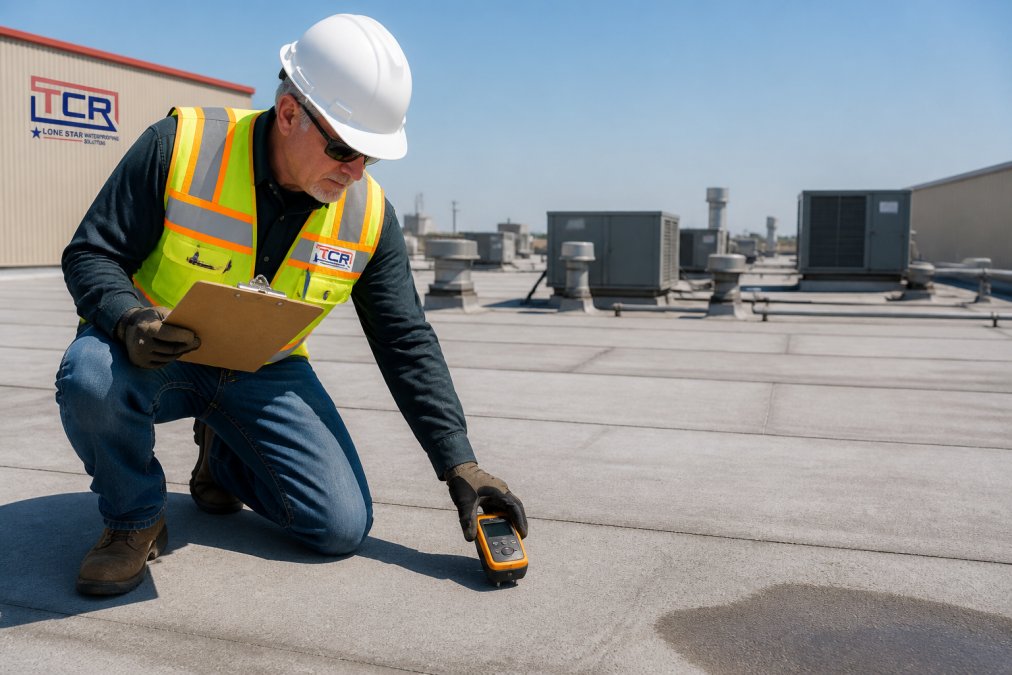
Core sampling is the step most contractors skip because it means cutting a hole. That hole tells you whether the insulation is dry. If it isn’t, refurbishment is off the table until the wet material is removed.
Pull cores from at least three zones: near drains, mid-field, and at the high point. Moisture rarely distributes evenly, and a single sample can mislead you in either direction.
Metal Roof Restoration: When It Works and What It Involves
Metal roof restoration is the right call when panels are structurally sound but fasteners, seams, and coatings have aged out. It means re-securing the system and applying a protective membrane or coating instead of replacing panels.
Metal roofs fail at their details, not their field: fasteners back out, sealants crack, and seams degrade while the panels often have decades left.
What the work involves:
- Re-tightening or replacing fasteners with larger, coated ones
- Treating surface rust and priming bare metal
- Reinforcing seams and penetrations
- Applying a reflective coating or membrane system
A restored metal roof can improve energy efficiency by reflecting solar heat, which matters in facilities with heavy internal loads. Puncture and chemical resistance depend on the coating, so matching the product to what your process emits is important.
Metal roofing technical resources from the Metal Construction Association outline how coating selection affects long-term performance on industrial metal systems.
Where it fails: if panels are perforated through, or if the purlins have corroded, restoration is a delay tactic, not a fix.
Building an Industrial Roof Maintenance Schedule That Prevents Surprises
An industrial roof maintenance schedule is a documented plan for inspecting, cleaning, and repairing the roof system at set intervals. It catches membrane deterioration before it becomes moisture infiltration and builds a written record showing when refurbishment is the right next step.
Most facility teams run reactive maintenance: they call someone when it leaks. This can lead to emergency pricing, production disruption, and a shortened roof lifecycle, making it harder to plan capital.
A practical schedule looks like this:
| Frequency | Task | Who Performs It |
|---|---|---|
| Monthly | Visual check of drains, scuppers, and debris | In-house maintenance |
| Quarterly | Seam, flashing, and fastener inspection | Facility staff or contractor |
| Annually | Full inspection with core sampling as needed | Roofing contractor |
| After major storms | Hail and wind damage survey | Roofing contractor |
| Every 3-5 years | Thermal imaging scan across the full assembly | Roofing contractor |
Why the Schedule Actually Extends Roof Life
Two mechanisms do the work. First, debris and ponding water are the leading causes of membrane failure on low-slope industrial roofs, standing water stresses seams, accelerates coating breakdown, and drives moisture toward any breach. Clearing a blocked drain takes minutes. Replacing saturated insulation across a bay does not.
Second, small repairs stay small when caught early. A backed-out fastener or cracked sealant is a fifteen-minute fix; left through a winter of freeze-thaw cycling it becomes a seam failure, then a membrane breach, then wet insulation, then a deck problem. The schedule interrupts that progression at the cheapest stage.
Trigger-Based Escalation: When Maintenance Becomes Refurbishment
A schedule without escalation logic is just a calendar. The useful version defines what findings move you from routine maintenance to a refurbishment conversation:
- More than a handful of new leaks per season in different areas, the membrane is failing systemically, not locally.
- Core samples showing saturated insulation in more than one zone, moisture is spreading and the assembly is losing R-value.
- Coating wear exceeding roughly half the original film thickness in high-traffic or high-UV areas, recoating window is opening.
- Fastener back-out on more than a small percentage of panels, the attachment system is degrading faster than the field.
- Ponding that persists more than 48 hours after rain, drainage is inadequate and the structure is carrying load it was not designed for.
When two or more of these triggers appear together, the honest answer is usually to scope a refurbishment rather than keep patching. That is the point of the schedule: it gives you the evidence to make that call on your terms.
Document Everything
Keep a written log of every inspection, repair, and photo. When you solicit quotes for refurbishment or replacement, that history is leverage: it shows the roof was cared for, tells contractors where the problems are, and supports the warranty and insurance conversations covered earlier in this guide.
OSHA’s guidance on walking-working surfaces sets the fall protection expectations that apply to anyone accessing your roof, including your own staff.
Never let untrained staff walk a membrane roof to “take a look.” A single misplaced footstep on a brittle membrane can create a puncture that leaks for months before anyone notices.
Photograph every repair and log the date, location, and material used. A two-minute habit that pays off the first time a manufacturer or insurer asks what was done to the roof.
Cost of Industrial Roof Replacement vs. Refurbishment: The Financial Case
The cost of industrial roof replacement is driven by tear-off, disposal, new insulation, and a new membrane across the entire area; refurbishment avoids most of that.
Here is where the money actually goes:
| Cost Driver | Full Replacement | Refurbishment |
|---|---|---|
| Tear-off and disposal | Required across full area | Avoided |
| New insulation | Full area | Only where core samples show saturation |
| Membrane or coating | Full new system | Overlay system |
| Production disruption | High, often multi-day shutdowns | Low with phased zoning |
| Service life added | Full new term | Extended term, typically shorter than new |
| Warranty reset | New manufacturer warranty | Depends on system and installer certification |
| Insurance treatment | Often triggers re-rating | Usually no re-rating if system class is unchanged |
The CAPEX vs. OPEX Question, Answered Properly
How to Justify the Spend to a CFO
Warranty and Insurance Implications
Refurbishment wins the financial case when you measure cost per year of service life added, not sticker price. Run that number before you run the comparison any other way.
OSHA Roofing Safety Requirements for Facility Managers and Contractors
What facility managers need to confirm before work begins:
Phased Scheduling and Operational Continuity During Refurbishment
Walk the roof with your contractor and your maintenance lead together. The maintenance lead knows which units fail and which drains back up, and that knowledge should shape the phasing plan.
Frequently Asked Questions
What is the 25% rule for commercial roofing?
The 25% rule in commercial building codes generally states that if more than 25% of a roof area is damaged or being repaired, the entire roof must be brought up to current code. This means a localized fix on a manufacturing plant roof can trigger a full-code upgrade. Facility managers should confirm how their local jurisdiction applies this threshold before authorizing partial repairs, because it can shift a refurbishment project into replacement territory.
How does roof refurbishment compare to full replacement in terms of cost?
Refurbishment typically costs significantly less than full replacement because it preserves the existing substrate and insulation where they pass inspection. The cost of industrial roof replacement includes tear-off, disposal, new insulation, and new membrane across the entire roof area. Refurbishment avoids most of that. However, if core sampling reveals widespread insulation saturation or substrate failure, replacement becomes the more cost-effective long-term choice. A professional assessment determines which path applies to your facility.
How do I determine if my manufacturing plant roof needs repair or replacement?
Start with a professional inspection that includes core sampling, moisture surveys, and thermal imaging. If the insulation is dry, the substrate is sound, and membrane deterioration is surface-level, metal roof restoration or coating refurbishment can extend service life. If more than 25% of the roof shows saturation, structural deflection, or failed flashing across multiple areas, replacement is usually the better investment. Documenting the roof system lifecycle helps justify the decision to ownership.
What safety protocols are required during industrial roof refurbishment?
OSHA roofing safety requirements mandate fall protection for work at heights of 6 feet or more in construction. This includes guardrail systems, safety net systems, or personal fall arrest systems. Contractors must also assess structural load capacity before staging materials on the roof, provide hazard communication for coatings and adhesives, and follow lockout/tagout procedures when working near rooftop equipment. Facility managers should verify the contractor’s written safety plan before work begins.
To upload drawings, specs and plans please go to the form on our contact page.
Get in Touch