Table of Contents
- 12 Critical Signs Your Warehouse Roof Needs Restoration
- 1. Visible Water Leaks and Interior Stains
- 2. Ponding Water and Drainage Failures
- 3. Membrane Blistering and Bubbling
- 4. Flashing Damage and Seam Failures
- 5. Rust, Corrosion, and Metal Deterioration
- 6. Structural Sagging and Deck Deflection
- 7. Mold and Mildew Growth
- 8. Rising Energy Costs and Insulation Saturation
- When to Replace vs. Restore Your Commercial Roof
- Metal Roof Restoration Cost and Financial Planning
- Commercial Roof Maintenance Checklist for Warehouses
- Creating a Preventative Maintenance Schedule
- How Local Climate Impacts Warehouse Roof Deterioration
- Next Steps: Getting a Professional Roof Assessment
- Frequently Asked Questions
Last Updated: September 27, 2026
12 Critical Signs Your Warehouse Roof Needs Restoration
Your warehouse roof is under constant stress. Heat cycles, moisture infiltration, UV exposure, and structural movement all work against the roof membrane over time. At Total Cladding and Roofing LLC, we’ve inspected numerous warehouse facilities across Texas, and the pattern is clear: most facility managers don’t recognize the early warning signs until the problem becomes expensive.
The difference between catching roof deterioration early and waiting until failure occurs is often the difference between a restoration project and a full replacement. Understanding the signs your warehouse roof needs restoration helps you make that decision before water damage spreads to inventory, equipment, or structural elements.
Below, we’ll walk through the 12 most critical indicators that your roof system is failing and what each one means for your building.
1. Visible Water Leaks and Interior Stains
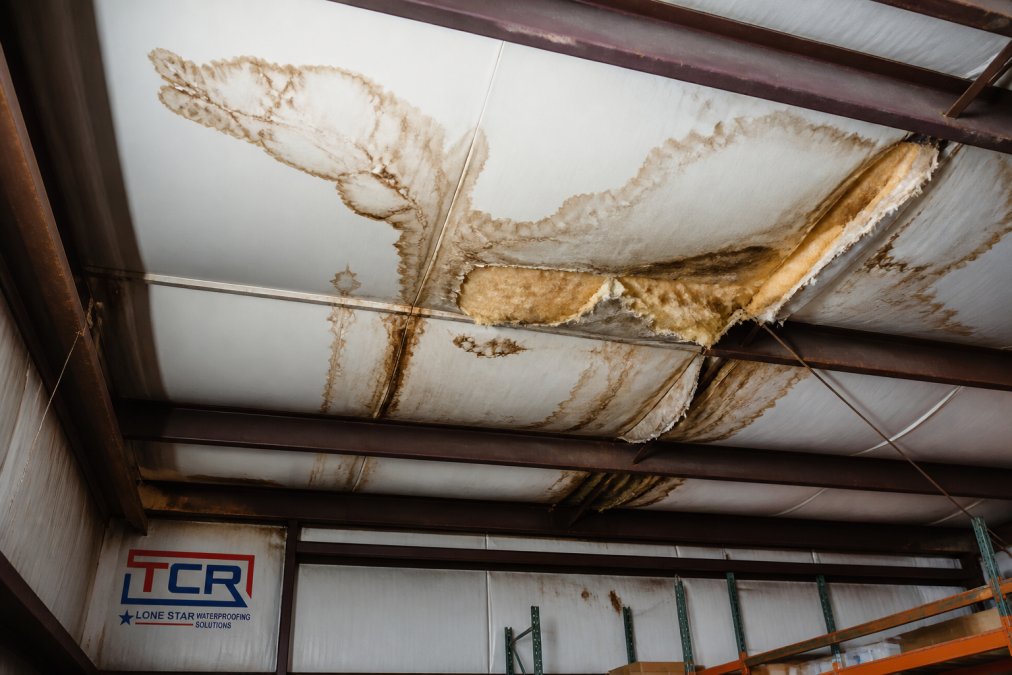
Water stains on the interior ceiling are the most obvious sign your warehouse roof needs restoration. These aren’t cosmetic issues, they’re evidence that water has penetrated the roof membrane and is actively moving through your building envelope.
Look for brown, yellow, or rust-colored stains that expand over time. These patterns show water is traveling along structural members or insulation. Fresh stains mean active leaks; old stains with new moisture around them mean the problem is worsening.
The real concern is what you can’t see. Water that enters the roof system often travels horizontally along the roof deck or insulation before it appears on the ceiling below. By the time you see a stain, water may have been inside your building for weeks.
2. Ponding Water and Drainage Failures
Ponding water, standing water that remains on the roof surface more than 48 hours after rain, is a critical warning sign. Flat roof systems are designed with slight slopes to direct water toward drainage systems, but age, settling, or poor installation can create low spots where water collects.
Ponding accelerates membrane deterioration. Water sitting on the roof causes the membrane to expand and contract repeatedly, breaking down the material. It also adds weight to the roof deck, stressing structural components.
Check your roof after heavy rain. If water pools in any area, your drainage system isn’t working properly. This needs immediate attention because ponding water will eventually penetrate the membrane.
3. Membrane Blistering and Bubbling
Blisters or bubbles in the roof membrane indicate trapped moisture inside the roof system. These form when water vapor becomes trapped between membrane layers or between the membrane and insulation, then expands due to heat.
Blisters start small but grow over time. As the membrane ages, these weak points become failure points. Foot traffic, weather stress, or thermal movement can rupture a blister, creating an opening for water infiltration.
If you see blistering on your roof, the underlying insulation is likely already wet or saturated. This means the membrane has already failed in those areas, and water is inside your building envelope.
4. Flashing Damage and Seam Failures
Flashing, the metal or rubber components that seal roof penetrations like pipes, vents, and equipment, is where many warehouse roof leaks originate. Flashing separates from the membrane, seals fail, or fasteners corrode, creating pathways for water entry.
Seams in the roof membrane are also vulnerable points. If seams are separating, pulling apart, or showing signs of degradation, water will find those gaps. Seams are typically the weakest part of any roof system.
Walk around the roof perimeter and at every penetration. Look for gaps, cracks, corrosion, or separation between the flashing and membrane. These are active leak points.
5. Rust, Corrosion, and Metal Deterioration
If your warehouse has metal roofing or metal components (flashing, fasteners, roof-mounted equipment), rust and corrosion are direct indicators of system failure. Rust forms when protective coatings break down and metal is exposed to moisture.
Corroded fasteners can no longer hold seams or flashing in place. Corroded metal panels lose structural integrity and develop holes. The progression from surface rust to structural failure can happen faster than many facility managers realize, especially in humid Texas climates.
Inspect all metal components closely. Surface rust can often be addressed with coating or restoration, but deep corrosion may require component replacement.
6. Structural Sagging and Deck Deflection
If the roof surface appears to sag or dip in certain areas, the roof deck is deflecting under load. This can be caused by wet insulation (insulation saturated with water weighs significantly more than dry insulation), failed structural supports, or excessive ponding water.
Sagging is a serious structural issue. It indicates the roof deck is no longer properly supported and may be at risk of failure. In extreme cases, sagging can lead to catastrophic collapse, especially if the building receives heavy snow or rain loads.
This requires immediate professional assessment. Structural sagging is not a cosmetic problem, it’s a safety hazard.
7. Mold and Mildew Growth
Mold and mildew on the interior ceiling or walls beneath the roof indicates persistent moisture. This happens when water infiltration is ongoing and humidity levels inside the building remain elevated.
Mold is both a health hazard and a sign of active water intrusion (the CDC). If you see mold, water is getting into your building regularly. The longer this continues, the more damage spreads to structural components, insulation, and stored materials.
Mold growth also suggests the roof membrane has been compromised for some time. This isn’t a new leak, it’s an established problem.
8. Rising Energy Costs and Insulation Saturation
If your utility bills have increased noticeably and your HVAC system is running longer to maintain temperature, your insulation may be wet. Saturated insulation loses its thermal resistance and forces your climate control system to work harder.
Wet insulation also becomes a breeding ground for mold and microbial growth. It adds significant weight to the roof deck and accelerates structural deterioration.
Rising energy costs combined with any of the other signs in this list strongly suggest your roof system is failing and water is inside your building envelope.
When to Replace vs. Restore Your Commercial Roof
The decision between restoration and replacement depends on the extent of damage, the age of the roof system, and your budget. Not every failing roof needs complete replacement.
Roof restoration works when damage is localized, the membrane still has service life remaining, and the underlying structure is sound. Restoration typically involves repairing specific problem areas, recoating the membrane, and addressing drainage issues. This approach extends the roof’s service life by 10-15 years at a lower cost than replacement.
Full replacement is necessary when the roof has reached the end of its service life, structural damage is extensive, or the cost of repeated repairs approaches replacement cost. A new roof system provides a clean slate and a full warranty period.
The key is getting a professional assessment.
Metal Roof Restoration Cost and Financial Planning
Metal roof restoration typically costs less than full replacement, but the exact investment depends on the scope of work. Restoration might involve recoating the existing metal panels, replacing corroded fasteners, resealing seams, and addressing flashing issues. Contact us for a professional assessment to determine the specific investment for your project.
Commercial Roof Maintenance Checklist for Warehouses
Regular maintenance prevents small problems from becoming major failures. Here’s a practical checklist for warehouse roof management:
| Maintenance Task | Frequency | Priority |
|---|---|---|
| Visual roof inspection | Quarterly | Critical |
| Clear debris and vegetation | After storms, seasonally | High |
| Check drainage systems and downspouts | Quarterly | Critical |
| Inspect flashing and seals | Quarterly | Critical |
| Look for ponding water | After rain events | Critical |
| Check interior ceilings for stains | Monthly | High |
| Inspect metal components for rust | Quarterly | High |
| Test HVAC efficiency | Seasonally | Medium |
| Document all observations | Each inspection | High |
| Schedule professional assessment | Annually | Critical |
Creating a Preventative Maintenance Schedule
Preventative maintenance is far more cost-effective than emergency repairs. A structured schedule ensures nothing falls through the cracks and that your roof receives attention before problems become critical.
How Local Climate Impacts Warehouse Roof Deterioration
Texas weather creates specific challenges for warehouse roofs. The intense heat causes thermal expansion and contraction cycles that stress roof membranes. High humidity promotes mold and corrosion. Occasional severe weather, hail, heavy rain, wind, can cause acute damage.
Next Steps: Getting a Professional Roof Assessment
If your warehouse shows any of the signs in this guide, the next step is a professional assessment. This is not something to guess about or delay. Water intrusion accelerates damage exponentially, a small leak today becomes a major problem in months.
Frequently Asked Questions
How can I tell if my warehouse roof needs repair or full restoration?
Minor leaks, isolated flashing failures, and surface-level rust can often be repaired. Widespread ponding water, multiple seam failures, structural sagging, and extensive membrane blistering typically signal the need for restoration or replacement. A professional roof inspection will identify whether your roof membrane, deck, and insulation can be restored or if full replacement is necessary to prevent inventory damage and facility downtime.
What does a commercial roof maintenance checklist include?
A comprehensive commercial roof maintenance checklist covers regular visual inspections for debris and standing water, flashing and seam checks, and seasonal assessments before storm seasons. Document all findings, photograph problem areas, and track repair history to build a maintenance record that informs restoration vs. replacement decisions.
What is the 25% rule in roofing?
The decision between restoration and replacement often involves evaluating the cost of repairs against the cost of a full replacement. If the cumulative cost of repairs approaches a significant percentage of a new roof, considering restoration or replacement can be more economical than ongoing repairs to avoid compounding costs and operational disruption. A professional assessment can help determine the most cost-effective approach for your facility.
How does metal roof restoration cost compare to full replacement?
Metal roof restoration typically costs less than full replacement. Restoration can extend service life, making it a cost-effective option for roofs in fair to good structural condition. The total cost depends on roof size, damage extent, materials, and specific project requirements. Contact us for a professional assessment to receive a detailed estimate for your facility.
To upload drawings, specs and plans please go to the form on our contact page.
Get in Touch