Table of Contents
- Industrial Roofing Solutions for Texas: Quick Comparison
- TPO Roofing Membranes: Energy Efficiency for Flat Industrial Roofs
- Standing Seam Metal Roofing: Durability and Structural Integrity
- EPDM and PVC Roofing: Weather Resistance for Extreme Texas Conditions
- Commercial Roofing Material Comparison: Selecting by Facility Type
- Industrial Roof Maintenance Best Practices and Inspection Protocols
- Commercial Roof Restoration Cost Factors and Service Life Extension
- Frequently Asked Questions
Last Updated: September 25, 2026
Industrial Roofing Solutions for Texas: Quick Comparison
Industrial roofing solutions in Texas must withstand extreme heat, hail, and humidity swings that separate durable systems from those that fail prematurely. Selecting the right system requires understanding how materials perform under these stresses and what your facility needs for long-term protection.
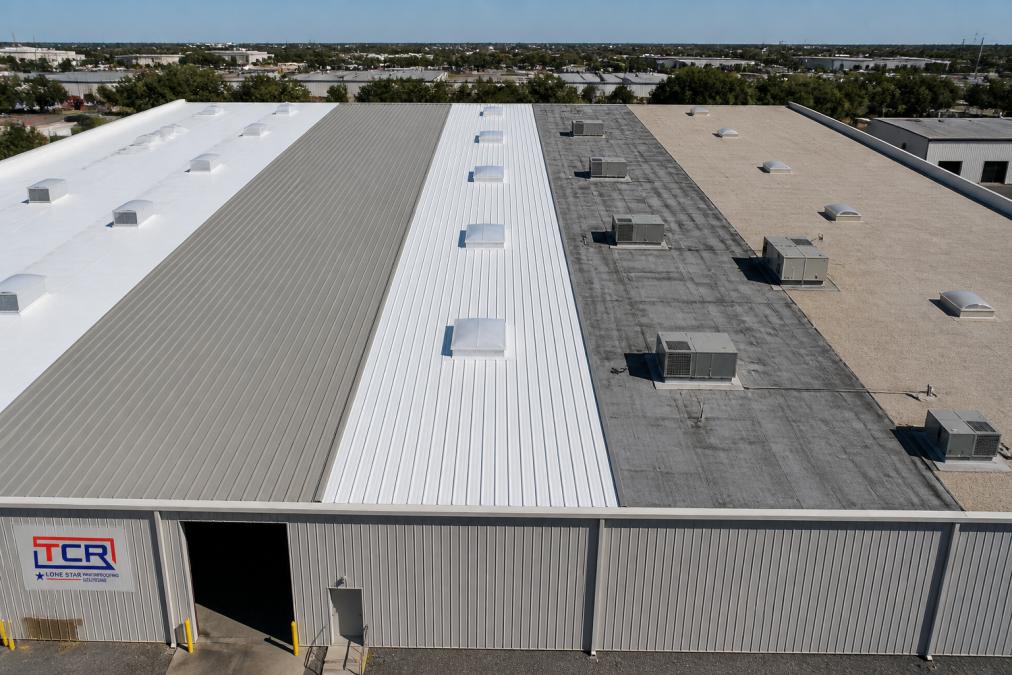
Total Cladding and Roofing LLC has worked with manufacturing plants, warehouses, and corporate facilities across Texas. The best solution depends on your roof’s pitch, current condition, budget constraints, and operational priorities.
This guide covers the major industrial roofing systems available, their strengths in Texas conditions, and how to evaluate which one fits your facility.
Quick Picks:
- Best Overall for Durability: Standing seam metal roofing, superior structural integrity and minimal maintenance for industrial facilities
- Best for Energy Efficiency: TPO roofing membranes, reflective properties reduce cooling costs on flat industrial roofs
- Best for Extreme Weather: EPDM roofing, proven thermal shock and hail resistance in harsh climates
- Best for Chemical Exposure: PVC roofing, inherent fire resistance and chemical resilience for manufacturing plants
| Roofing System | Material Type | Best For | Key Strength | Typical Maintenance |
|---|---|---|---|---|
| Standing Seam Metal | Metal | Long-term durability | Structural integrity, wind resistance | Minimal |
| TPO Membrane | Single-ply plastic | Flat roofs, energy savings | Heat reflectivity, cost-effective | Periodic inspections |
| EPDM Rubber | Synthetic rubber | Extreme weather areas | Thermal shock resistance | Moderate |
| PVC Membrane | Thermoplastic | Chemical exposure areas | Fire resistance, chemical immunity | Periodic inspections |
| Corrugated Metal | Metal | Budget-conscious facilities | Low cost, quick installation | Fastener monitoring |
TPO Roofing Membranes: Energy Efficiency for Flat Industrial Roofs
TPO (thermoplastic polyolefin) roofing delivers measurable energy savings on flat industrial roofs. High solar reflectivity reduces cooling costs under intense summer heat. Heat-welded seams create a continuous barrier against water penetration and resist punctures from foot traffic and equipment installation.
TPO’s main advantage is its performance-to-cost ratio, making it accessible for large industrial footprints.
TPO seam quality depends entirely on installer expertise; poorly executed heat welds become leak points within months. Total Cladding and Roofing LLC prioritizes certified installers trained in proper heat-welding protocols to ensure seam integrity.
TPO membranes in dark colors absorb heat rather than reflect it. Always specify white or light gray TPO to capture the energy efficiency benefit. Dark TPO performs no better than EPDM for cooling costs.
TPO works best for flat or low-slope industrial roofs needing reliable waterproofing without premium metal pricing.
Standing Seam Metal Roofing: Durability and Structural Integrity
Standing seam metal roofing is the premium choice for facilities prioritizing longevity. Concealed fasteners eliminate leak points, vertical seams shed water aggressively, and the metal’s strength handles equipment loads and HVAC units without concern.
A properly installed standing seam roof lasts for decades with minimal maintenance versus TPO’s typical service life, making per-year cost competitive despite higher upfront investment.
This means fewer roof replacements over your facility’s lifetime and eliminates that roof from the maintenance rotation for decades.
Standing seam metal roofing handles Texas hail better than any membrane system. The metal’s rigidity and seamless design mean hail damage rarely causes leaks. Membranes, by contrast, can develop pinhole punctures that don’t show up until water stains appear inside.
Standing seam requires higher upfront investment than membrane systems, but pays itself back through avoided downtime and emergency repairs in facilities where replacement disruption is costly.
EPDM and PVC Roofing: Weather Resistance for Extreme Texas Conditions
EPDM (ethylene propylene diene terpolymer) and PVC roofing systems address the three climate stressors that degrade industrial roofs fastest: thermal shock, hail impact, and UV degradation.
Thermal Shock and Temperature Cycling
Texas industrial facilities experience daily temperature swings exceeding 40°F. Rigid materials develop micro-fractures at seams after repeated cycles, while EPDM’s synthetic rubber composition maintains elasticity, flexing without cracking. EPDM’s elongation at break (300-400%) absorbs stress that causes membrane failure in less flexible systems.
PVC membranes vary by formulation. High-quality UV-stabilized, cold-resistant grades maintain better performance under extreme climates, though many facility managers overlook this detail when comparing bids.
When evaluating EPDM quotes, confirm the membrane thickness. 45-mil EPDM provides better thermal shock resistance than 30-mil, though at higher cost. For facilities in areas experiencing 30+ freeze-thaw cycles annually, the thicker membrane justifies the investment.
Hail Resistance and Impact Performance
Hail events regularly produce 1-2 inch stones, with occasional golf-ball-sized hail. Material response determines whether hailstorms cause immediate leaks or latent damage.
EPDM’s elasticity absorbs hail impact without tearing, earning a Class 4 hail rating under UL 2218 testing. PVC membranes also achieve Class 4 ratings at proper thickness (60-mil) with reinforced seams.
Standing seam metal’s rigidity bounces hail off without penetrating, but impact can create stress concentrations at seams. Exposed-fastener systems are vulnerable to fastener strikes. Concealed-fastener standing seam systems perform better but require post-hail inspection.
Membranes often show no visible damage after hail impact, but pinhole punctures don’t leak until water pressure builds. Post-hail inspections are essential, visual inspection alone misses punctures smaller than 1/16 inch.
UV Degradation and Material Longevity
This region receives 220+ days of direct sunlight annually. UV radiation breaks down polymer chains, causing brittleness and loss of flexibility. Uncoated EPDM can lose some of its elongation after years of exposure.
PVC membranes resist UV better than EPDM if the formulation includes adequate UV absorbers. Budget PVC cuts costs by reducing stabilizers, accelerating degradation. Premium PVC costs 15-25% more but maintains better long-term performance.
Reflective coatings on EPDM or PVC reduce surface temperature by 30-50°F, slowing UV degradation and reducing cooling loads. Coatings can extend membrane life, making them cost-effective for long-term operations.
Chemical Exposure Considerations
PVC outperforms EPDM in chemical exposure environments. Manufacturing plants with rooftop vents releasing oils, grease, or solvents see EPDM degrade faster. PVC’s chemical resistance is inherent to its molecular structure, making it correct for chemical manufacturing and food processing.
EPDM works well for warehouses and distribution centers where chemical exposure is minimal. Cost savings can make it attractive for facilities without chemical stressors.
If your facility has rooftop vents, exhaust stacks, or equipment that releases any chemical vapors, specify PVC or verify that your EPDM supplier provides chemical-resistant formulations. Standard EPDM in a chemical environment will fail prematurely, negating cost savings.
EPDM is better for facilities prioritizing thermal shock and hail resistance at lower cost. PVC is better for manufacturing plants or operations with chemical exposure, where its inherent chemical and fire resistance justifies higher cost. Choosing wrong leads to premature failure and emergency repairs.
Commercial Roofing Material Comparison: Selecting by Facility Type
The right roofing choice depends on balancing upfront cost, operational lifespan, maintenance burden, and facility-specific stressors. Total cost of ownership, not just installation price, reveals why the cheapest option often becomes the most expensive over time.
Lifecycle Cost Framework
A system failing prematurely costs more per year than a durable system lasting for decades. Correct comparison accounts for installation cost, service life, annual maintenance, operational impact, energy performance, and insurance costs.
TPO Membranes: Cost-Effective for Flat Roofs with Moderate Demands
TPO offers a significant service life. Annual maintenance is typically low.
Standing Seam Metal Roofing: Premium Investment for Longevity
For a facility planning a long operational life, standing seam metal’s per-year cost can be lower than TPO’s when you factor in the replacement cycle.
EPDM Rubber: Balanced Cost and Performance for Extreme Weather
PVC Membranes: Specialized Choice for Chemical Exposure
The Hidden Cost of Wrong Decisions
Industrial Roof Maintenance Best Practices and Inspection Protocols
Preventative maintenance separates roofs lasting 40 years from those failing at 15. Conduct inspections twice annually and after severe weather to identify debris, membrane damage, and drainage issues. Document every inspection with photographs and notes, this documentation is invaluable for repair versus replacement decisions.
For TPO and PVC membranes, annual cleaning removes algae and debris that can trap moisture and degrade the material. A gentle pressure wash (under 1,500 PSI) keeps the surface clean without causing damage. Metal roofs rarely need cleaning but benefit from inspection of fasteners and seams.
Commercial Roof Restoration Cost Factors and Service Life Extension
Roof restoration, strategic repairs, coatings, and reinforcement, can extend service life by 10-15 years. Restoration begins with detailed assessment to identify sections needing immediate attention versus those safe with preventative care.
Frequently Asked Questions
What is the best roofing material for extreme heat and storm resistance in Texas?
Standing seam metal roofing and EPDM membranes both excel in Texas conditions. Metal roofing handles hail and high winds with concealed fasteners and high structural integrity, while EPDM’s synthetic rubber composition resists thermal shock from temperature swings and maintains flexibility during freeze-thaw cycles. TPO offers excellent solar reflectivity to reduce cooling costs in high-heat environments. Your choice depends on whether you prioritize longevity and durability (metal) or energy efficiency and cost-effectiveness (TPO or EPDM).
How do I choose between roof restoration and full replacement?
A common benchmark suggests that if repairs exceed a certain percentage of your roof’s replacement cost, replacement becomes more economical. However, restoration extends service life when the underlying structure remains sound and you have recurring leak points or aging membranes. A detailed building investigation reveals whether your roof has 5-10 years of remaining life (restoration candidate) or is approaching end-of-life (replacement). Restoration also minimizes business disruption and coordinates well with other building envelope work like insulation or drainage upgrades.
What are the primary differences between TPO, PVC, and metal roofing systems?
TPO is a thermoplastic membrane offering heat-welded seams and high solar reflectivity, making it cost-effective and energy-efficient for flat roofs. PVC is a similar membrane but more resistant to oils, chemicals, and grease, making it ideal for manufacturing plants or facilities with rooftop equipment. Metal roofing (standing seam or corrugated) provides superior durability, wind uplift resistance, and minimal maintenance but requires higher initial investment. TPO and PVC suit industrial roofs prioritizing energy savings; metal suits facilities prioritizing longevity and structural protection.
What maintenance schedule is required for industrial roofs?
Professional inspections twice yearly (spring and fall) catch debris accumulation, membrane damage, and drainage issues before they become leaks. Monthly visual checks for standing water, punctures, or coating degradation extend service life significantly. Membrane roofs (TPO, PVC, EPDM) benefit from annual coating reapplication to maintain reflectivity and seal protection. Metal roofing requires less frequent maintenance but benefits from fastener checks and debris removal. Preventative maintenance programs coordinate inspections with minor repairs, avoiding the cost and disruption of emergency leak response.
To upload drawings, specs and plans please go to the form on our contact page.
Get in Touch