Table of Contents
- Why Texas Facilities Need Cantex Roofing Alternatives
- Commercial Roofing Systems Comparison for Texas Weather
- Preventative Roof Maintenance Checklist for Commercial Properties
- Industrial Roofing Contractor Evaluation: What to Look For
- How Insurance Premiums and Warranties Affect Your Roofing Choice
- Sustainability and Eco-Friendly Roofing Alternatives
- Frequently Asked Questions
Last Updated: September 17, 2026
Why Texas Facilities Need Cantex Roofing Alternatives
Texas commercial roofs face a specific set of stressors that most roofing guides ignore: hail that arrives in minutes, summer surface temperatures that push past 150°F, and humidity swings that work sealants loose over a single season. For property managers currently weighing Cantex roofing alternatives for Texas facilities, the decision usually comes down to three things: how a system handles hail, how it performs thermally, and what it does to insurance premiums.
This guide from Total Cladding and Roofing LLC breaks down the commercial roofing systems that hold up in this climate, what maintenance actually prevents failures, and how to evaluate an industrial roofing contractor before you sign anything.
Here’s the uncomfortable truth most guides skip: the material you choose matters less than whether the assembly, underlayment, flashing, and ventilation were specified for Texas conditions. A premium metal roof installed with the wrong moisture barrier fails faster than a modest system built correctly.
The most common mistake we see is replacing a roof without first investigating why the old one failed. If the root cause was inadequate roof ventilation or failing flashing, a new roof deck will repeat the same failure within a few seasons.
Commercial Roofing Systems Comparison for Texas Weather
Three systems dominate commercial roofing conversations in this climate: standing-seam metal, Class 4 impact-resistant shingles, and concrete tile. Each trades upfront cost against hail resistance, thermal performance, and lifespan. What most comparisons skip is the mechanism behind each trade-off, and that mechanism is what determines whether a system actually survives a decade of hail seasons, 100°F-plus summers, and humidity swings that work sealants loose.
| System | Hail Rating | Thermal Performance | Lifespan | Relative Upfront Cost | Best For |
|---|---|---|---|---|---|
| Standing-seam metal | High impact resistance; passes UL 2218 Class 4 in many profiles | High solar reflectivity; cool-roof rated | 50+ years | Highest | Large commercial, warehouses, industrial |
| Class 4 asphalt shingles | UL 2218 Class 4 | Moderate; depends on granule reflectivity | 20-30 years | Lowest | Smaller commercial, multifamily, tight budgets |
| Concrete tile | Fire-resistant, wind-resistant; Class 4 available | High thermal mass; slow heat transfer | 50-100+ years | Mid-to-high plus structural cost | Structurally capable buildings |
Standing-Seam Metal Roofing
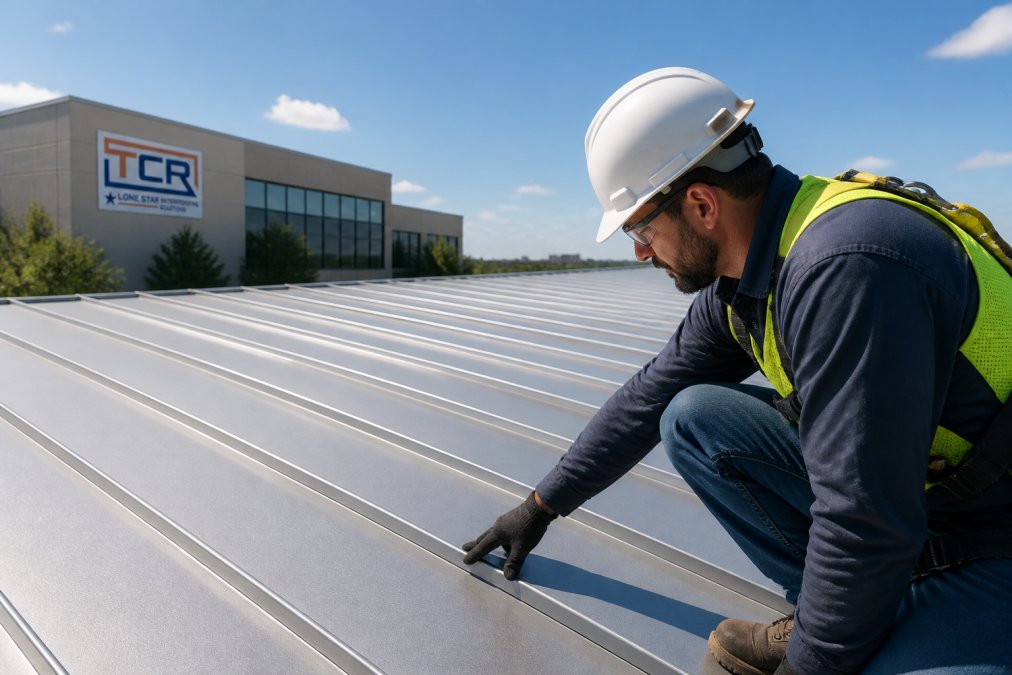
Standing-seam metal is the strongest performer for commercial facilities here. Concealed fasteners eliminate the leak points that plague exposed-fastener panels, and high solar reflectivity reduces cooling loads during peak summer. The mechanism matters: metal reflects solar radiation rather than absorbing it, so the roof surface stays cooler and less heat conducts into the building envelope.
Class 4 Impact-Resistant Asphalt Shingles
Class 4 impact-resistant shingles carry a UL 2218 rating for hail resistance, making them a practical middle option. Multi-layered construction improves wind uplift protection, and architectural and designer profiles keep them visually acceptable on smaller commercial and multifamily buildings.
Concrete Tile Roofing
Concrete tile offers the longest lifespan of the three, often exceeding 50 years. The material resists rot, insect damage, and high winds, and its thermal mass helps regulate indoor temperatures by absorbing heat during the day and releasing it slowly at night.
How These Systems Perform Against Specific Climate Stressors
Generic comparisons treat “hail” and “heat” as single variables. In practice, performance depends on the size and speed of the hail, the intensity of UV exposure, and how humidity interacts with each material.
- Hail: Impact resistance is rated on a scale, and Class 4 is the highest UL 2218 rating. Metal and Class 4 shingles are engineered to resist denting and cracking from larger stones; standard shingles and some tile profiles can crack or shatter. The practical question is not whether a material is “hail resistant” but whether it maintains that rating after years of UV degradation.
- UV and heat: Reflective surfaces (metal, cool-roof shingles) reduce surface temperature and cooling load. Thermal mass (tile) delays heat transfer but does not reflect it. The two strategies solve different problems: reflection lowers peak demand, mass smooths temperature swings.
- Humidity and sealants: Humidity swings work sealants and flashing loose over a single season. Systems with fewer sealant-dependent joints (standing seam) tend to hold up better than systems with many sealed penetrations.
- Wind uplift: Concealed-fastener metal and multi-layer shingles resist uplift better than exposed-fastener panels or poorly adhered tile. Wind-driven rain finds every failed seal, so uplift resistance and water intrusion resistance are linked.
The most common mistake we see is replacing a roof without first investigating why the old one failed. If the root cause was inadequate roof ventilation or failing flashing, a new roof deck will repeat the same failure within a few seasons, regardless of which material you choose.
Preventative Roof Maintenance Checklist for Commercial Properties
A preventative roof maintenance checklist is the cheapest insurance a facility manager has. Most catastrophic roof failures start as minor issues, a lifted flashing edge, a clogged drain, a cracked sealant, that go unnoticed for months.
- Inspect flashing and roof edges for lifting or separation
- Clear drains, scuppers, and gutters of debris
- Check roofing underlayment and membrane seams for cracking
- Examine roof deck for soft spots or moisture staining
- Verify roof ventilation is unobstructed
- Photograph and log any new damage for warranty records
- Confirm moisture barrier integrity around penetrations
Photograph every inspection with a date stamp, even when nothing is wrong. When a warranty claim is disputed, a documented maintenance history is often the deciding factor.
Industrial Roofing Contractor Evaluation: What to Look For
Industrial roofing contractor evaluation comes down to four things: licensing and association membership, investigation depth, coordination capability, and warranty terms. A contractor who quotes a replacement without inspecting the assembly is guessing.
Ask every candidate these questions:
- Will you investigate the cause of the current failure before recommending a fix?
- Can you coordinate roof, insulation, wall panel, and drainage work under one contract?
- What warranty do you offer, and does it cover workmanship or materials only?
- Can you phase work around our operating hours to minimize disruption?
How Insurance Premiums and Warranties Affect Your Roofing Choice
Insurance premium impact is the angle most roofing comparisons ignore, and it’s often the deciding financial factor. Carriers increasingly weigh roof age, material class, and documented maintenance when setting commercial premiums. The mechanism is straightforward: a roof that generates fewer hail and wind claims is cheaper to insure, so carriers price that reduced risk into the premium.
How Carriers Actually Evaluate Your Roof
Underwriters look at four things when pricing a commercial roof:
- Material class and impact rating. Class 4 systems, including many standing-seam metal profiles and UL 2218-rated shingles, are recognized as reducing hail claim frequency. Some carriers apply a specific credit; others factor it into a broader risk score.
- Roof age and remaining service life. A roof near the end of its expected lifespan is priced as a near-term claim, even if it hasn’t failed yet. Replacing a 25-year-old shingle roof with a 50-year metal system changes the underwriting math.
- Documented maintenance history. A roof with dated inspection records, photo logs, and repair receipts is easier to insure than one with no history. This is where the maintenance checklist above pays off twice.
- Claim history on the property. A building with repeated hail claims may face higher premiums or coverage restrictions regardless of the current roof material.
Warranty Coverage: What Actually Gets Covered
Warranty coverage works the same way as insurance: documentation drives outcomes. Manufacturer warranties typically require proof of proper installation and routine maintenance. A workmanship warranty from the installer covers labor, which material warranties don’t. Read both carefully before choosing.
The cheapest roof is rarely the lowest-cost roof. Insurance discounts, warranty protection, and service life often make a higher upfront system the better long-term investment, but only if you document the installation and maintenance well enough to claim the benefits.
Sustainability and Eco-Friendly Roofing Alternatives
Sustainability is a genuine differentiator in Texas commercial roofing, not a marketing add-on. Cool roof technology and high solar reflectivity reduce cooling demand, which lowers both energy costs and a building’s carbon footprint.
Frequently Asked Questions
What is the best roofing material for Texas commercial buildings?
Standing-seam metal roofing offers excellent durability, energy efficiency, and low maintenance for Texas commercial properties. It reflects heat, resists hail and high winds, and can last over 50 years. Class 4 impact-resistant asphalt shingles provide a more budget-friendly option with good hail resistance. Concrete tile is another durable choice but requires structural assessment due to its weight. The best material depends on your building’s structure, budget, and performance needs.
How does preventative maintenance extend the life of a commercial roof?
Regular preventative maintenance, including inspections, cleaning, and timely repairs, can add years to your roof’s service life. A checklist should cover checking for loose flashing, sealing penetrations, clearing drains, and assessing membrane condition. Addressing small issues before they escalate prevents water damage and costly replacements. For Texas roofs, schedule inspections after hail or high-wind events to catch impact damage early.
What should I look for when evaluating an industrial roofing contractor?
Look for contractors with specific experience in industrial roofing, proper licensing, and insurance. Check references from similar facilities and ask about their safety record. A good contractor will conduct a thorough building investigation, explain options clearly, and provide a detailed scope of work. Membership in trade associations like RCAT or CTRCA indicates professionalism. Also confirm they can coordinate complex work such as insulation and drainage upgrades.
Are metal roofing systems more energy-efficient than asphalt shingles?
Yes, metal roofing systems typically outperform asphalt shingles in energy efficiency. Metal roofs with cool roof technology reflect solar radiation, reducing cooling loads in Texas heat. This can lower HVAC costs and improve indoor comfort. Asphalt shingles absorb more heat, though lighter-colored options can help. For maximum efficiency, consider metal roofing with a reflective coating or insulated metal panels.
How do roofing choices impact commercial insurance premiums?
Insurance premiums can be influenced by your roof’s wind and hail ratings. Class 4 impact-resistant shingles and standing-seam metal roofs often qualify for discounts because they reduce damage risk. Some insurers offer lower premiums for roofs with high wind uplift ratings. Upgrading to a more resilient roofing system may offset higher upfront costs through long-term savings on premiums and repairs.
To upload drawings, specs and plans please go to the form on our contact page.
Get in Touch