Table of Contents
- What Drives Commercial Roof Maintenance Costs in 2026
- Commercial Roof Inspection Frequency and Budget Impact
- Preventative Maintenance vs. Reactive Repairs: The Cost Difference
- Metal Roof Restoration Cost and When to Choose It
- Commercial Roof Maintenance Checklist for Facility Managers
- Budgeting for Roof Replacement vs. Extended Service Life
- Tax Implications and Depreciation of Roof Maintenance Investments
- Conclusion
- Frequently Asked Questions
Last Updated: September 19, 2026
What Drives Commercial Roof Maintenance Costs in 2026
Commercial roof maintenance cost in 2026 depends on material inflation, labor availability, and building characteristics. Today’s pricing reflects supply chain realities, regional labor shortages, and the growing complexity of modern roofing systems.
Three primary drivers shape costs: roof age and material type (TPO, metal, or built-up roofing each demand different protocols), geographic location (affecting labor costs and climate-related wear), and drainage/flashing/structural condition (determining how quickly problems escalate).
Preventative maintenance spending reduces total cost of ownership significantly. Deferred maintenance creates false short-term savings that compound into expensive emergency repairs, the difference between regular inspections and reactive repairs can exceed 40-50% of annual building envelope budget.
Commercial Roof Inspection Frequency and Budget Impact
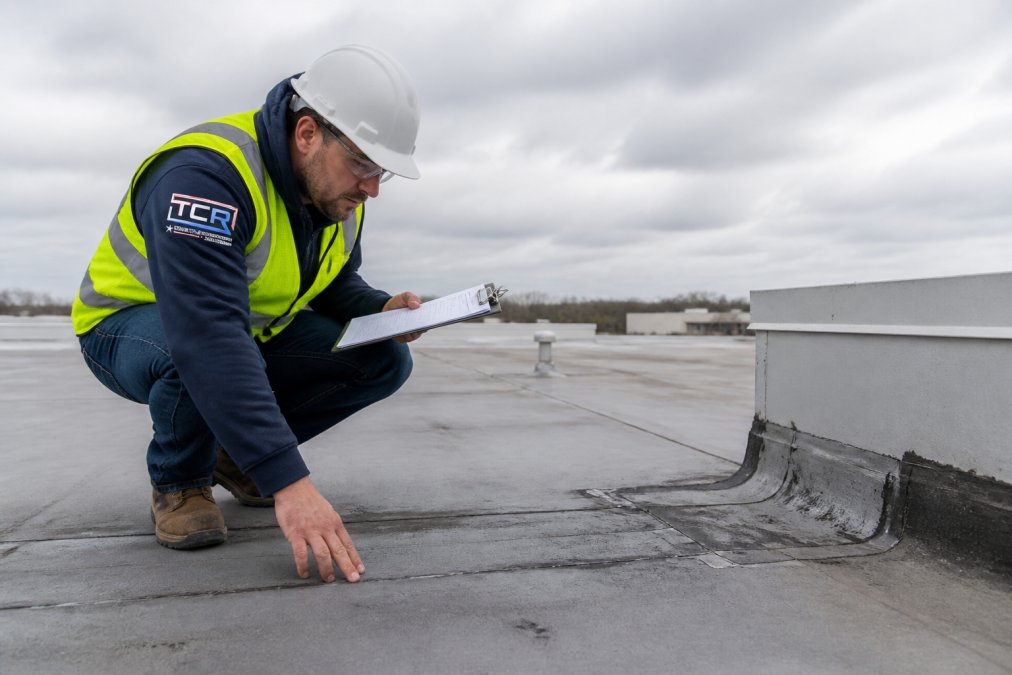
Professional roof inspections should occur at minimum twice annually (spring and fall), or quarterly for properties older than 10 years or in severe weather areas. Inspection frequency directly affects total cost of ownership.
Inspection Cost Structure in 2026
Inspection costs vary depending on size, complexity, and location.
Inspection costs are negligible compared to repair expenses prevented. An undetected leak penetrating insulation can lead to significant remediation costs. A flashing failure caught during inspection is typically less expensive to repair than one discovered after water entry.
ROI of Inspection Frequency
Facilities on regular inspection schedules often experience lower annual repair costs than those on annual or no-inspection schedules. Investing in regular inspections can help avoid emergency repairs, preventing significant reactive costs over time.
A qualified inspector documents roof condition index (membrane integrity, flashing, drainage), identifies deferred maintenance, and assesses structural integrity. This data becomes your asset management foundation for replacement vs. restoration decisions.
Frequency Impact on Capital Expenditure Planning
Quarterly inspections catch problems at stage one (straightforward, affordable fixes). Annual inspections often face stage-two issues requiring intensive intervention. No formal program means discovering problems only after water entry, when damage spreads to insulation and framing.
Quarterly inspections generate trend data showing whether degradation is slow or rapid, enabling you to schedule work during favorable seasons. Annual inspections provide less trend data and force decisions based on a single snapshot.
Schedule inspections after major weather events, not just on a calendar. Hail, high winds, and temperature swings create damage that worsens if left untreated for months. Catching it within days of occurrence keeps repair costs predictable and prevents secondary damage to insulation and structural systems.
Regional Variation in Inspection Costs and Frequency Needs
Climate and geography shift inspection costs and optimal frequency. Severe winter regions benefit from post-winter inspections; coastal areas need frequent flashing inspections; arid regions require frequent coating assessments. Upper Midwest facilities may justify quarterly inspections; stable climates optimize at semi-annual.
Preventative Maintenance vs. Reactive Repairs: The Cost Difference
Preventative maintenance involves scheduled interventions based on roof age and condition; reactive repairs occur after failure. The financial difference between these approaches shapes your entire maintenance budget.
Preventative programs include annual coating inspections, flashing repairs, drainage cleaning, and early-stage patching, all at predictable costs and convenient scheduling. Reactive approaches force emergency crews, overtime, and expedited delivery at premium rates.
Preventative service agreements lock in labor costs and prioritize scheduling, providing budget certainty. Reactive repairs force you to compete for contractor availability during peak demand, often paying rush fees.
Small repairs made early prevent large urgent repairs. A flashing issue costing a few hundred dollars during routine maintenance becomes a multi-thousand-dollar water damage claim if deferred. Insurance may not cover damage from deferred maintenance.
Metal Roof Restoration Cost and When to Choose It
Metal roofing systems last 30-50 years with proper maintenance. Metal roof restoration (cleaning, recoating, targeted repairs) extends service life without full replacement when the substrate remains structurally sound.
Restoration includes pressure washing, fastener/panel inspection, seam resealing, and new protective coating (silicone, acrylic, or polyurethane). Coating choice affects cost and performance, thermal reflectivity, water shedding, and climate durability vary by system.
Metal roof restoration makes sense when the substrate shows no rust perforation and fasteners remain secure. It’s unsuitable for severe corrosion, multiple failed seams, or buildings planning operational changes requiring different roof specifications.
Restoration can extend the lifespan of a sound metal roof at a fraction of replacement cost. The decision hinges on the structural integrity assessment; if the substrate is compromised, restoration becomes a temporary fix rather than a long-term investment.
Commercial Roof Maintenance Checklist for Facility Managers
Monthly: Check for interior water stains, pooling water/debris on roof, and HVAC/penetration damage.
Quarterly: Document membrane condition, assess flashing integrity, evaluate drainage, check sealant condition.
Annually: Perform detailed coating assessment, address minor damage, clean gutters/drainage, inspect fasteners and seams.
Every 5 years: Conduct infrared thermography for insulation moisture, assess restoration vs. replacement timing.
| Maintenance Task | Frequency | Priority Level | Typical Impact |
|---|---|---|---|
| Visual inspection | Monthly | High | Catches problems early |
| Professional assessment | Quarterly | High | Documents condition trends |
| Debris removal | Quarterly | Medium | Prevents drainage blockage |
| Sealant inspection | Semi-annually | Medium | Maintains water shedding |
| Coating evaluation | Annually | High | Extends service life |
| Structural assessment | Every 5 years | High | Guides replacement timing |
Documentation of regular inspections and timely repairs demonstrates responsible asset management, protecting insurance coverage, tenant relations, and property value.
Budgeting for Roof Replacement vs. Extended Service Life
The replacement vs. restoration decision hinges on structural integrity, cost comparison, and long-term facility plans. Sound substrates favor restoration; structural compromise requires replacement regardless of cost.
Service Life Extension by Material Type
Roof restoration extends service life 10-20 years depending on material and climate:
- Metal roofs: 15-20 years (restoration $2-$4/sq ft vs. replacement $8-$15/sq ft)
- TPO membranes: 5-10 years (restoration $1-$2/sq ft vs. replacement $5-$8/sq ft)
- EPDM rubber: 8-12 years (restoration $1.50-$3/sq ft vs. replacement $4-$7/sq ft)
- Built-up roofs: 5-8 years (restoration $1.50-$3/sq ft vs. replacement $6-$10/sq ft)
Cost Comparison Framework
For a 15,000-square-foot roof:
Metal roof (12 years old): Restoration $45,000 ($3,000/year) vs. replacement $165,000 ($5,500/year), saves $2,500/year.
TPO membrane (16 years old): Restoration $22,500 ($3,214/year) vs. replacement $97,500 ($4,875/year), saves $1,661/year.
Geographic Cost Variance in Replacement Budgeting
Replacement costs vary significantly by region due to labor rates, material availability, and climate-specific requirements:
- High-cost markets (California, New York, Massachusetts): Add 25-40% to base costs. A $6/sq ft TPO replacement becomes $7.50-$8.40/sq ft.
- Moderate-cost markets (Texas, Florida, Ohio, Illinois): Use baseline figures ($5-$8/sq ft for TPO).
- Lower-cost markets (rural Midwest, Southeast): Subtract 10-20% from base costs. TPO replacement may run $4.50-$6.50/sq ft.
- Snow-load regions (Minnesota, Colorado, upstate New York): Add structural reinforcement costs ($1-$2/sq ft) if existing framing cannot support snow load.
- High-wind zones (coastal areas, tornado corridors): Add wind-resistant fastening and membrane systems ($0.50-$1.50/sq ft premium).
Timing Replacement for Material Inflation
Material and labor costs can fluctuate. When deciding between restoration now and replacement in a few years, it’s important to factor in potential cost escalation. Restoration can buy time to spread capital expenditure across multiple budget cycles.
Conversely, if your roof is approaching end-of-life and restoration would only extend it 3-4 years, replacement now may be more economical than restoration followed by replacement shortly after.
Structural Assessment as the Decision Foundation
Many facility managers face pressure to choose replacement because it’s a known cost with a clear warranty. Restoration feels uncertain because it depends on the building’s actual condition. The solution is a detailed inspection that quantifies remaining service life and creates confidence in the restoration timeline.
- Membrane or coating integrity: Percentage of surface showing degradation, punctures, or loss of reflectivity.
- Substrate condition: Evidence of rot, rust perforation, or structural compromise.
- Fastener and seam integrity: Corrosion, separation, or fastener pull-through.
- Insulation moisture: Infrared thermography to detect wet insulation (common in older TPO and EPDM systems).
- Drainage performance: Evidence of ponding, blocked gutters, or inadequate slope.
Tax Implications and Depreciation of Roof Maintenance Investments
Roof maintenance and restoration have different tax treatment than replacement, and understanding this distinction affects your financial planning. Routine maintenance is generally deductible as an operating expense in the year incurred. Restoration work that extends service life may be capitalized and depreciated over the asset’s remaining useful life.
Misclassifying a capital improvement as a repair can trigger IRS challenges and penalties. Document the scope of work carefully and discuss tax treatment with your accounting team before the project begins, not after.
Conclusion
Commercial roof maintenance costs in 2026 reflect material inflation, labor market realities, and the complexity of modern building envelope systems. Preventative approaches consistently cost less than reactive repairs, yet many facility managers still defer maintenance to reduce short-term budgets. That approach creates false savings that evaporate the moment a roof fails.
Frequently Asked Questions
How much does a yearly roof maintenance inspection cost for a commercial roof?
Inspection costs vary based on roof size, complexity, and accessibility. Smaller roofs under 10,000 square feet typically cost less than larger industrial facilities. Regular inspections catch minor issues early, preventing expensive emergency repairs. Many facility managers budget for at least one comprehensive inspection annually, with additional inspections after severe weather events. Contact Total Cladding and Roofing LLC for a quote tailored to your specific roof size and condition.
Does preventative maintenance extend the life of a commercial roof?
Yes. Regular preventative maintenance addressing minor repairs, drainage cleaning, and coating reapplication can extend roof lifespan compared to reactive repair approaches. By addressing flashing leaks, membrane damage, and debris buildup before they worsen, facility managers avoid structural deterioration. This approach reduces capital expenditure pressure in the short term and protects building asset value long-term.
What is included in a commercial roof maintenance plan?
A comprehensive maintenance plan typically includes scheduled inspections, debris removal from drainage systems, flashing repairs, minor leak detection and patching, membrane or coating reapplication, and documentation of roof condition. Service agreements often specify inspection frequency, emergency response protocols, and warranty coverage. The specific inclusions depend on your roof material, metal roofing systems, TPO membranes, and built-up roofing each have different maintenance requirements.
When should you choose roof restoration over full replacement?
Roof restoration makes financial sense when your roof is structurally sound but showing wear, typically in years 15-20 of its lifespan. If inspections reveal the underlying structure is intact and leak issues are addressable through coating systems or targeted repairs, restoration extends service life at a fraction of replacement cost. However, if structural damage is extensive or the roof is near end-of-life, replacement becomes the better investment. A detailed roof condition assessment determines which path is right for your facility.
To upload drawings, specs and plans please go to the form on our contact page.
Get in Touch