Commercial Metal Roof Restoration in Texas

Repairs, corrosion treatment, fastener and seam work and a protective coating for existing metal roofs that are sound enough to keep.

Metal roof restoration

Can your metal roof be restored?

Metal roof restoration keeps a commercial metal roof in service by repairing what has failed and protecting what is still sound. The work replaces failed fasteners, seals laps and seams, treats corrosion, repairs flashings and penetrations, and finishes with a coating system made for metal roofs. Total Cladding and Roofing restores R-panel, PBR, corrugated and standing seam roofs on warehouses, workshops, factories and other existing commercial buildings in Texas.

Restoration only makes sense when most of the roof is worth keeping. If the panels have rusted through across large areas, the purlins are corroding or the insulation below is wet, a coating will not fix it, and a new roof over the old one or a replacement is the better route. The first job is to find out which situation your roof is in.

Request a roof review or call (210) 775-0995.

The Technical Library holds the data sheets for products used in this work, including Geocel 4350 Hybrid Metal Roofing and Siding Construction Sealant, Pipe Flashing (Gibraltar Building Products), MarcoFlex Weather-Tite Gunnable Butyl, 35 Year Master Flash, NovaFlex Pro Premium Adhesive Sealant (Novagard Solutions) and Titebond WeatherMaster Metal Roof Sealant.
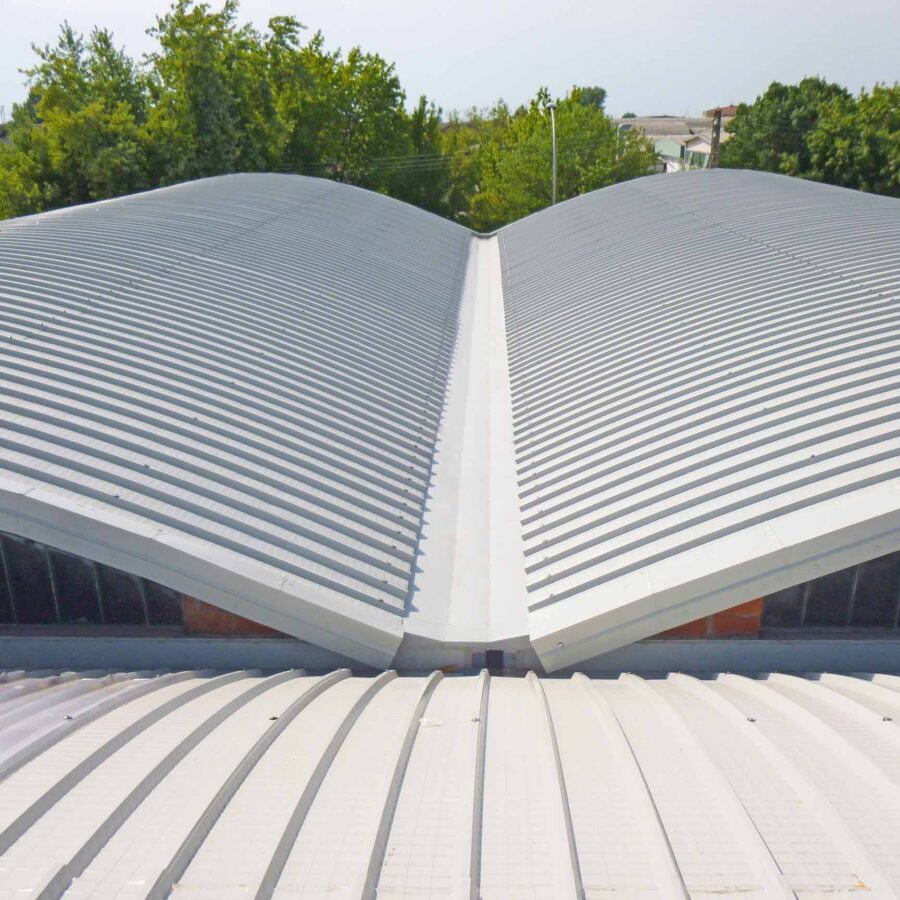

Metal roofing with ridge flashings and skylight panels

When a metal roof can be restored

A roof is usually a good restoration candidate when its problems are at the connections and the surface rather than in the metal itself:

  • leaks at screws, laps, ridge caps, flashings and penetrations;
  • fastener washers that have hardened, cracked or pulled away from the panel;
  • surface rust, chalking or a worn paint finish on panels that are still full thickness;
  • rust at cut edges, end laps and gutters that has not eaten through the sheet;
  • failed sealant and old patches that keep reopening.

It is usually not a candidate when corrosion has holed the panels across large areas, when purlins or clips have lost strength, when the insulation is saturated, or when hail has creased and split panels across most of the roof. Age on its own does not decide it. A 30-year-old roof in good order can often be restored, while a younger roof with widespread hidden damage may not be worth the cost.

How far the rust has gone

Most restoration decisions come down to corrosion, and it is easier to judge in stages.

Cut edges and end laps rust first, because the cut steel has no protective coating and water sits in the overlap. Cut-edge corrosion repair deals with these areas before the rest of the roof is coated.

Surface rust and chalking:

the metal is intact. It is cleaned, treated and primed as part of the coating system.

Scaling and pitting:

loose rust is removed back to sound metal and treated with a rust-inhibiting primer. Badly pitted spots may need a patch or a replacement panel.

Holes:

holes mean lost metal. Small areas can be patched or the panel replaced. Widespread holing usually rules restoration out.

What metal roof restoration includes

A restoration proposal should list each of these as separate work, with quantities, so you can see what is being repaired and what is only being coated.

Fasteners

Exposed-fastener roofs depend on thousands of screws and their sealing washers. Loose, stripped or rusted screws are replaced, using a larger screw where the hole has worn oversize, and the rest are checked and sealed as the coating system requires.

Laps and seams

Side laps and end laps are cleaned and sealed, usually with a reinforcing fabric or tape set into the base coat so the joint can move with the roof as it heats and cools.

Flashings and penetrations

Ridge caps, eave and rake trims, equipment curbs, pipe boots and wall junctions are repaired or replaced, so water has no route under the new surface.

Coating system

The roof is cleaned, primed where the system calls for it, and coated to the thickness the manufacturer sets for that system and its warranty.

Choosing a coating system for a metal roof

Coating manufacturers publish complete restoration systems for metal roofs, covering cleaning, primer, seam treatment and topcoat. The main types are:

The Technical Library holds metal roof systems and data sheets from manufacturers including Metacrylics and American WeatherStar. For a closer comparison, see metal roof coatings and acrylic or silicone coatings.

Light-colored coatings reflect much of the sun’s heat, which matters on a Texas metal roof in summer. Reflectance and emittance figures for many roof coatings are published through the Cool Roof Rating Council, so products can be compared on the same basis.

Acrylic:

water-based, reflective and straightforward to recoat later. It suits sloped metal roofs that drain well.

Silicone:

holds up well to sun and standing water and keeps its reflectivity, but later recoating is normally limited to silicone.

Polyurethane and hybrid systems:

tougher against foot traffic and impact, often used at seams or as a base coat under a reflective topcoat.

Tests before the coating goes on

Two checks decide whether a coating will last on a particular roof:

  • Adhesion: a test patch of the proposed system shows whether it bonds to the existing panels and any old coating. Loose or incompatible old coating has to come off first.
  • Moisture: where leaks have run for years, the insulation and liner below can be wet. Coating over wet materials traps the moisture, so suspect areas are opened up and checked before the scope is fixed.

Some conditions only show once work starts. The proposal should say what has been checked, what has not, and how anything found during the work will be priced.

Restoration, a new roof over the old, or replacement?

The fair way to choose is to price the options against the same survey of the same roof. A restoration that needs a large share of the panels replaced can cost more than it first appears, and a replacement that solves problems the building does not have is money spent for nothing.

Restoration

keeps the existing panels. It is usually the least disruptive and lowest-cost route when the metal and supports are sound.

A roof over the existing roof

adds new framing and a new metal roof above the old one, fixed through to the original purlins. It suits roofs too far gone to restore on buildings that cannot easily have the roof opened. See metal roof retrofit and overlays.

Replacement

takes the old roof off. It is the route when the purlins, insulation or liner need to be reached and repaired. See metal roof replacement.

What restoration costs depend on

The price comes from the roof area and height, the number of fasteners to replace, the amount of corrosion treatment and panel replacement, seam and flashing work, removal of failed old coating, the coating system and its thickness, skylights and gutters, and how the roof is reached.

When comparing quotations, check that each one states the preparation, repairs, coating system, thickness and exclusions. A low price per square foot that leaves out fastener replacement or corrosion treatment is not comparable with one that includes them.

How long a restored roof lasts

There is no single figure that applies to every restored roof. The condition of the retained metal, the quality of the repairs, the coating system, its thickness, exposure and maintenance all affect it. Coating manufacturers commonly tie the length of a system warranty to the thickness applied and to an inspection of the finished work, so read the warranty offered for a specific system for what it covers and for how long.

A restored roof that is looked after can usually be cleaned and recoated when the coating wears, which is part of the case for restoring a sound roof rather than replacing it.

Skylights, gutters and rooftop equipment

Translucent skylight panels are not coated. Aged or cracked panels are replaced to match the roof profile before the coating goes on; see skylight repair and replacement. Gutters often need the same corrosion and joint work as the roof, or a lining; see gutter repair and lining. Equipment curbs are reflashed, and any planned HVAC changes should be known before the roof is coated so new openings are not cut through finished work.

Working over an occupied building

Restoration is carried out from the roof surface, so the building can usually stay in use. Cleaning water, primer odors and overspray still need managing near air intakes, vehicles and neighboring buildings, and work is phased around loading areas and sensitive operations. We agree work areas, access and protection with your site contact before work starts.

Talk to our team

Request a metal roof restoration review

Contact TCR with the property address, the problems you are seeing, and any previous repair records or photos. We will discuss an inspection and tell you whether restoration, a new roof over the old one or replacement fits the building.

Request a Roof Review

Frequently asked questions

Metal Roof Restoration FAQs

How is restoration different from a repair?

Repair addresses a defined defect. Restoration combines broader repairs and suitable protective treatment across an existing roof that can remain in service.

How is restoration different from coating alone?

Restoration includes the defects being corrected before treatment. A coating price may cover less preparation or repair work, so compare the actual inclusions.

Can a rusty metal roof be restored?

Surface corrosion may be treatable. Deep pitting, holes and weakened connections can require replacement metal or a wider replacement project.

Can restoration fix wet insulation?

A surface treatment does not remove trapped moisture. Wet materials and their cause need assessment and correction within the agreed work.

What happens to failing fasteners and seams?

They need compatible repairs. Applying a thicker coating over a connection that no longer holds will not restore that connection.

Will all previous coating stay in place?

Only material suitable for the new system can remain. Loose, poorly bonded or incompatible finishes may need removal.

Can the building remain occupied?

Often, when most roofing can stay in place. Access, local opening and protection below still depend on the repairs and building use.

Is restoration always cheaper than replacement?

No. Extensive preparation and repairs can change the comparison. Price both options against the actual condition and required work.

How much longer will a restored roof last?

Performance depends on retained condition, repair work, treatment and maintenance. There is no universal extra lifespan for a restored roof.

What is the first step?

Send the address and describe the roof problems. A condition review can establish whether restoration is worth developing into a proposal.

UK refurbishment experience, a Texas office

Refurbishment specialists

Our business grew through roof and cladding refurbishment in the UK. That experience shapes the work we now offer from our Texas office.

Repair what can be retained

We investigate the roof problem and explain what can be repaired, restored or replaced, so you can decide how to invest in the building.

Roofing and cladding together

We can coordinate roof, insulation, wall panel and drainage work, including the connections where separate repairs can leave problems behind.

A plan for your working building

We agree access, work areas and protection with your site team, including any restrictions needed while the roof is opened.

Roofing and cladding systems

Roofing systems and materials for Texas facilities

Rustoleum Logo
Sika Logo
Kingspan Logo
Morin Logo
American WeatherStar Logo
GAF Logo
TAMKO Logo
PAC-CLAD Logo
1

Tell us about the building

Start with the address and the roof or cladding problem. Photographs are helpful if you already have them.

2

Arrange a site visit

We review the affected areas and discuss how you use the building and what you want the work to achieve.

3

Review the quotation

Your quotation explains the proposed repairs or refurbishment, the areas included and the price.

4

Agree the work plan

We discuss timing, access, deliveries and protection with your site contact before work begins.

5

Complete the work

We carry out the agreed work and discuss any changes needed if opening the roof reveals additional damage.

6

Handover

We review the completed work and provide the care information and documents included in your project.