Last Updated: October 28, 2026
Quick Summary
Drone roof inspections give commercial owners a faster, safer way to survey an entire roof from the air. The camera captures defects, drainage problems and damage without crews walking fragile surfaces, and the footage creates a record that can be compared over time. Hands-on work is still needed where physical testing is required.
- Drones survey a large commercial roof in a single flight, covering ponding water, seams, flashing and coping.
- Fewer workers on the roof reduces fall risk and avoids foot traffic damage to coatings and seams.
- Thermal imaging can reveal trapped moisture, but thermal findings need confirmation by moisture testing or a physical check.
- Use a drone for the broad condition survey and a traditional inspection for areas the camera cannot confirm.
- Ask providers for raw images and log GPS locations so each defect can be tracked against future surveys.
Table of Contents
Drone roof inspections give commercial property owners a faster, safer way to see what is happening on a roof. For a business with a large flat or metal roof, the old method meant sending a crew up a ladder, walking the membrane and taking notes that were hard to check later. Total Cladding and Roofing LLC provides roofing and external cladding services for commercial and industrial properties across Texas.
A drone roof inspection is an aerial survey in which a camera-equipped unmanned aircraft photographs and records a roof surface so that defects, drainage problems and damage can be reviewed on the ground. The footage is then compared against the building’s history and handed to the people making maintenance decisions. Owners usually come to this method for three reasons: they want to see the whole roof at once, they want a record they can revisit, and they want to avoid unnecessary foot traffic on fragile surfaces.
Commercial owners are also looking at the hazard side. Falls from roofs remain one of the most serious risks in construction and maintenance work, and the OSHA fall protection guidance for construction makes clear that employers must control those risks. Sending fewer people onto a roof for routine inspections is one practical way to reduce exposure, which is why many facility managers now treat drones as a first-pass tool.
Here is where the switch gets interesting. The main argument is not that drones replace all human inspection. It is that they change the sequence: survey from the air first, then send a specialist crew only to the spots that need hands-on testing. That approach tends to produce a clearer scope of work and fewer surprises once the job starts.
Safety Gains: Keeping Crews Off Steep and Fragile Roof Surfaces
Fewer people on the roof means fewer chances for a fall or a damaged membrane. A drone can cover a large commercial roof in a single flight, capturing images of ponding water, seam separation, failed flashing and damaged coping without a worker stepping onto the surface. For steep metal roofs and aged membranes, that difference matters.
Walking a fragile roof can also cause damage of its own. Foot traffic can crack coatings and open seams, which means an inspection can create the very defects it is meant to find. An aerial survey avoids that problem for the first look.
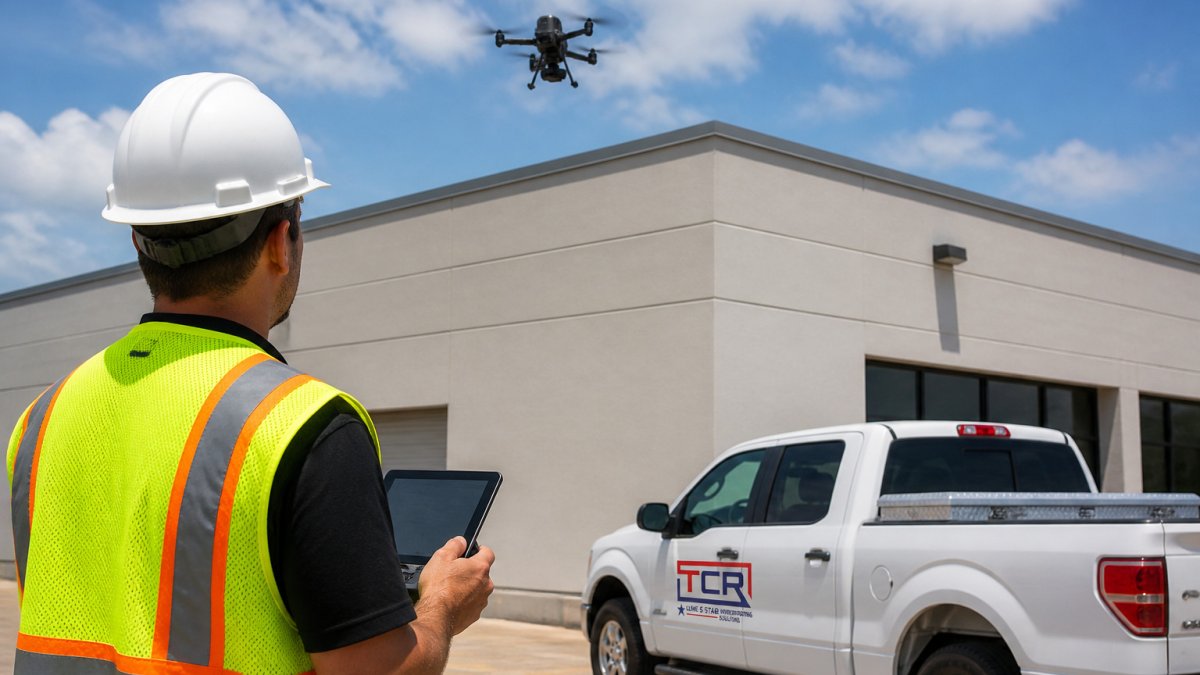
Drones do not remove the need for rope access, harnesses or trained crews where hands-on work is required. For San Antonio facilities, a commercial roof coating assessment and repair service can handle that hands-on work once the survey has identified the areas that need it. They shrink the number of trips onto the roof to the ones that actually add information.
Drone Roof Inspection Cost: What Businesses Should Budget
For current prices or a quote for your facility, contact Total Cladding and Roofing LLC through our website.
Budgeting well means comparing the survey cost against what it prevents. A survey that finds a failing seam early can cost far less than the interior water damage that follows a late-discovered leak. Ask any provider how the survey data will be stored and reviewed, because a survey you cannot compare against the next one loses much of its value.
Drone Roof Inspection vs Traditional Inspection: Where Each Method Wins
Drones win on coverage, speed and safety for the first assessment. A traditional inspection, where a technician walks the roof and tests materials by hand, still wins when the job requires physical testing, core samples, moisture probing or close examination of penetrations and roof-to-wall details. You can review what a full commercial roof inspection service covers, including leaks, hail and wind damage and the final report. The two methods answer different questions.
A practical rule is to use a drone for the broad condition survey and reserve a traditional inspection for the places the camera cannot confirm. Many owners find this combination gives them both a complete picture and a defensible scope of work.
Roof Inspection with Thermal Imaging: Finding Hidden Moisture
Thermal imaging picks up temperature differences that can point to trapped moisture beneath a membrane, where the surface looks sound but the insulation is wet. Surface-only inspections often miss these areas. The U.S. Department of Energy guidance on roofing and moisture explains why moisture in roof assemblies reduces insulating performance, which is the basis for why owners care about thermal findings.
Thermal results are not a standalone verdict. A warm or cool patch needs confirmation by moisture testing or a physical check before anyone commits to a repair, and a good report will say which findings are confirmed and which are only suspected.
Building a Commercial Roof Inspection Checklist for Drone Surveys
A useful checklist covers the roof itself, its drainage, its edges and its penetrations. Use it to judge whether a provider’s survey is complete and to make sure your next survey can be compared with the last one. A complete commercial roof inspection checklist from the National Roofing Contractors Association is a good starting reference. You can also compare it against a complete commercial roof inspection checklist to check your drone survey plan.
- Confirm the flight date, weather conditions and roof areas covered
- Record ponding water, drainage path and blocked drains
- Check seams, laps and membrane condition across the field
- Inspect flashing, parapets, coping and roof edges
- Review penetrations, HVAC curbs, skylights and rooftop equipment
- Note any signs of blistering, cracking, granule loss or coating failure
- Log the GPS location and image reference for every defect
- Compare findings against the previous survey and any repair history
- Agree on which items need a hands-on follow-up inspection
Keep the checklist and the survey report together in your property file. Consistent records are what let you track whether a defect is getting worse.
Limitations and How to Plan Your Next Roof Survey
Drone surveys have real limits. Weather such as high wind, rain or low visibility can stop a flight. Images cannot show what is under the membrane without additional testing, and some low-slope details are hidden from above. Flight operations also require the pilot to follow the relevant FAA rules for small unmanned aircraft and to respect site restrictions near occupied areas.
To plan your next survey, start by listing the roof areas you are most concerned about, then ask the provider which of those can be confirmed from the air and which need hands-on work. Book the survey after any recent storm so the report reflects current conditions, and ask for the raw images as well as the summary. If you manage several facilities, a standard checklist applied to each site will make the results easier to compare across the portfolio.
Get in touch through our website for a quote.
Frequently Asked Questions
What are the benefits of drone roof inspections for businesses?
Drone roof inspections let businesses assess large commercial roofs faster, with fewer people working at height and less disruption to daily operations. Drones capture high-resolution imagery and video that can be reviewed later, creating a visual record for maintenance planning and insurance documentation. Owners also get a clearer view of areas that are hard to reach, such as parapets, rooftop units and drainage points, which supports earlier detection of leaks and wear.
How much does a drone roof inspection cost?
For current pricing tailored to your property, contact Total Cladding and Roofing LLC through our website for a quote based on your specific site and requirements.
Are drone roof inspections safer than traditional inspections?
In many cases, yes. Drones reduce the need for technicians to walk steep, fragile or wet roof surfaces, which lowers the risk of slips and falls. Traditional inspections still matter, however, for close-up verification of problem areas and for confirming findings that a drone cannot fully assess. Many businesses use both methods together.

To upload drawings, specs and plans please go to the form on our contact page.
Get in Touch