

Last Updated: October 27, 2026
Quick Summary
Essential safety protocols for commercial roof access define who may go on the roof, how they reach it, what fall protection they use, and how a rescue would happen. Under OSHA, fall protection is required at edges 6 feet or more above a lower level in construction and 4 feet in general industry. A written, trained, and regularly reviewed protocol keeps access repeatable across crews and contractors.
- OSHA requires fall protection at 4 feet in general industry and 6 feet in construction work.
- Warning lines on low-slope roofs must be erected at least 15 feet from the edge.
- Access should require logged approval naming the purpose, route, controls, and everyone entering.
- Contractors should provide a site-specific fall-protection plan, training proof, and equipment inspection records.
- Rescue planning must state who rescues, what equipment is staged, and how the rescue is triggered.
Table of Contents
- OSHA Rooftop Fall Protection Requirements You Must Meet
- Identifying Rooftop Fall Hazards and Assessing Risk
- Safe Access Points: Ladders, Hatches and Crossover Ramps
- Fall Protection, Guardrails and Anchorage Systems
- Commercial Roof Access Safety Checklist and Step-by-Step Procedure
- Access Authorization, Contractor Control and Emergency Rescue Planning
- Booking a Roof Access Safety Review for Your Texas Facilities
- Frequently Asked Questions
Essential safety protocols for commercial roof access matter even on simple visits. A technician climbs a ladder, steps onto the membrane, and the edge is closer than expected.
A written protocol defines who may go on the roof, how they get there, what they must wear, what they check before stepping onto the surface, and what happens if something goes wrong.
Essential safety protocols for commercial roof access also create a record.
Watch out: a protocol that exists only on paper fails the same way no protocol does.
OSHA Rooftop Fall Protection Requirements You Must Meet
Fall protection on commercial roofs is governed by the Occupational Safety and Health Administration, and the standard that applies depends on the work being done. A facilities crew changing filters on an HVAC unit and a contractor replacing membrane are often covered by different rules on the same roof, so the protocol should name which standard governs each task OSHA Fall Protection standards for general industry and construction.
The thresholds are the part most summaries leave vague. Under the general industry walking-working surfaces standard (1910.28), employers must provide fall protection when workers are exposed to unprotected sides or edges 4 feet or more above a lower level.
OSHA also assigns duties by role, and the protocol should reflect them:
- Employers must assess the workplace, select and provide the fall protection system, train workers, and enforce use.
- Supervisors verify that controls are in place before access and that workers are trained on the specific system in use.
- Workers must inspect equipment before use, use it as trained, and report defects.
Conventional fall protection is not the only option.
Training is a separate requirement, not an afterthought. Workers exposed to fall hazards must be trained to recognize them and to use the systems correctly, and retraining is required when workplace conditions or equipment change.
OSHA updates standards and letters of interpretation periodically. Confirm the current text of 1910.28, 1910.29, 1926.501 and 1926.502 before finalizing your protocol, and check whether your state operates its own OSHA-approved plan with different requirements.
Identifying Rooftop Fall Hazards and Assessing Risk
Before anyone steps onto a roof, identify the hazards on it. Look for unprotected edges, skylights, roof hatches, penetrations, fragile panels, ponded water and surfaces that are slick from weather or debris. Each of these changes how a person should move across the roof.
A practical assessment asks four questions: where can someone fall, what would they fall onto, how would they reach the work area, and what conditions could change while they are up there. Heat, wind, hail damage and recent rain all affect footing and equipment stability, which is why a pre-access check matters even on routine visits.
Document the assessment in the access record. A short list of identified hazards, the controls chosen for each, and the person who approved them gives a clear starting point for the next visit.
Safe Access Points: Ladders, Hatches and Crossover Ramps
The access point is where many incidents begin. Choose the route that puts workers on the roof with the most stable footing and the fewest exposed edges.
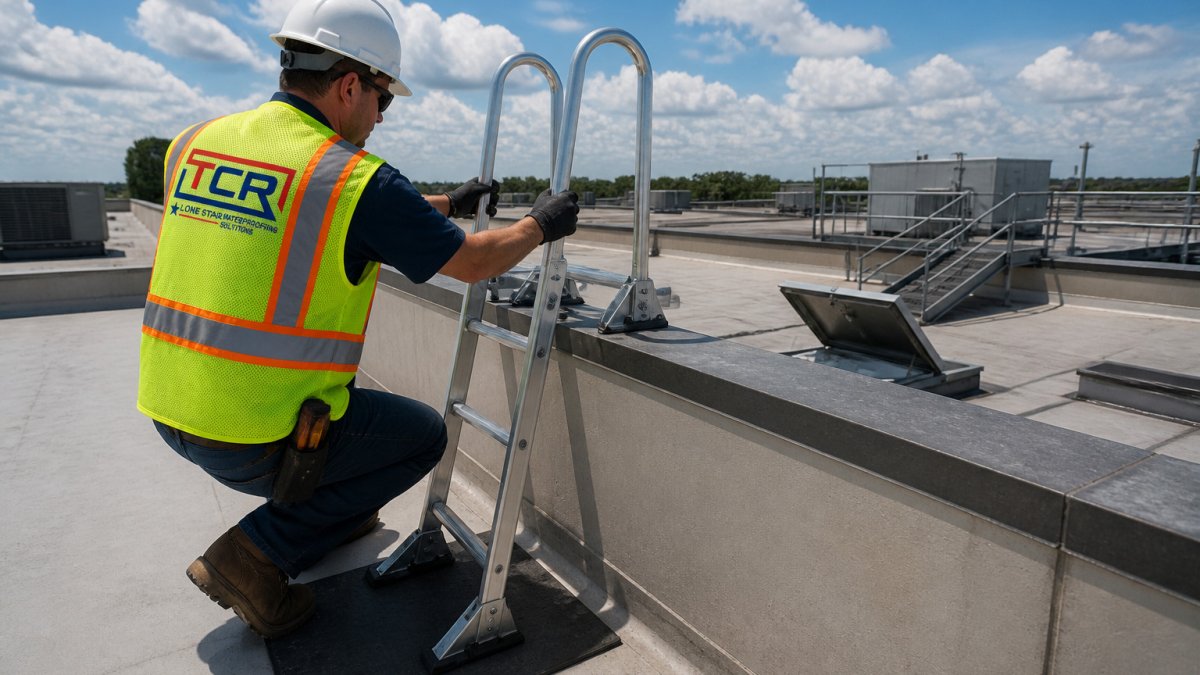
Roof hatches need guardrails or a cover when open, and the opening must be clearly marked. Ramps should be secured at both ends and kept free of debris. Any access point that a crew has to improvise should be treated as an unapproved route.
Setting Up Portable and Fixed Ladders
Ladders are a common access method and a common source of falls at the transition onto the roof. Set a portable ladder on firm, level ground, secure its top to a stable surface, and extend it so it rises a few feet above the landing point, so workers have something to hold while stepping across.
Assign one person to watch the base of the ladder during climbing and descent. Do not carry tools up in hand, and do not climb while another worker is standing on the rungs.
Fall Protection, Guardrails and Anchorage Systems
Where a roof edge cannot be guarded, fall protection must be in place. Guardrail systems provide passive protection and are preferred where they can be installed.
An anchorage point must be rated for the load it will carry and attached to structure that can support it.
Many providers use a combination of these methods depending on the roof layout, and other providers may approach the choice differently, so the protocol should state which system applies to which roof.
Commercial Roof Access Safety Checklist and Step-by-Step Procedure
A checklist turns the protocol into something a crew can use on site. The steps below are a working model you can adapt to your facilities.
- Confirm the work order, the approved access route and who is responsible for the visit.
- Check weather and surface conditions, including wind, heat, rain, ice and recent storm damage.
- Inspect the access point, ladder or ramp and confirm it is secured.
- Verify guardrails, covers or fall protection for every exposed edge and opening.
- Inspect harnesses, lanyards and anchors before use, and confirm they are rated for the load.
- Brief the crew on hazards, the route, the work area and the emergency plan.
- Keep tools and materials tethered or staged away from edges.
- Record the work performed, any defects found and the time the crew left the roof.
Document each completed checklist with the date, crew names and any corrective actions.
Watch out: a checklist completed after the work instead of before it does not prevent anything. The pre-access items must be confirmed before anyone climbs.
The steps below give a working model that crews can adapt to each facility.
| Step | What to do | Timing |
|---|---|---|
| 1. Confirm work order | Confirm the approved access route and responsible person | Before access |
| 2. Check conditions | Check wind, heat, rain, ice and storm damage | Before access |
| 3. Inspect access point | Inspect the ladder or ramp and confirm it is secured | Before each climb |
| 4. Verify edge protection | Confirm guardrails, covers or fall protection for every exposed edge | Before access |
| 5. Inspect equipment | Inspect harnesses, lanyards and anchors; confirm load rating | Before use |
| 6. Brief the crew | Cover hazards, route, work area and emergency plan | Before access |
| 7. Secure materials | Tether or stage tools and materials away from edges | During work |
| 8. Record the visit | Log work done, defects found and time the crew left the roof | After work |
Access Authorization, Contractor Control and Emergency Rescue Planning
Most roof-access protocols stop at prevention. This section covers the two things that decide whether a bad day becomes a catastrophe: who is allowed on the roof, and what happens in the minutes after a fall.
Who May Access the Roof
Access should be a permission, not a habit. The protocol should name the authorizing role, typically the facility manager or a designated safety coordinator, and require a written or logged approval before anyone climbs.
Visitors, inspectors, and vendors should be escorted unless they hold their own documented fall-protection program. Building owners remain responsible for coordinating multiple employers under OSHA’s multi-employer citation policy, so the protocol should state who controls the roof and who verifies controls before each contractor’s crew goes up.
Contractor and Subcontractor Controls
Before a contractor is approved for roof access, collect and verify:
- A written site-specific fall-protection plan naming the systems and anchor points they will use.
- Proof of fall-protection training for each worker who will be on the roof.
- Certificates of insurance that meet the building owner’s requirements.
- Equipment inspection records for harnesses, lanyards, anchors, and lifelines.
- A rescue plan that covers their own workers, not just the building’s.
Our contractor portal terms set out the requirements subcontractors and crews must meet before work is approved. Facility managers can apply the same principle internally: no approval, no access, and no exceptions for familiar contractors.
Emergency Rescue Planning
A worker suspended in a fall arrest harness after a fall is in a medical emergency even if uninjured. Suspension trauma, also called orthostatic intolerance, can cause loss of consciousness within minutes as blood pools in the legs, and the risk rises the longer the worker hangs.
The rescue plan should answer five questions in writing:
- Who performs the rescue? Trained on-site rescuers, a contracted rescue service, or the local fire department, and the plan should confirm the chosen provider can actually reach the roof and the anchor point.
- What equipment is staged? Rescue ladders, controlled descent devices, retrieval lines, and a strap or step to relieve suspension pressure should be on site before the first access, not ordered after an incident.
- How is the rescue triggered? A clear communication path, radio, phone, or pull station, with a named contact and a backup.
- How is the fallen worker reached? The plan should identify the anchor point, the descent path, and any obstructions such as parapets, HVAC units, or skylights.
- What happens after rescue? The worker should be evaluated by medical personnel, the scene preserved, and the incident reported under the employer’s incident-reporting obligations.
Self-rescue should be considered only where the equipment and training support it. A worker who is unconscious or injured cannot self-rescue, which is why a assisted-rescue capability is the baseline.
Prevention keeps workers off the edge; rescue planning keeps a fall from becoming a fatality. Both belong in the same written protocol, reviewed on the same schedule, and drilled at least annually.
Document the rescue plan, the drill records, and the equipment inspection log with the rest of the access records. When an insurer, inspector, or new contractor asks how the roof is managed, that file is the answer.
Booking a Roof Access Safety Review for Your Texas Facilities
A written protocol works best when it is built around the actual roofs it governs.
Frequently Asked Questions
What are the OSHA requirements for commercial roof access?
Property owners should confirm which requirements apply to their own crews and to contractors working on the roof.
What safety equipment is required for roof access?
The required equipment depends on the work and the roof edge.
How often should commercial roof access points be inspected?
Access points should be inspected before each planned use, with a formal documented inspection at least once a year and after severe weather such as hail or high winds. Check hatch hinges and locks, ladder rungs and side rails, fastenings, guardrail posts and anchor points for corrosion, loose fittings and damage. Record each inspection with the date, inspector name, findings and corrective actions, so the property team can show a consistent maintenance history.
Who is responsible for rooftop fall protection on commercial properties?
Responsibility is shared. The property owner or manager typically controls the building, so they are responsible for providing safe permanent access and maintaining guardrails and anchor points. Employers, including roofing and maintenance contractors, are responsible for their own workers’ fall protection, training and equipment. Contracts should state who supplies and inspects the access systems, who authorizes roof entry, and who responds in an emergency.
What are the best practices for ladder safety on commercial roofs?
Choose a ladder rated for the load and long enough to extend at least three feet above the roof edge. Set portable ladders on a firm, level base at the correct angle, tie or secure them at the top, and never place them on unstable surfaces. Only one person should climb at a time, with three points of contact maintained. Fixed ladders should have cages or fall protection where required, and any damaged ladder should be tagged out of service.
Does a commercial roof access safety checklist need to be written down?
A written checklist is strongly recommended, because it gives crews a repeatable routine and gives owners evidence of due diligence. A practical checklist covers pre-entry authorization, weather conditions, access point and ladder inspection, fall protection setup, roof hazard review, communication plans and sign-out. Keep completed checklists with maintenance records so each visit can be traced.

To upload drawings, specs and plans please go to the form on our contact page.
Get in Touch