Table of Contents
- Why Extending Industrial Roof Service Life Matters
- Step 1: Establish an Industrial Roof Inspection Frequency Schedule
- Step 2: Implement a Commercial Roof Preventative Maintenance Checklist
- Step 3: Apply Industrial Roof Coating Benefits Through Strategic Restoration
- Step 4: Address Common Causes of Commercial Roof Damage Before They Escalate
- Step 5: Know When Roof Restoration Outperforms Full Replacement
- Frequently Asked Questions
Last Updated: September 23, 2026
Why Extending Industrial Roof Service Life Matters
Premature roof failure disrupts operations, damages inventory, and forces costly emergency repairs. Most industrial roofs fail not from defective materials, but from deferred maintenance. Extending industrial roof service life through proactive care transforms a liability into a managed asset.
Extending industrial roof service life protects structural integrity, maintains energy efficiency, and creates predictable capital planning. Well-maintained roofs deliver lower utility bills, fewer shutdowns, and higher asset values.
The five-step process below shows how to extend industrial roof service life systematically, the concrete actions that separate 15-year roofs from 30-year roofs.
Step 1: Establish an Industrial Roof Inspection Frequency Schedule
Extending industrial roof service life starts with knowing what you have. Most facility managers inspect reactively, only when leaks appear. A scheduled program catches problems early, when they’re fixable.
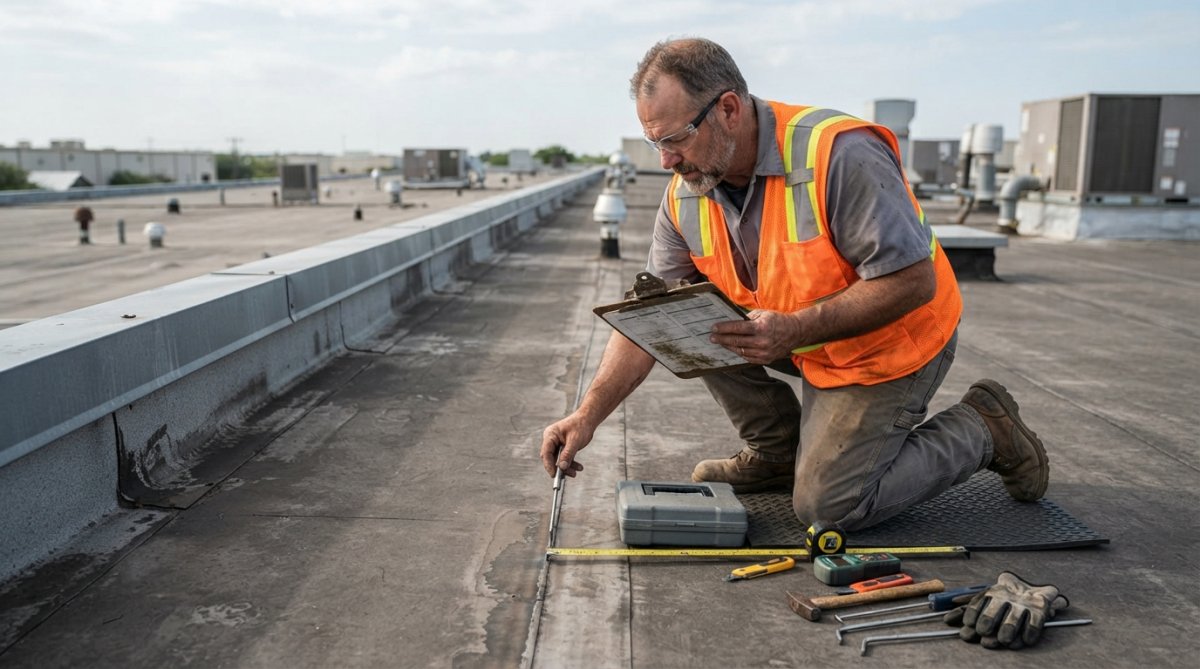
Establish a baseline inspection frequency based on your roof’s age and material type. Newer roofs in good condition need inspections twice yearly (spring and fall). Roofs over 10 years old should be inspected quarterly. Roofs showing visible wear need monthly checks until repairs are completed.
What to Look for During Inspections
During each inspection, document specific conditions that indicate deterioration. Look for:
- Membrane seams that are separating or showing cracks
- Ponding water that collects in low spots (a sign of poor drainage)
- Flashing around penetrations, edges, and transitions that’s lifting or corroded
- Surface blistering, crazing, or chalking on the membrane
- Debris accumulation that blocks drainage systems
- Rust or corrosion on metal components
- Areas where UV exposure has visibly degraded the coating
A structured inspection protocol prevents missing problems that only appear under specific lighting or weather conditions.
Documentation and Records
Track each inspection date, findings, and actions in a spreadsheet with photographs. Over time, this record shows whether damage is worsening, stable, or improving.
Document drainage system condition separately, drainage issues are a leading cause of premature failure. Note whether gutters are clear, downspouts function, and water flows away from the building.
Step 2: Implement a Commercial Roof Preventative Maintenance Checklist
Preventative maintenance is the difference between a 15-year roof and a 25-year roof. A structured checklist ensures nothing gets overlooked.
Your checklist should cover seasonal and monthly tasks. Assign responsibility to a specific team member or contractor and track completion dates to prevent postponement.
Monthly and Seasonal Tasks
Monthly tasks take 30 minutes to 2 hours and require no special equipment:
- Clear debris from roof surface, gutters, and downspouts
- Check for new cracks, seams separating, or membrane damage
- Inspect flashing around vents, skylights, and penetrations
- Look for ponding water after rain or snow melt
- Verify that roof drains are flowing freely
Climate-Specific Maintenance Schedule
Local weather patterns create unique maintenance demands that generic checklists miss.
Pre-Hurricane Season (May-August): Inspect all roof penetrations, flashing, and seams. Verify fasteners are tight, seams sealed, and flashing secure. Test drains with a hose to verify capacity. Clear gutters and downspouts completely. Document roof condition for insurance purposes.
Post-Summer Heat Cycle (September-October): Inspect for thermal stress damage from heat expansion and cooling contraction. Look for new cracks, blistering, or separated seams. Check reflective coatings for chalking or loss of reflectivity.
Winter Preparation (November-December): Inspect slope and drainage before winter. Check for ponding areas and verify expansion joints have clearance. Document condition as a baseline for winter leaks.
Post-Winter Assessment (March-April): Inspect seams, flashing, and penetrations for cracks or separation. Check for ice dam damage and membrane blistering. Clear debris and verify drainage function.
Drainage System Maintenance
Your roof’s drainage system is critical to extending industrial roof service life. Water sitting on the membrane accelerates deterioration. Inspect drains and gutters monthly and after significant weather events.
Remove debris manually or with a shop vacuum, never use high-pressure washers. Check that water doesn’t collect in corners or low spots. If ponding persists, you have a structural issue needing professional assessment.
Step 3: Apply Industrial Roof Coating Benefits Through Strategic Restoration
Roof coatings are one of the most cost-effective ways to extend industrial roof service life, adding 10-15 years without full replacement cost.
Coatings work best on structurally sound roofs showing age. If the membrane has significant damage, leaks, or failed seams, repairs are needed first. On intact, weathered roofs, coating is transformative.
Coating Types and Material Selection
The most common coatings for industrial roofs are acrylic, polyurethane, and silicone. Each has different properties:
Acrylic coatings are water-based, easy to apply, and affordable. They provide good UV protection but require recoating every 5-7 years. They’re best for roofs in moderate climates.
Polyurethane coatings are more durable and provide better waterproofing than acrylic. They cost more but last 10-12 years before recoating is needed. They handle foot traffic better and resist chemicals.
Silicone coatings offer the longest lifespan (15+ years) and excellent weathering. They’re the most expensive option but require minimal maintenance. Silicone maintains flexibility in temperature swings, which is critical in climates with extreme heat or freeze-thaw cycles.
Before applying any coating, the roof surface must be cleaned, primed, and prepared properly. Existing damage must be repaired. Seams must be sealed. The prep work is as important as the coating itself.
Step 4: Address Common Causes of Commercial Roof Damage Before They Escalate
Understanding what damages industrial roofs helps you prevent problems before they start. The most common failure modes are thermal stress, UV degradation, ponding water, and flashing failures. Each has a specific cause and a preventable solution.
Thermal Shock and UV Degradation
Thermal shock occurs when temperature swings cause the roof membrane to expand and contract rapidly. This stress concentrates at seams, penetrations, and edges, the weak points. Over time, repeated thermal cycling causes membranes to crack and seams to separate.
UV degradation happens continuously when the membrane is exposed to sunlight.
Ponding Water and Flashing Failures
Ponding water is standing water that collects on the roof after rain. It indicates poor drainage design or debris blocking drainage paths. Water sitting on the membrane accelerates deterioration and creates weight loads the roof wasn’t designed for.
Step 5: Know When Roof Restoration Outperforms Full Replacement
The decision between roof restoration and full replacement hinges on the roof’s structural condition, remaining useful life, and total cost of ownership. Restoration extends industrial roof service life by 10-20 years at a fraction of replacement cost. But it only works on structurally sound roofs. Understanding the financial and contractual implications of each path prevents costly mistakes.
Structural Assessment and Restoration Viability
If your roof has widespread membrane damage, multiple active leaks, failed seams across large areas, or structural settling, restoration won’t solve the problem. You need replacement. But if the roof is fundamentally sound, no active leaks, seams intact, membrane intact, restoration is the smarter choice.
Financial Justification: Restoration vs. Replacement ROI
Facility managers and building owners need a clear financial framework to justify the restoration decision. Here’s how to calculate the true cost of ownership for each option:
Restoration Cost Model:
- Inspection and assessment: $500-$1,500
- Repairs (seams, flashing, penetrations): $1-$3 per square foot
- Coating application: $0.75-$2.50 per square foot (depending on coating type)
- Annual maintenance: $0.10-$0.25 per square foot
- Expected service life extension: 10-20 years
Replacement Cost Model:
- Removal and disposal: $0.50-$1.50 per square foot
- New membrane installation: $3-$8 per square foot (depending on material)
- New flashing and penetrations: $500-$2,000
- Annual maintenance: $0.10-$0.25 per square foot
- Expected service life: 20-30 years
Example Calculation (10,000 sq. ft. roof):
Insurance and Warranty Implications
A critical factor that many facility managers overlook is how documented maintenance affects insurance coverage and manufacturer warranties.
Documentation Requirements: To preserve insurance discounts and manufacturer warranties, maintain:
- Dated inspection reports with photographs
- Records of all maintenance and repairs performed
- Copies of contractor invoices and work orders
- Proof of coating application (if applicable) with certification from the coating manufacturer
- Annual summary reports showing roof condition trends
Making the Final Decision
Use this decision tree:
- Is the roof structurally sound? (No active leaks, seams intact, no settling) → Consider restoration.
- Is the roof under 15 years old? → Restoration extends life cost-effectively.
- Is the roof over 20 years old? → Replacement may be more economical over the next 25-year cycle.
- Do you have 5+ years of maintenance records? → Insurance and warranty protections are in place; restoration is lower risk.
- Is the membrane material still available? → Older materials (certain EPDM formulations, outdated TPO) may not be repairable; replacement ensures consistency.
If restoration meets criteria 1-4, proceed with restoration and establish a formal maintenance program to protect your investment. If replacement is necessary, use the decision as an opportunity to upgrade to a higher-performance membrane material that will extend the next service cycle.
Frequently Asked Questions
What is the average service life of an industrial roof?
Industrial roof service life depends on material and maintenance. Built-up roofing systems typically last 15-20 years; TPO and EPDM membranes 15-25 years; metal roofing 40-60 years. Preventative maintenance and protective coatings can extend these timelines by 5-15 years. Regular inspections and prompt repairs are critical to achieving the upper end of these ranges.
How often should industrial roofs be inspected for damage?
Conduct visual inspections at least twice yearly, once in spring and once in fall, plus after severe weather events. In climates with extreme temperature swings and hail risk, quarterly inspections are advisable. After any major storm, inspect for membrane damage, flashing separation, and debris accumulation. Document all findings to track deterioration patterns and plan maintenance timing.
What are the benefits of roof coatings for industrial buildings?
Roof coatings extend service life by protecting the membrane from UV degradation and thermal shock. They improve energy efficiency by reflecting solar heat, reducing cooling costs. Coatings seal minor cracks and extend the roof’s functional life by 10-15 years at a fraction of replacement cost. They also improve waterproofing and reduce maintenance frequency for aging roofs approaching end-of-life.
How does preventative maintenance reduce long-term roofing costs?
Preventative maintenance catches small issues, loose seams, debris accumulation, drainage blockages, before they become costly leaks. Early intervention costs 10-30% of what emergency repairs or replacement would cost. A structured maintenance plan extends asset life, reduces emergency downtime, and allows you to budget capital expenditures predictably rather than facing unexpected replacement bills.
To upload drawings, specs and plans please go to the form on our contact page.
Get in Touch