Last Updated: October 30, 2026
Quick Summary
Look for three core coverages in roofing contractor insurance: general liability for third-party injury and property damage, workers’ compensation for crew injuries, and commercial auto for vehicles and equipment. Request a current certificate of insurance directly from the insurer, then call the insurer to confirm the policy is active and the limits fit your building.
- General liability covers third-party injury and property damage caused by the contractor.
- Workers’ compensation pays a crew member’s medical care and lost wages for on-the-job injuries.
- Confirm commercial auto is a commercial policy, not a personal auto policy.
- Call the insurer using the number on the certificate, not one the contractor gives you.
- Ask the contractor to add your company as an additional insured before work begins.
Table of Contents
- The Core Coverages Every Roofing Contractor Should Carry
- Reading a Roofing Contractor Certificate of Insurance
- How to Verify Roofing Contractor Insurance Step by Step
- Roofing Contractor Insurance Exclusions That Leave You Exposed
- Why an Additional Insured Endorsement for a Roofing Contractor Matters
- Questions to Ask Before You Sign the Contract
- Request Insurance Documentation for Your Next Roofing Project
- Frequently Asked Questions
The Core Coverages Every Roofing Contractor Should Carry
A roofing contractor’s insurance is the safety net that protects your building, your budget, and your business when a job goes wrong. An uninsured crew can turn a routine roof repair into a legal and financial problem for the property owner. Knowing what to look for in roofing contractor insurance starts with the three core coverages below.
Here is the short version of what matters most:
- General liability covers third-party injury and property damage
- Workers’ compensation covers the crew if someone gets hurt on your roof
- Commercial auto covers the vehicles and equipment that show up on your site
Each one protects a different part of the job. Skip any of them and the gap lands on you.
General Liability: The Baseline Protection
General liability insurance is the foundation of any roofing policy. It covers damage the contractor causes to your building or someone else’s property, plus injuries to people who are not employees. A dropped bundle of shingles that dents a parked car, a ladder that cracks a window, or a visitor who slips near the staging area all fall under this coverage.
Ask for the per-occurrence and aggregate limits. A common approach is to require limits that match the value of your building and the risk of the work. For a large industrial roof, low limits can leave you exposed.
Workers’ Compensation and Commercial Auto
Workers’ compensation is what pays for a crew member’s medical care and lost wages if they are hurt on the job (Workers’ Compensation). Roofing is physical, high-access work, so this coverage is not optional in practice. If a contractor has no workers’ comp, an injured worker may come after the property owner to cover the bills.
Commercial auto insurance covers the trucks and trailers used to haul materials. Confirm it is a commercial policy, not a personal auto policy that will not pay out for business use.
Reading a Roofing Contractor Certificate of Insurance
A roofing contractor certificate of insurance is a one-page summary that proves a contractor holds active coverage. It lists the policy types, limits, insurer names, and effective dates. It is not the full policy, but it tells you whether the basics are in place.
Ask for a current certificate before any crew arrives. Then read it line by line. For a look at how roof insurance claim documentation in Texas is handled on real commercial storm damage projects, see our related page.
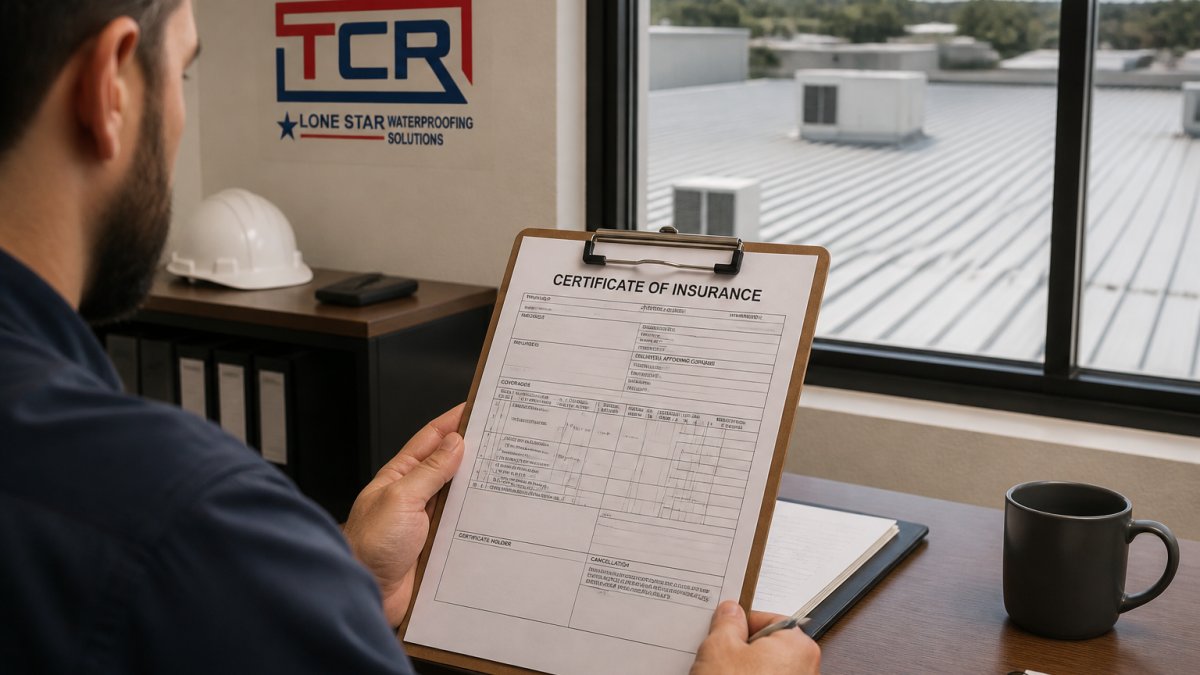
Check these items on the certificate:
- The named insured matches the contractor’s legal business name
- The policy effective dates cover your project window
- General liability limits are listed clearly
- Workers’ compensation appears as its own line
- The insurer is a real, licensed carrier
Watch out: a certificate that is expired, or one where the named insured is a different company than the one you hired, is a red flag. Ask questions before work starts.
How to Verify Roofing Contractor Insurance Step by Step
Verifying roofing contractor insurance means confirming the certificate is real and current, not just that it exists. Anyone can email a PDF. The check takes a few minutes and protects you for the life of the project.
Follow these steps:
- Request the certificate directly. Ask the contractor to have their insurer or agent send it to you, not a forwarded copy.
- Call the insurer. Use the phone number on the certificate, not one the contractor gives you, and confirm the policy is active.
- Match the names. The named insured must match the business you are hiring.
- Check the dates. The policy must be active for the full project, including any weather delays.
- Confirm the limits. Make sure the coverage amounts fit the size of your building.
- Ask about renewals. If the policy expires mid-project, ask how renewal will be handled.
- Keep a copy. Save the certificate with your project file for your records.
A common mistake is checking insurance once and never again. Policies lapse. A quick re-check before each phase of work closes that gap.
The Insurance Information Institute’s guide to business insurance explains how certificates work and why they are only a snapshot of coverage.
Verifying coverage takes a few minutes and follows a clear sequence.
| Step | What to do |
|---|---|
| 1 | Request the certificate directly from the insurer or agent |
| 2 | Call the insurer using the number on the certificate |
| 3 | Match the named insured to the business you are hiring |
| 4 | Check the dates cover the full project, including weather delays |
| 5 | Confirm the limits fit the size of your building |
| 6 | Ask how renewals will be handled if the policy expires mid-project |
| 7 | Keep a copy of the certificate with your project file |
Roofing Contractor Insurance Exclusions That Leave You Exposed
Roofing contractor insurance exclusions are the events a policy does not cover. Every policy has them, and the gaps are where property owners get hurt. Knowing the common exclusions helps you ask better questions.
Frequent exclusions to look for:
- Faulty workmanship. If the roof leaks because of how it was installed, the policy may not pay.
- Wear and tear. Normal aging is not a covered loss.
- Subcontractor work. Some policies exclude damage caused by crews the contractor hires out.
- Certain weather events. Some policies limit or exclude specific storm types.
- Intentional damage or code upgrades. Bringing an old roof up to current code may not be covered.
Watch out: a contractor who says “we’re fully insured” without explaining exclusions may not know their own policy. Ask for the exclusions in writing. For a deeper look at how roof insurance claims work in Texas and where coverage gaps appear, read our article.
Why an Additional Insured Endorsement for a Roofing Contractor Matters
An additional insured endorsement for a roofing contractor adds your business to the contractor’s liability policy. That means if a claim arises from their work, their insurer defends you too. See how this plays out on damaged roofs in our guide to commercial roof insurance claims in Texas. Without it, you rely on the contractor’s promise to cover you, which is a much weaker position.
Ask the contractor to add your company as an additional insured before work begins. The endorsement should name your business and tie to the specific project. Get the updated certificate showing the endorsement.
Questions to Ask Before You Sign the Contract
The right questions separate a prepared contractor from a hopeful one. Ask these before you sign:
- Can you send a current certificate of insurance from your insurer?
- What are your general liability per-occurrence and aggregate limits?
- Do you carry workers’ compensation, and can you prove it?
- Will you add our company as an additional insured?
- Which exclusions apply to roofing work on this project?
- Who is your insurer, and how do we reach them to confirm coverage?
- What happens if your policy lapses during the project?
A contractor who answers these quickly and in writing is usually the one you want. Our guide on what to look for when hiring a commercial roof consultant offers a checklist-style approach to vetting roofing professionals. One who dodges them is telling you something.
Request Insurance Documentation for Your Next Roofing Project
Insurance paperwork is not the exciting part of a roofing project. It is the part that decides who pays when something goes wrong.
At Total Cladding and Roofing LLC, we plan work around your operations to help keep disruption low. Our team handles inspections, leak repairs, preventative maintenance, and roof and cladding restoration.
Before you compare bids, get the insurance side straight. To see how a proper roofing estimate is built, read our article on how a commercial roofing estimate is built.
Frequently Asked Questions
What kind of insurance should a roofing contractor have?
A roofing contractor should carry general liability insurance, workers’ compensation, and commercial auto coverage. General liability protects against third-party bodily injury and property damage, while workers’ compensation covers injuries to the contractor’s own crew. For commercial and industrial projects, ask for limits that match your building’s replacement value and confirm the policy is active. Request a roofing contractor certificate of insurance directly from the insurer or agent, not just from the contractor, so you can confirm the coverage is real.
How can you verify that a roofing contractor is insured?
Ask for a certificate of insurance and then call the insurance agent or carrier listed on it to confirm the policy is active and the limits match what is stated. Check the named insured matches the contractor’s legal business name, review the expiration dates, and ask for an additional insured endorsement naming your property or company. If the contractor hesitates or provides a certificate that looks altered, treat that as a red flag and pause the hiring process until you have verified coverage.
What are red flags on a roofing contractor’s insurance certificate?
Common red flags include a named insured that differs from the contractor’s business name, expired or soon-to-expire policy dates, missing workers’ compensation coverage, and limits that are far below the project value. Watch for certificates that list only a generic address or lack an agent contact. Also be wary if the contractor refuses to add you as an additional insured or cannot explain the roofing contractor insurance exclusions on their policy. Any of these should prompt a direct call to the insurer before work begins.
Does a roofing contractor’s general liability insurance cover roof damage?
General liability typically covers damage the contractor causes to your building or a third party’s property during work, but it does not cover the cost of fixing defective workmanship itself. Damage to the roof being installed or repaired is often excluded or handled under a separate installation floater. Review the roofing contractor insurance exclusions carefully and ask the contractor to explain what happens if their work damages the building envelope. For large commercial projects, confirm whether the policy covers water intrusion and interior damage.
The challenge is simple: most property owners only discover an insurance gap after a claim is denied. Get the documentation up front and the gap disappears. Total Cladding and Roofing LLC helps you do exactly that, with verified certificates, additional insured endorsements, and coordinated commercial roofing work across your portfolio. Get started with Total Cladding and Roofing LLC and put a properly insured roof over your building.

To upload drawings, specs and plans please go to the form on our contact page.
Get in Touch