Table of Contents
- Why Hiring a Commercial Roof Consultant Matters
- Roof Consultant vs Roofing Contractor: Key Differences
- Essential Credentials and Experience to Verify
- Roofing Consultant Scope of Work: What They Should Deliver
- Commercial Roof Inspection Checklist: Questions to Ask
- Red Flags and Conflict of Interest Disclosure
- Conclusion: Making the Right Choice for Your Roof Asset
- Frequently Asked Questions
Last Updated: September 30, 2026
Why Hiring a Commercial Roof Consultant Matters
Hiring a commercial roof consultant is the step that decides whether a roofing project protects your building or drains your budget. A commercial roof consultant is an independent professional who inspects, specifies, and oversees roofing work on your behalf, without selling or installing the roof itself. At Total Cladding and Roofing LLC, we work alongside consultants on commercial and industrial projects across Texas, and we see the difference good oversight makes. This guide covers the credentials, scope, and red flags to check before you sign.
Most property teams skip this step. They call a contractor, get a quote, and approve it.
That works until the roof fails early, the warranty claim gets denied, or the bids come in far apart with no clear reason why. A consultant exists to prevent all three.
Here’s what most guides get wrong: they treat a consultant like a second contractor. The value isn’t in the labor. It’s in the independent judgment.
A consultant inspects the roof, writes the specifications, solicits bids, and checks the finished work. That independence is the whole point, and it’s the first thing to verify.
Roof Consultant vs Roofing Contractor: Key Differences
A roof consultant advises and inspects. A roofing contractor installs and repairs. The two roles should never be filled by the same company on the same project.
That separation protects you.
| Factor | Roof Consultant | Roofing Contractor |
|---|---|---|
| Main role | Inspect, specify, oversee | Install and repair |
| Sells materials | No | Yes |
| Writes specs | Yes | No |
| Bids on the work | No | Yes |
| Paid by | You, the owner | Project contract |
| Conflict risk | Low if independent | High if self-specifying |
Essential Credentials and Experience to Verify
Verify four things before you hire anyone: licensing, insurance, manufacturer certification, and a real project history. Skip any one of these and you’re carrying the risk yourself.
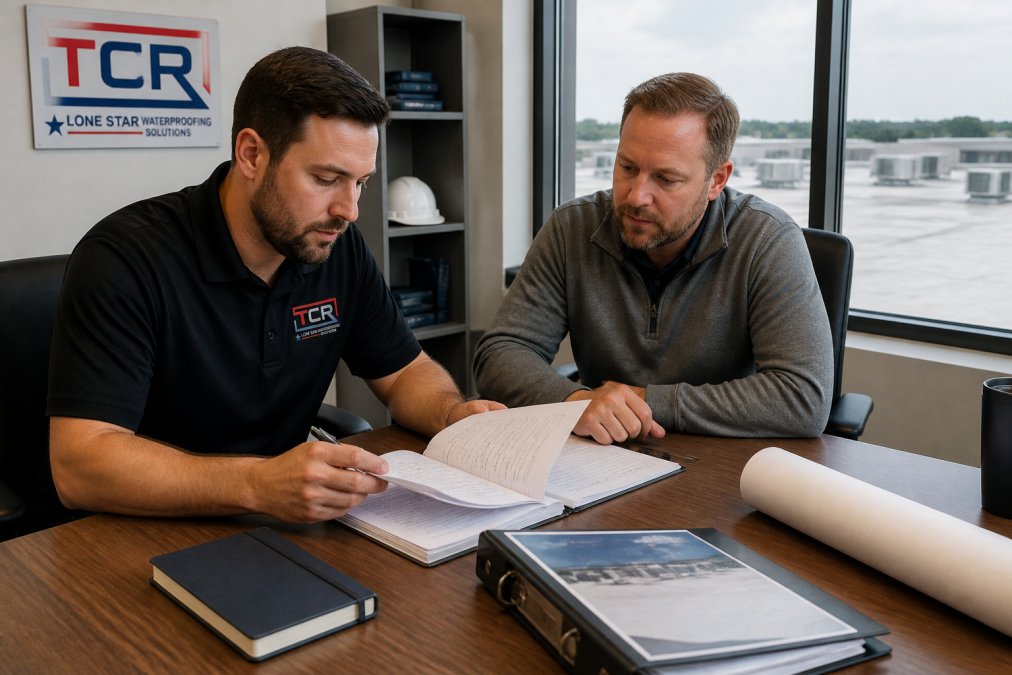
Ask for these documents directly:
- State licensing and registration for the work being overseen
- General liability insurance with current certificates
- Workers compensation coverage for anyone on site
- Manufacturer certifications for the systems they specify, such as TPO, EPDM, PVC, or modified bitumen
- A portfolio of completed commercial projects, with dates and scope
A common mistake is accepting a certificate of insurance without checking the dates and coverage limits. An expired policy or a low limit leaves you exposed if something goes wrong on your roof.
Roofing Consultant Scope of Work: What They Should Deliver
A roofing consultant’s scope of work should spell out every deliverable in writing, from the first inspection to the final sign-off. Vague scopes are where projects go wrong, and the vaguest part of most scopes is what happens after the contract is awarded.
A complete scope typically includes:
- A full roof condition assessment, using core sampling and thermal imaging where needed
- Written specifications for materials and installation methods
- Bid solicitation and a side-by-side review of contractor proposals
- Project management and on-site quality checks during installation
- A post-installation inspection before final payment
- A roof asset management plan for ongoing preventative maintenance
The independent quality-control role most owners overlook
Here is the distinction that separates a consultant from a contractor with a clipboard: the consultant’s job does not end when the bids are opened. It intensifies.
A consultant earning their fee during construction will typically:
- Verify that materials delivered to the site match the specified system, including thickness, fastener type, and insulation R-value
- Inspect substrate preparation and deck condition before the membrane is installed
- Check seam welds, flashing details, and penetration seals while they are still accessible
- Document each phase with dated photographs tied to the specification
- Require corrective work before the next layer covers the defect
- Attend manufacturer warranty inspections on your behalf
Post-installation inspection and final payment
The most valuable clause in a consultant’s contract is the one that ties final payment to their sign-off, not the contractor’s.
Before you release retainage, the consultant should confirm:
- The installed system matches the written specification
- All flashing, drainage, and penetration details are complete
- Manufacturer warranty documentation is submitted and registered in your name
- Punch-list items are corrected and re-inspected
- As-built drawings and maintenance instructions are delivered to you
Ask the consultant to include a site-visit schedule in the proposal, for example, a defined number of visits tied to project milestones. A scope that says “periodic visits” without a number is not a scope. It is a hope.
Do not release final payment based on the contractor’s own completion notice. The consultant’s written sign-off is the document that protects your warranty and your budget.
Commercial Roof Inspection Checklist: Questions to Ask
Use this commercial roof inspection checklist when you interview consultants. The answers tell you more than any brochure.
- How will you document existing conditions (photos, core samples, thermal imaging)?
- Do you check flashing details, roof drainage, and structural integrity?
- Will you write specifications that meet manufacturer warranty requirements?
- How do you handle bid solicitation and contractor vetting?
- What is your role during construction, and how often will you visit the site?
- Do you perform a post-installation inspection before we release final payment?
- How do you disclose any relationships with contractors or suppliers?
- What does your fee cover, and what costs extra?
Ask each consultant to walk one roof with you before you hire them. How they move across the roof, what they photograph, and what they flag tells you more about their skill than any proposal document.
Red Flags and Conflict of Interest Disclosure
The biggest red flag is a consultant who also wants to bid on the installation. That is a conflict of interest, and it should be disclosed in writing. But “disclosed in writing” is where most owners stop, and that is exactly where the problems start.
What a real conflict-of-interest disclosure contains
A credible disclosure is a signed document, not a sentence in a proposal. It should name:
- Any ownership stake, partnership, or revenue-sharing arrangement with a roofing contractor, distributor, or manufacturer
- Any commission, rebate, or volume incentive tied to a specific product or brand
- Any family or business relationship with a contractor who may bid on your project
- Any prior work the consultant performed for a contractor likely to submit a proposal
- How the consultant is compensated, and whether that compensation changes based on which bid you accept
The three fee models and the conflict each one creates
Most consultants bill in one of three ways. Each has a specific failure mode you should watch for.
| Fee model | How it works | Conflict it can create |
|---|---|---|
| Hourly | Billed per hour of inspection, specification, and site visits | Incentive to stretch the scope or visit more often than needed |
| Flat fee per project | One price for a defined scope of work | Incentive to under-invest time once the fee is locked |
| Percentage of project cost | A set percentage of the final construction value | Incentive to approve change orders and higher-cost systems |
How to verify independence before you sign
Ask these questions and listen for specifics, not assurances:
- “Who else have you worked for on this building in the last three years?”
- “Do you receive anything of value from any manufacturer whose products you specify?”
- “If the lowest bid comes from a contractor you have worked with before, how do you handle that?”
- “Will you put your fee structure and any relationships in the contract itself?”
A consultant who answers these directly is worth more than one who deflects with a promise of objectivity. Objectivity is not a promise. It is a contract term.
Other warning signs
Beyond fee structure and disclosure, watch for:
- No written conflict-of-interest disclosure at all
- Pressure to skip the inspection and move straight to replacement
- A specification that names only one manufacturer’s system with no alternates
- No references from similar commercial or industrial facilities
- Unwillingness to put the scope of work in writing
- A proposal that arrives suspiciously fast, before anyone has been on the roof
A consultant who specifies a single proprietary system and refuses to consider equivalent alternates is not necessarily corrupt, but you cannot tell the difference without a disclosure. Ask why the alternate was excluded, and get the answer in writing.
Independence is the product. A consultant who discloses relationships, puts the scope and fee structure in writing, and stays out of the bidding process is worth more than one who promises the lowest price.
Conclusion: Making the Right Choice for Your Roof Asset
The hardest part of hiring a commercial roof consultant is proving independence before you sign, not after. Ask for disclosures, written scopes, and references from buildings like yours.
Frequently Asked Questions
What does a commercial roof consultant do?
A commercial roof consultant provides independent advice on roof condition, repair, and replacement. They conduct inspections, prepare written specifications, manage bid solicitation, and oversee installation to ensure warranty compliance. They do not perform the work, so their recommendations are unbiased. They also help with roof asset management and preventative maintenance planning.
What is the difference between a roofing contractor and a roof consultant?
A roofing contractor installs or repairs roofs and profits from the work. A roof consultant works only for the building owner, offering third-party oversight and objective assessments. Consultants do not bid on installation, which removes conflict of interest. They focus on specifications, quality control, and long-term roof lifecycle analysis.
What are red flags when hiring a roof consultant?
Red flags include reluctance to provide references, lack of manufacturer certifications, no liability insurance or workers compensation, vague scope of work, and failure to disclose conflicts of interest. Also be wary if they pressure you toward a specific contractor or product without justification. A reputable consultant will welcome scrutiny and provide clear documentation.
How does a roof consultant save money on commercial projects?
A roof consultant can extend roof service life by identifying cost-effective repairs instead of full replacement. They ensure competitive bids through detailed specifications, reducing change orders. Their independent inspections catch defects early, avoiding expensive emergency repairs. Over time, this proactive approach lowers total cost of ownership.
To upload drawings, specs and plans please go to the form on our contact page.
Get in Touch