
Last Updated: November 11, 2026
Quick Summary
Sustainable roofing tax incentives for manufacturers are not one program but several separate federal provisions, each with its own eligibility test, limits and paperwork. Whether a roof project qualifies depends on ownership, the project’s energy or solar purpose, and the placed-in-service date. Confirm each rule with a tax advisor before work begins.
- Confirm current law and the placed-in-service deadline before committing budget to any project.
- Section 179D may be relevant, depending on who owns the building and whether energy performance is planned.
- Insulation above the deck is often the strongest efficiency component in a re-roof.
- Itemize invoices to separate repair from improvement, insulation, membrane, coating and solar work.
- Sequence the roof replacement before installing solar to avoid removing and reinstalling panels later.
Table of Contents
- How Federal Tax Incentives Apply to Industrial Roofing
- Current Law Status and Incentive Expiration Dates
- Section 179D Commercial Buildings Energy-Efficiency Tax Deduction for Plant Roofs
- Energy Efficient Roofing for Factories: Which Components Qualify
- Investment Tax Credit (ITC) for Commercial Solar Roofing
- Interaction Among Credits, Deductions, Rebates, and Depreciation
- Documenting Your Claim: A Step-by-Step Workflow for Your Next Roof Project
- Frequently Asked Questions
How Federal Tax Incentives Apply to Industrial Roofing
Sustainable roofing tax incentives for manufacturers are not one program. Federal tax incentives for sustainable roofing sit across several separate provisions, each with its own eligibility test, limits and paperwork. Treating them as a single credit is the fastest way to over-claim or miss a benefit you were entitled to.
Tax treatment for industrial roofing depends on the specific project and the owner’s tax position. Which applies depends on whether the roof is part of a building you own, whether the project is energy-efficiency or solar, and whether your facility manufactures qualifying equipment. Start with ownership and purpose, because that decides which rules you read next.
Before any roof project, confirm your position with a tax advisor who works with commercial real estate and manufacturing clients. Total Cladding and Roofing LLC can document what was installed and when, but the tax treatment is a decision for your accountant.
Current Law Status and Incentive Expiration Dates
Federal energy tax provisions can change over time, so their current status should be confirmed before a project begins. Whether a roof project qualifies can turn on the date the property was placed in service, not the date the contract was signed. That distinction catches many projects out.
Check each provision’s current status with the relevant authorities before you commit budget. Note the placed-in-service deadline, any annual cap, and whether the credit is reduced for projects beginning construction after a set date. Keep a dated record of contract signing, start of physical work, and completion.
A common mistake is building the financial case on a schedule that was valid last year. Re-verify the rules at the start of each project and again before filing.
Section 179D Commercial Buildings Energy-Efficiency Tax Deduction for Plant Roofs
Section 179D is one provision that may be relevant to a factory roof, depending on the project and the building. For a manufacturer, the useful questions are mechanical: what must be true about the building, what must be true about the roof, how big is the deduction, and who signs off.
Start with the building. Ownership structure matters for any building-related tax deduction, so confirm who owns the building before the specification is written.
Next, the energy test. Energy-based tax provisions generally evaluate the building as a whole, so a roof is best considered as part of the overall building envelope and energy performance.
A roof replacement undertaken only for leak repair may not address energy performance goals, so the specification should be planned with energy objectives in mind before work starts.
Then the money. Labor requirements can affect the amount of certain tax deductions, so the labor question is worth raising with your tax advisor early in project planning.
Some deduction approaches are based on specific energy-efficiency measures rather than whole-building models. Ask your tax advisor which approach fits the project before you commit to a modeling scope.
Finally, the paperwork. Tax deductions tied to energy performance generally require supporting documentation. Retain project records, specifications, and any performance documentation together, and confirm requirements with your tax advisor.
For a manufacturing plant, the building envelope is an important part of overall energy performance. Insulation above the deck, reflective surfacing, and air sealing at penetrations can all contribute to that performance. Total Cladding and Roofing LLC can document the installed assembly and component performance ratings for your records.
Energy Efficient Roofing for Factories: Which Components Qualify
A roof can be viewed as a set of components rather than a single line item. A factory roof is a stack of components, each treated differently for incentive purposes depending on what it does and how it is documented. This component-by-component view is where a manufacturer can actually plan a project, because it shows which dollars are likely to carry an incentive and which will be treated as ordinary repair.
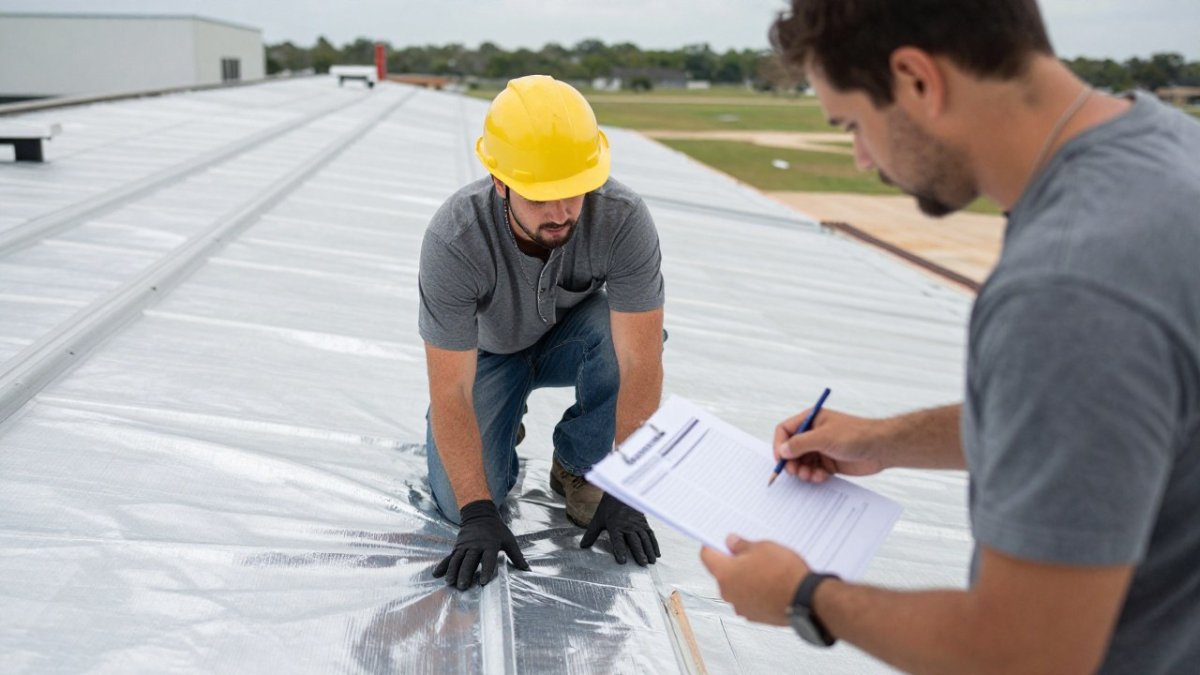
Roof membrane or panel system. The membrane or metal panel is the visible surface and usually the weakest incentive candidate on its own. A like-for-like replacement restores function; it does not by itself reduce energy use. The exception is a membrane specified as part of a reflective or cool roof assembly with rated solar reflectance and thermal emittance, which can contribute to the energy model. Keep the manufacturer’s rated values for the installed product, not a generic data sheet. Explore commercial roof restoration options for existing metal, membrane, built-up and coated roofs in Texas.
Insulation above the deck. This is often the strongest efficiency component in a re-roof. Adding or upgrading insulation changes the building’s thermal performance directly, and it is the component most likely to move a whole-building model. Document the installed R-value and the area covered, and separate the insulation cost from the membrane cost on the invoice so the two can be treated correctly.
Reflective coatings and restoration. Coating a sound roof can be a cost-effective alternative to replacement in some cases, and it leaves the existing assembly in place. Confirm the accounting treatment for restoration work with your tax advisor before work begins.
Rooftop solar and solar-ready upgrades. Solar panels and roofing are often considered separately for planning and documentation purposes. A solar-ready specification, structural capacity, conduit pathways, and mounting details designed in before the array, can help avoid the cost of removing and reinstalling panels later.
Structural work and drainage. Reinforcement, deck repair, and drainage improvements are part of the overall building and roof system. They still matter to the project because the roof has to carry the array and shed water for the system’s life, but do not expect them to generate an incentive on their own.
Repair versus improvement. The distinction between a repair and an improvement is an important documentation question on a roof project. A repair returns the roof to working order, while an improvement changes its performance or extends its life. Itemized invoices that separate tear-off, repair, insulation, membrane, coating, and solar work make that line visible. A single lump-sum invoice hides it and creates disputes later.
Restoration versus replacement economics. Coating or restoring a sound roof can be an alternative to full replacement, depending on the roof’s condition and project goals. Replacement makes sense when the deck or insulation is failing, when the existing assembly cannot carry an array, or when added insulation is the main efficiency lever. Run both scenarios against your facility’s size and condition, and treat the incentive as one input rather than the reason for the decision.
Total Cladding and Roofing LLC works with metal roofing, flat roof systems, and insulated metal panels, and assesses existing roofs before recommending replacement or refurbishment. Ask for a component-level scope and itemized pricing so the incentive analysis and the capital decision rest on the same numbers.
Investment Tax Credit (ITC) for Commercial Solar Roofing
If your roof will carry a solar array, certain federal clean-energy tax credits may apply to the solar equipment itself. Eligibility depends on the property and is not determined by the roof work alone. The roof must still be sound enough to carry the array for the system’s life, a practical reason to refurbish or replace it before installation.
Coordinate the roof and solar schedules. Get the roof right before solar goes on with TPO and metal roof retrofits planned around the array. Installing a solar array on a roof with a few years of life left can mean removing and reinstalling panels later, which adds cost and can complicate the claim. Get a structural and condition assessment first, then decide the sequencing.
Confirm current credit rules and placed-in-service requirements with your tax advisor, and do not rely on older guidance.
Interaction Among Credits, Deductions, Rebates, and Depreciation
Federal credits, deductions, rebates and depreciation may apply to the same roof project, and the order in which each is applied to a given cost should be confirmed with your tax advisor.
Depreciation treatment can depend on how roofing work is classified, so confirm classification with your accountant. Ask your accountant how the project will be capitalized before the invoices arrive.
Map the stack before you commit: list each available incentive, the cost base it applies to, and whether it reduces that base for another incentive. A simple table makes the overlaps visible and prevents surprises at filing.
| Incentive | Applies to | Reduces cost basis for others? | Key check |
|---|---|---|---|
| Section 179D deduction | Qualifying efficiency improvements | Usually yes | Energy savings modeled and verified |
| Solar ITC | Solar equipment | Usually yes | Placed-in-service date |
| State or utility rebate | Eligible equipment or work | Often yes | Program funding and deadlines |
| Depreciation | Capitalized roof cost | Not applicable | Classification of roof components |
Documenting Your Claim: A Step-by-Step Workflow for Your Next Roof Project
Good records support any tax claim. The steps below set out a practical workflow for a commercial roof project.
- Confirm eligibility before signing. Check current rules for any available incentive with your tax advisor.
- Commission a condition survey. Record the existing roof’s age, condition and reason for work, with dated photographs.
- Agree the specification in writing. Name each component, its performance rating and its purpose, so it can be matched to eligibility rules.
- Keep the energy analysis. Where Section 179D applies, retain the modeling and the qualified person’s verification.
- Collect the paperwork. Learn what a commercial roofing estimate should include so your documents match the scope. Retain the signed contract, itemized invoices separating repair from improvement, manufacturer data sheets and completion certificates.
- Record dates. Log the contract date, start of physical work and completion date.
- Hand the file to your tax advisor. Share the complete record before the filing deadline, not after.
Total Cladding and Roofing LLC can provide scope, specification and completion documentation for a roof project. Ask for itemized invoicing from the start so the cost split is clear when you file.
Frequently Asked Questions
What federal tax incentives are available for energy-efficient commercial roofing?
Several federal provisions can apply to commercial roofing work, depending on the scope and the building. Some federal provisions may offer deductions or credits for energy-efficient commercial building improvements and clean-energy property. Eligibility depends on the property type, the installation date and the owner’s tax position, so confirm current requirements with a qualified tax advisor before filing.
Do metal roofing installations qualify for manufacturer tax credits?
Metal roofing does not automatically qualify for a credit simply because it is metal. Qualification depends on the applicable rules, so ask your roofing contractor for product performance documentation and have your tax advisor verify how it applies. Ask your roofing contractor for product performance documentation, and have your tax advisor verify how that documentation maps to the applicable provision.
What is the difference between a tax credit and a tax deduction for roofing projects?
A tax credit reduces your tax bill dollar for dollar, so a $100,000 credit lowers your liability by $100,000. A tax deduction reduces your taxable income instead, so its value depends on your marginal tax rate. For a manufacturer in a higher bracket, a deduction of the same amount is worth more than a deduction for a smaller taxpayer, but it is still less valuable than an equal credit. Many roofing projects can involve either, and the choice affects how the project should be planned and documented.
How does the Inflation Reduction Act affect industrial roofing tax benefits?
Federal clean-energy and energy-efficiency incentives can change over time, so the available benefit may depend on the project’s timing. Confirm current status with a qualified tax professional. Confirm the current status of each provision with a qualified tax professional before committing to a project timeline.

To upload drawings, specs and plans please go to the form on our contact page.
Get in Touch