Table of Contents
- Why Warehouse Roof Leaks Cost More Than You Think
- Step 1: Establish a Commercial Roof Maintenance Checklist
- Step 2: Address Ponding Water and Drainage Failures
- Step 3: Industrial Roof Leak Detection Methods That Work
- Step 4: Apply Benefits of Roof Coatings for Warehouses
- Step 5: Manage TPO and Metal Roof Maintenance
- Step 6: Document Everything for Insurance and Liability
- Emergency Response: Containing a Warehouse Roof Leak
- Frequently Asked Questions
Last Updated: September 20, 2026
Why Warehouse Roof Leaks Cost More Than You Think
Water infiltration into a warehouse doesn’t just damage the roof. It threatens inventory, disrupts operations, and creates liability exposure that extends far beyond the repair bill. A single leak that goes undetected for weeks can compromise thousands of dollars in stored goods, force production shutdowns, and trigger insurance claim complications that take months to resolve.
Facility managers often underestimate the true cost of warehouse roof leaks. Most focus only on the immediate repair. They miss the compounding damage: structural deterioration, mold growth, electrical hazards, and the operational chaos of emergency containment. The real cost isn’t just fixing the leak, it’s preventing the cascade of problems that follow.
This guide walks through a systematic approach to preventing warehouse roof leaks in Texas. The steps are straightforward, but they require discipline and documentation. Skip them, and you’re gambling with your facility’s integrity.
Step 1: Establish a Commercial Roof Maintenance Checklist
A preventative maintenance checklist is your first line of defense. It transforms roof care from reactive firefighting into predictable, manageable work. The checklist forces consistency, the same inspector, the same criteria, the same documentation every time.
Your checklist should cover visible damage, drainage function, and membrane integrity. It needs to be simple enough to follow every month but detailed enough to catch problems early.
Monthly Visual Inspections
Walk the roof yourself or assign someone who understands what to look for. You’re not conducting a forensic investigation, you’re looking for obvious red flags.
Check for these conditions each month:
- Visible cracks, blisters, or punctures in the roof membrane
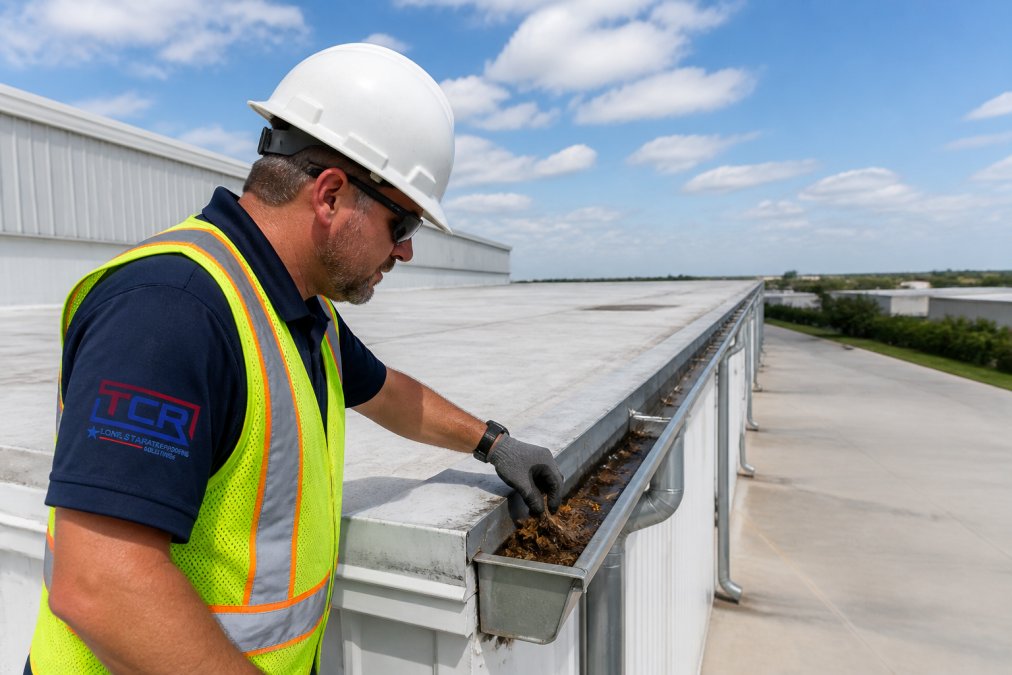
- Debris accumulation on the surface or in gutters
- Standing water or ponding water that hasn’t drained
- Seam separation or lifted flashing around penetrations
- Discoloration or staining that suggests moisture infiltration
- Damage from weather events (hail, wind, branches)
- Animal damage or pest entry points
Document what you see with photos. Note the date, location, and condition. If you spot something questionable, mark it for closer inspection during your quarterly check.
Quarterly Drainage System Checks
Drainage failure is one of the most common causes of warehouse roof leaks. Water that should flow off the roof instead pools, saturates the membrane, and finds its way inside.
Every three months, inspect your drainage system:
- Clear gutters and downspouts of leaves, dirt, and debris
- Check that scuppers are open and unobstructed
- Verify that drainage paths slope toward outlets (no flat spots that trap water)
- Look for debris or sediment blocking drain inlets
- Test drainage by running water and watching it flow
- Inspect for rust, corrosion, or structural damage to gutters and downspouts
Ponding water is a warning sign. If water sits on your roof for more than 48 hours after rain, your drainage system isn’t working. Address this immediately, it accelerates membrane degradation and creates an environment for moisture infiltration.
Step 2: Address Ponding Water and Drainage Failures
Ponding water is deceptive. It looks like a minor issue, water sitting on the roof after a storm. In reality, it’s one of the fastest ways to destroy a roof membrane and create leaks that spread through your building.
Water weight stresses the structure. The membrane absorbs moisture, loses elasticity, and develops cracks. Thermal shock from sun exposure accelerates degradation. Within months, a ponding problem becomes a structural problem.
The fix depends on the root cause. If your drainage system is blocked, clear it. If your roof has settled or sagged, you need structural correction. If your slope is inadequate, you may need tapered insulation or a coating system that directs water flow.
Don’t ignore ponding water hoping it will resolve itself. It won’t. Every rain event makes it worse.
Step 3: Industrial Roof Leak Detection Methods That Work
Finding a leak before it causes damage requires more than visual inspection. Water travels horizontally along beams and insulation before it appears inside. By the time you see a stain on the ceiling, the leak may have been active for weeks.
Professional detection methods pinpoint moisture infiltration before it becomes visible damage.
Thermal Imaging for Hidden Moisture
Thermal imaging cameras detect temperature differences caused by moisture in the roof assembly. Wet insulation and membranes retain heat differently than dry materials. An experienced technician can map moisture patterns across the entire roof.
This technology is particularly valuable for flat roof systems and TPO roofing, where moisture can hide within the membrane layers. It’s non-invasive and doesn’t require cutting into the roof to investigate.
Water Testing and Dye Tracing
A simpler method involves controlled water application and visual tracking. The technician applies water to suspected leak areas while an observer watches from inside for entry points. Dye tracers make the water path visible, helping isolate the exact location of the breach.
This approach works well for localized leaks and seam failures. It’s less expensive than thermal imaging but requires access to the interior of the building during testing.
Step 4: Apply Benefits of Roof Coatings for Warehouses
A roof coating is a protective layer applied over the existing membrane. It seals minor cracks, extends membrane life, and reflects solar heat, reducing cooling costs and slowing UV degradation.
Coatings work best on roofs that are structurally sound but showing age. They’re not a solution for failing membranes or roofs with significant damage. But for a well-maintained roof facing environmental stress, a coating can add years to its service life.
The benefits include:
- Extended service life without full replacement
- Reduced thermal shock from temperature swings
- Improved reflectivity that lowers interior temperatures
- Sealed microcracks that prevent water entry
- Lower cost than membrane replacement
Warehouse coatings need to withstand Texas heat and UV exposure. Choose products rated for industrial environments. Application requires proper surface preparation and curing time, plan around your operational schedule.
Step 5: Manage TPO and Metal Roof Maintenance
TPO (thermoplastic polyolefin) and metal roofing systems dominate commercial and industrial warehouses. Each has distinct maintenance requirements and common failure modes.
Seam and Flashing Inspection
TPO roofs are vulnerable at seams where sheets are joined. Heat-welded seams can separate if the weld is compromised or if the membrane experiences thermal stress. Metal roofs fail at flashing where panels connect to walls, vents, and penetrations.
Monthly inspections should focus on seams and flashing:
- Look for separation, gaps, or lifted edges
- Check for corrosion or rust on metal flashing
- Verify that sealant around penetrations hasn’t cracked
- Test seam integrity by gentle pulling (they should not move)
Seam failure is one of the most common causes of warehouse roof leaks. Catch it early, and you can re-weld or reseal. Ignore it, and water penetration spreads through the roof system.
UV Degradation and Thermal Shock Prevention
Both TPO and metal roofing experience UV degradation and thermal shock. Extreme temperature swings, common in Texas, stress the material and accelerate failure.
UV degradation appears as color fading, brittleness, and surface cracking.
Mitigate these stressors by:
- Applying UV-protective coatings every 3-5 years
- Ensuring proper ventilation to reduce attic heat buildup
- Maintaining drainage to prevent ponding and moisture accumulation
- Inspecting fasteners and re-torquing if necessary
- Using tapered insulation to manage thermal stress
Step 6: Document Everything for Insurance and Liability
Documentation is your proof that you maintained the roof. When a leak occurs, your insurance claim depends on showing that you took reasonable steps to prevent it. Without records, you’re arguing from memory, and insurers will deny the claim.
Create a maintenance log that includes:
- Date and time of each inspection
- Inspector name and credentials
- Conditions observed (with photos)
- Repairs or maintenance performed
- Contractor name and contact information
- Cost of work
- Parts replaced or materials applied
Emergency Response: Containing a Warehouse Roof Leak
When a leak develops, your priority is containment, stopping water from reaching inventory and equipment. You have minutes, not hours, to respond.
Your emergency plan should include:
- Identification of the leak location (interior staining or water entry point)
- Immediate water diversion using buckets, tarps, or temporary barriers
- Notification of relevant staff (facility manager, safety officer, insurance)
- Documentation of the incident with photos and timestamps
- Temporary patching to stop active water entry
- Professional repair scheduled within 24-48 hours
Frequently Asked Questions
How often should I inspect my warehouse roof to prevent leaks?
Conduct visual inspections monthly and comprehensive inspections twice yearly, spring and fall. After severe weather (hail, high winds, heavy rain), inspect immediately for damage. Regular commercial roof maintenance checklists help catch issues like flashing failures, seam separation, and ponding water before they become costly leaks. Document every inspection for insurance purposes.
What are the most effective industrial roof leak detection methods?
Thermal imaging identifies moisture trapped in roof membranes without visible damage. Water testing with dye tracing pinpoints leak sources when origin is unclear. Visual inspections of seams, flashing, and penetrations catch obvious issues. Combine these methods: start with thermal imaging for hidden problems, use dye tracing to confirm location, then inspect physically. This layered approach catches 95% of leaks before they damage inventory.
Can roof coatings actually prevent warehouse leaks?
Yes. Roof coatings seal micro-cracks in membranes, reflect UV rays that degrade materials, and reduce thermal shock stress that causes seam failure. Benefits include extended roof membrane life (often 5-10 years), reduced water infiltration, and lower energy costs. Coatings work best on TPO and metal roofs as preventative maintenance, not as fixes for existing leaks. Apply every 3-5 years depending on climate exposure and coating type.
What should I do immediately if my warehouse roof starts leaking during heavy rain?
Move inventory away from the leak area immediately. Contain water with buckets or tarps to minimize damage. Document the leak location and water damage with photos for insurance. Contact a roofing contractor for emergency tarping or temporary sealing. After rain stops, assess whether the leak is from a seam failure, flashing separation, or ponding water. Temporary fixes buy time, but permanent repair requires professional inspection and proper roof restoration.
To upload drawings, specs and plans please go to the form on our contact page.
Get in Touch