
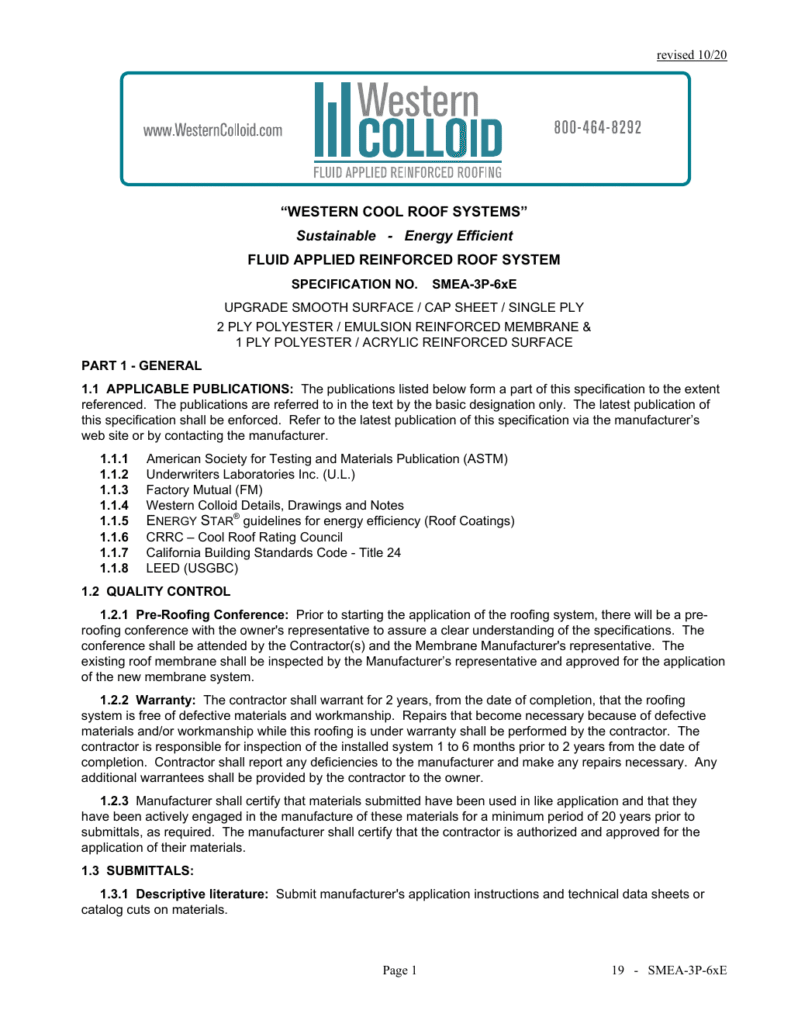
SMEA-3P-6xE — Acrylic-surfaced reinforced roof system
- Manufacturer
- Western Colloid
- Product
- SMEA-3P-6xE — Acrylic-surfaced reinforced roof system
- Status
- Current
- Market
- United States
- Latest revision
- 1105b
- Last verified
- September 20, 2026
Overview
SMEA-3P-6xE is a Western Colloid fluid applied reinforced roof system titled Upgrade Smooth Surface / Cap Sheet / Single Ply. Its membrane is two plies of polyester set in emulsion, and its surface is one ply of polyester set in acrylic, which makes three polyester plies in all. The system is a cold process, water based method for upgrading existing roofing that includes BUR, Mod Bit, EPDM, TPO and Hypalon. It has very low odor and is reinforced with light weight polyester fabrics. The reflective elastomeric surface is ElastaHyde. Its listed criteria begin with Energy Star and LEED (USGBC), then California Title 24, Factory Mutual Standard 4470 Class 1 and U.L. Class A. Use over EPDM or TPO membranes follows its own specific specifications.
System components and weights
Seven layers make up the system. Dry weights are approximate and are given per 100 sq. ft.
- Base coat of #298 Emulsion: 6 gallons, 23 lb
- Polyester fabric, first ply, set in emulsion: 2.5 lb
- Interply coat of #298 Emulsion: 6 gallons, 23 lb
- Polyester fabric, second ply, set in emulsion: 2.5 lb
- Base coat of ElastaHyde: 3 gallons, 21 lb
- Polyester fabric set in ElastaHyde: 2.5 lb
- Surface and reflective coating of ElastaHyde White Acrylic: 3 gallons, 21 lb
The total system dry weight is 95.5 lb and the approximate total dry thickness is 165 mils.
Data sheets and technical documents
Current manufacturer system specifications, application guidelines and component data sheets matched to this assembly.
Current files
Archived files
No older reviewed revisions are archived for this product yet.
Existing roof and surface preparation
The manufacturer's representative inspects the existing roof membrane and approves it before the new system is applied. The membrane must be sound and watertight, and properly fastened or adhered. Light dirt and dust may need only sweeping or power blowing, while heavier dirt, dried mud or contamination may need washing. The strongest cleaning method needed is the one used. Valleys and ponding areas are washed and may be primed with #298 Asphalt Emulsion diluted 20 to 30 percent with water, brushed on vigorously and left to dry. These areas receive an extra ply of polyester set in #298 before the membrane. Blisters are repaired as a floating patch of modified cap sheet in asphalt flashing compound. Large splits use the same materials, and small splits are repaired with polyester fabric between two coats of #800 Elastic Cement.
Membrane application
The emulsion membrane starts with #298 at 6 gallons per 100 sq. ft. A half-width ply of polyester goes in first at the low edge, followed by full-width sheets up the roof. A second #298 coat of 6 gallons per 100 sq. ft. takes a full-width second ply. The polyester stops at the base of the wall or cant and overlaps the wall flashings by at least 3 inches. No top coat of emulsion goes on the fabric, and the membrane cures before the acrylic layer. The acrylic ply is applied early in the day, before heat softens the emulsion. If the surface turns soft and sticks to equipment or feet, work stops. After washing off asphaltic residue, ElastaHyde goes on at 3 gallons per 100 sq. ft. and a full-width ply of polyester is embedded while it is wet. Areas around drains and scuppers, valleys, waterways and spots where water ponds for more than 48 hours take an extra ply of polyester in ElastaHyde that extends 12 inches beyond the ponding area. The reflective coat is two applications of 1 1/2 gallons per 100 sq. ft. in a cross-hatch pattern, the first drying 24 hours. The coating is not thinned or diluted and is strained if sprayed.
Polyester fabric
The system calls for either W26/T326, a 2.75 ounce firm stitchbonded polyester, or T272, a 3.0 ounce soft one. The WCP-SF (W-26) bulletin covers the firm type. Its firm, starched finish gives fewer wrinkles and lays straighter and smoother during application, and it has fewer stitches per inch for better wetability and less brooming. Its published properties are 0.025 inch thickness, 41 lb tensile average, 25 percent elongation, 127 lb burst strength and 14 lb trapezoid tear. It is sold in 10 square rolls of 40 inches by 324 feet. The T272 type is the WCP-HS fabric at 3 ounces per square yard, with 57 lb tensile, 61 percent elongation and 176 lb burst strength.
Emulsion and coating properties
#298 is applied by brush, roller, soft broom or squeegee at 3 gallons per 100 sq. ft. per coat, and two coats at right angles are recommended. For spray application up to 10 percent water can be added, with the application amount raised by the same percentage. At 32 degrees F the dry film shows no cracking or flaking, and at 212 degrees F it shows no sag, blistering or slipping. An elastomeric 298E blend exists. The wet film is non-combustible and the dry film is self extinguishing. ElastaHyde White has an initial solar reflectivity of 84 percent (ASTM C1549) and an initial thermal emittance of 89 percent (ASTM C1371). Its dry flammability rating is Class A under U.L. 790 and ASTM E108. The coating is the finishing layer in this reinforced liquid-applied membrane.
Installing this in San Antonio or Austin?
We install protective coatings for metal roofs and cladding on commercial and industrial buildings from our Bulverde office.
Related products
 Illustration
Sikalastic-624 WP Fluid-Applied Protected Membrane Roofing
Illustration Sikalastic-621 Fluid-Applied Roofing
Modified Bitumen Silicone
Ure-A-Sil Eco
Illustration SMAA-2P-10xE — All-acrylic reinforced roof system
Illustration WCP-MTL1-4.5E — Metal roof acrylic restoration system
Contribution history
Published changes remain in this permanent record. Corrections create a new entry instead of deleting earlier history.
- September 21, 2026 at 8:48 amLibrary Record
SMEA-3P-6xE — Acrylic-surfaced reinforced roof system — initial source record
Created the system record and matched the current manufacturer system specification, application guidance and component data sheets.
By Tom · Verified Primary Source
Sources: Official Western Colloid SMEA-3P-6xE — Acrylic-surfaced reinforced roof system system page