Table of Contents
- Signs of Structural Damage in Industrial Wall Panels
- Common Causes of Wall Panel Deterioration
- Industrial Metal Wall Panel Maintenance Tips
- Tilt-Wall Panel Repair: Methods and When to Intervene
- Understanding Tilt-Wall Panel Repair Cost and ROI
- DIY vs. Professional Repair: Where to Draw the Line
- Preventative Maintenance Checklist for Industrial Facilities
- Regulatory Compliance and Building Code Requirements
- Frequently Asked Questions
Last Updated: September 18, 2026
Signs of Structural Damage in Industrial Wall Panels
Professional wall panel repair services address structural damage in industrial wall panels before it announces itself loudly. It starts small: a hairline crack, surface discoloration, or a section that feels softer than it should. By the time most facility managers notice something’s wrong, the problem has usually progressed beyond cosmetic repair.
The earliest warning signs matter most. Look for visible cracks in cementitious wall panels, especially those that radiate outward from corners or joints. Metal panels showing rust, denting, or separation from fasteners indicate corrosion has begun eating through the material. Concrete tilt-wall panels that have shifted or tilted slightly signal foundation settlement or structural movement that demands immediate assessment.
Water staining around seams and joints is deceptive because it appears minor but signals moisture infiltration. Once water gets behind the panel, it accelerates deterioration exponentially. You’ll see efflorescence (white chalky deposits) on concrete surfaces, which means water is carrying salts through the material itself.
Listen for what contractors call “hollow spots”, areas where panels have separated from their backing or substrate. Tap the surface with a hammer. A solid panel rings clearly; a compromised one sounds dull and flat. This simple test catches delamination before it becomes visible.
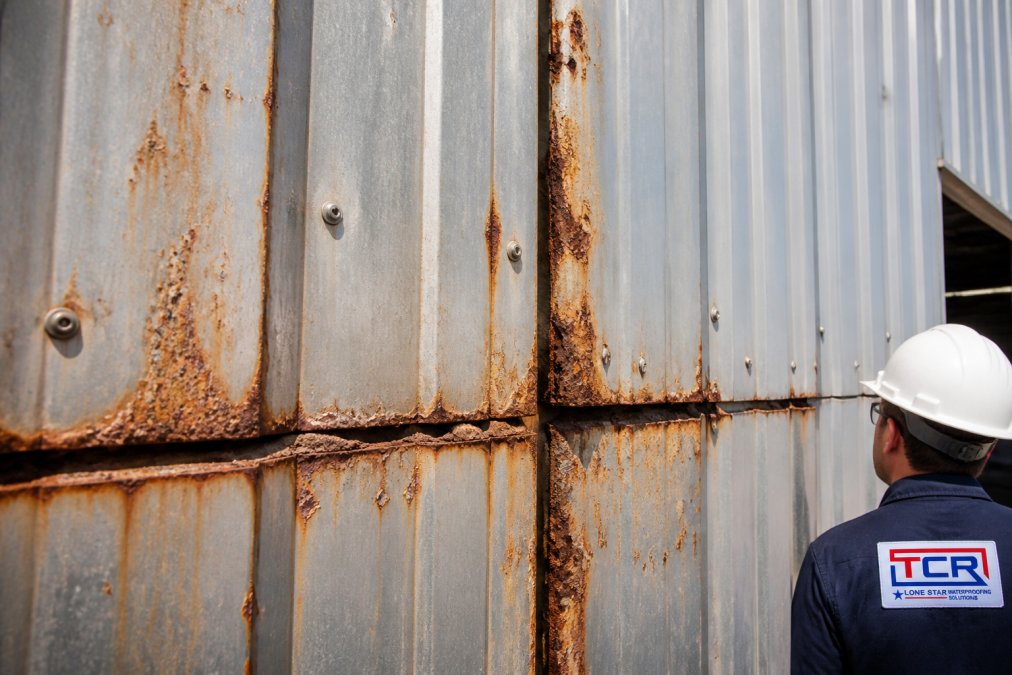
At Total Cladding and Roofing LLC, we conduct structural integrity assessments to catch issues before they compromise load-bearing capacity or create safety hazards for workers below.
Common Causes of Wall Panel Deterioration
Wall panel deterioration rarely stems from a single cause. Most often, multiple factors combine to accelerate failure. Understanding what drives deterioration helps you prioritize which problems demand immediate attention and which can be managed through preventative maintenance.
Moisture infiltration tops the list for metal and composite panels. Water finds its way through compromised seals at joints, around fasteners, and where panels connect to the building frame. Once inside, it triggers rust in metal systems and promotes rot in wood-based substrates. The problem compounds because moisture creates an environment where biological growth accelerates corrosion.
Thermal cycling stresses panels constantly in industrial settings. Texas heat swings from freezing overnight to scorching by midday. Metal panels expand and contract with these temperature changes, eventually fatiguing fasteners and opening seams. Cementitious panels crack as they move differently than the steel frame they’re anchored to.
UV exposure and weathering degrade surface coatings and protective finishes. Unprotected metal oxidizes. Paint and sealants can fail in direct sun. Once the protective layer is gone, the underlying material deteriorates rapidly.
Foundation settlement causes tilt-wall panel damage that no amount of sealant will fix. If the building foundation shifts, even slightly, the panels it supports shift with it. Cracks follow the stress lines. Panel realignment becomes necessary when settlement has moved the structure enough to create misalignment between adjacent panels.
Corrosion resistance failures occur when the wrong material was selected for the environment. Uncoated steel in humid climates rusts aggressively. Aluminum in coastal areas (or near salt-laden air from industrial processes) oxidizes faster than expected. Galvanized finishes eventually fail if they’re damaged during installation.
Industrial Metal Wall Panel Maintenance Tips
Metal wall panels dominate industrial construction because they’re durable, economical, and fast to install. That durability depends entirely on consistent maintenance.
Inspect seals and fasteners quarterly. This is non-negotiable. Walk the perimeter with binoculars and a checklist. Look for fasteners that have backed out or corroded. Check that sealant at panel joints remains flexible and hasn’t cracked or pulled away. Missing sealant is an open invitation for water infiltration.
Clean panels annually. Industrial facilities generate dust, salt spray, and chemical residue that accelerates corrosion. Pressure wash panels at low pressure (below 1,500 PSI) to avoid damaging coatings. Use mild detergent for stubborn buildup. Rinse thoroughly. This simple step extends panel life by years.
Repair fastener corrosion immediately. Corroded fasteners weaken the connection and allow panels to shift. Replace them with stainless steel or hot-dip galvanized fasteners rated for your environment. Don’t wait for fasteners to fail completely, replace them as soon as corrosion appears.
Touch up paint and coatings. Small scratches in protective coatings expose bare metal to rust. Keep touch-up paint matching your panel color on hand. A timely repair can prevent a costly panel replacement.
Monitor thermal movement. In high-temperature environments, metal panels need expansion room at joints. Ensure fasteners allow for panel movement and that sealants remain flexible. Rigid connections fail under thermal stress.
Address rust spots immediately. Surface rust can be cleaned and treated, but deep pitting requires panel replacement. Catch rust early when it’s still surface-level. Wire brush the area, apply rust converter, prime, and paint.
Tilt-Wall Panel Repair: Methods and When to Intervene
Tilt-wall construction creates impressive industrial spaces efficiently, but it introduces specific vulnerabilities. Tilt-wall panels are large, monolithic concrete sections that are tilted up into place during construction. Once in service, they’re subject to structural loads and environmental stress that can cause cracking and misalignment.
Crack injection is the standard repair for non-structural cracks (hairline to 1/8-inch width). Epoxy or polyurethane is injected under pressure into the crack, bonding the concrete and restoring structural continuity. This method works well for cracks that don’t indicate deeper structural problems. This method works well for cracks that don’t indicate deeper structural problems and can restore water-tightness.
Panel realignment becomes necessary when foundation settlement or structural movement has shifted panels out of plumb. This is more complex than crack repair. It typically involves hydraulic jacking to lift and reposition the panel, then shimming and re-securing it to the building frame. Realignment must be done carefully to avoid introducing new stresses.
Surface rehabilitation addresses spalling, weathering, and minor surface damage. Damaged concrete is ground or chipped away, the surface cleaned and primed, then patched with concrete repair mortar matched to the original finish. This is cosmetic but important for preventing water infiltration through damaged surfaces.
Structural assessment must precede any major repair. A qualified structural engineer evaluates whether cracks indicate minor concrete shrinkage or serious structural movement. This determines whether you can use simple crack injection or need more involved panel stabilization work.
The decision to repair versus replace depends on crack location, severity, and what caused it. Hairline cracks from concrete shrinkage are cosmetic and can wait. Cracks wider than 1/4-inch, cracks that continue to grow, or cracks near panel connections signal structural problems requiring professional assessment immediately.
Understanding Tilt-Wall Panel Repair Cost and ROI
Repair costs vary dramatically based on damage severity and repair method. A simple crack injection costs far less than panel realignment or replacement. Understanding what drives cost helps you make decisions that balance immediate expense against long-term building performance.
Crack injection for small cracks is the most economical repair. The process is straightforward, requires minimal site disruption, and delivers permanent results. Costs scale with crack length and complexity.
Panel realignment is significantly more expensive because it requires structural engineering, specialized equipment, and careful coordination.
DIY vs. Professional Repair: Where to Draw the Line
Some industrial facility managers attempt minor repairs in-house to save costs. This works for simple maintenance but fails quickly when structural issues are involved.
DIY is appropriate for:
- Cleaning and inspecting panels
- Applying touch-up paint to minor scratches
- Replacing fasteners in accessible locations
- Applying new sealant to joints (using proper materials and technique)
- Monitoring for changes in existing cracks
Professional repair is required for:
- Crack injection (requires specialized injection equipment and epoxy/polyurethane knowledge)
- Panel realignment (requires structural engineering and hydraulic equipment)
- Corrosion repair beyond surface rust (requires assessment of structural impact)
- Any repair involving fall protection or work at height
- Repairs affecting structural integrity or load-bearing capacity
Preventative Maintenance Checklist for Industrial Facilities
Preventative maintenance transforms wall panel repair from emergency response to predictable, manageable expense. A structured program catches problems early when fixes are simple and inexpensive.
| Maintenance Task | Frequency | Impact |
|---|---|---|
| Visual inspection of panels and seals | Quarterly | Catches moisture infiltration early |
| Pressure wash and clean panels | Annually | Removes corrosive residue, extends life |
| Check and tighten fasteners | Annually | Prevents panel movement and water entry |
| Inspect and repair sealants | Annually | Maintains water-tightness at joints |
| Touch up paint and coatings | As needed | Prevents rust initiation |
| Structural assessment for cracks | If cracks appear | Determines repair vs. replacement |
| Thermal imaging inspection | Every 2-3 years | Identifies moisture behind panels |
| Professional building envelope audit | Every 5 years | Comprehensive assessment of building health |
Create a digital log of all inspections and repairs. Document photo evidence of any damage found. This record proves due diligence if issues arise later and helps contractors understand your building’s history.
Regulatory Compliance and Building Code Requirements
Building codes govern how industrial structures must be maintained and repaired. Compliance isn’t optional, it’s a legal requirement that protects workers, ensures insurability, and maintains property value.
Frequently Asked Questions
What are the most common causes of industrial wall panel damage?
Industrial wall panels fail from moisture infiltration, thermal bridging, foundation settlement, and corrosion. Texas heat and humidity accelerate deterioration of metal and cementitious panels. Hail damage, impact from equipment, and poor original installation also contribute. UV exposure degrades sealants over time. Regular inspections catch these issues early, preventing structural compromise and costly emergency repairs.
How do I know when to repair versus replace industrial wall panels?
Minor surface damage, small cracks, and localized corrosion respond well to repair and sealing. Structural cracks wider than 1/4 inch, load-bearing panel failure, extensive spalling on concrete, or corrosion affecting more than 30% of panel area typically require replacement. A professional structural assessment determines whether crack injection, epoxy repair, or full panel replacement best restores integrity and extends service life.
What does industrial metal wall panel maintenance involve?
Routine maintenance includes visual inspections every 6-12 months, clearing debris from joints, washing panels to prevent salt and dirt accumulation, and sealing gaps where moisture can enter. Check fasteners for corrosion, inspect sealants for cracking, and verify weatherproofing around penetrations. Preventative maintenance slows thermal bridging, reduces moisture infiltration, and can extend panel service life by 10-15 years compared to neglected systems.
How much does tilt-wall panel repair typically cost?
Repair costs depend on damage severity, panel size, structural assessment findings, and repair method. Minor crack injection costs less than structural realignment or full panel replacement. A professional assessment identifies the most cost-effective solution. Refurbishment through crack sealing and joint restoration can be a cost-effective alternative to replacement while extending service life significantly. Request a detailed quote from a structural contractor to understand your specific situation.
To upload drawings, specs and plans please go to the form on our contact page.
Get in Touch