Last Updated: October 29, 2026
Quick Summary
Metal wall cladding is generally considered one of the more fire-resistant exterior options because aluminum and steel do not combust. However, the full wall assembly, including insulation, sealants and fasteners, determines actual fire performance, so ask for the tested assembly rating.
- Aluminum and steel are non-combustible, so a flame will not sustain burning on the metal alone.
- Insulated panels with foam cores can contribute fuel, while mineral wool cores generally perform better.
- An ASTM E84 result describes surface burning only, not whether the wall assembly is fire-rated.
- Verify the exact tested assembly against your build-up, since substitutions can void the rating.
- Check the adopted code, construction type and fire separation distance before finalizing the specification.
Table of Contents
- Why Metal Wall Cladding Usually Resists Ignition
- Combustibility vs. Assembly Fire Resistance: Why the Difference Matters
- Aluminum vs. Steel Cladding: How Metal Type Affects Fire Performance
- Fire-Rated Insulated Metal Panels and How Core Composition Changes Results
- Reading ASTM E84 Fire Ratings for Metal Siding
- Commercial Building Fire Code Requirements You Need to Verify
- Wildfire Exposure, Heat Limits and Failure Points to Check Before You Specify
- Planning Your Next Metal Cladding Project With Total Cladding and Roofing
- Frequently Asked Questions
Metal wall cladding is generally considered one of the more fire-resistant exterior options available, but the answer depends heavily on what the cladding is made of, how it is assembled, and what sits behind it. Fire performance is a common question on metal wall panel projects for commercial and industrial buildings. Metal itself does not burn, yet a finished wall assembly can behave very differently from the metal sheet alone.
Why Metal Wall Cladding Usually Resists Ignition
Metal wall cladding typically resists ignition because aluminum and steel do not combust the way wood, vinyl or foam plastics do. A flame applied directly to a metal panel will not sustain burning on its own.
That said, resistance to ignition is only one part of the picture. Coatings, seals, gaskets and any foam or plastic components within the wall build-up can still contribute to fire spread.
Combustibility vs. Assembly Fire Resistance: Why the Difference Matters
Combustibility describes how a material itself behaves when exposed to fire. Assembly fire resistance describes how a complete wall system performs, including every layer, fastener and joint.
A panel can be made of non-combustible metal and still fail to deliver the fire performance a project requires if the insulation, sealants or attachment details are not appropriate. Assembly ratings are determined through tested configurations, so the specific build-up matters more than the outer skin.
Aluminum vs. Steel Cladding: How Metal Type Affects Fire Performance
Both aluminum and steel are non-combustible, so neither metal will feed a fire on its own. Compare the full range of commercial metal panel and cladding systems available in Texas before choosing a metal type.
Neither metal is automatically the safer choice. The coating system, panel thickness and attachment method often influence performance as much as the base metal. Evaluate each option against the specific fire requirements of the building rather than assuming one metal always outperforms the other.
Fire-Rated Insulated Metal Panels and How Core Composition Changes Results
Insulated metal panels combine metal faces with an insulating core, and the core is the component that most affects fire behavior. For a site-assembled option, see built-up insulated metal roof and wall systems for Texas projects. Explore insulated wall and rainscreen systems offered for Texas commercial and industrial buildings.
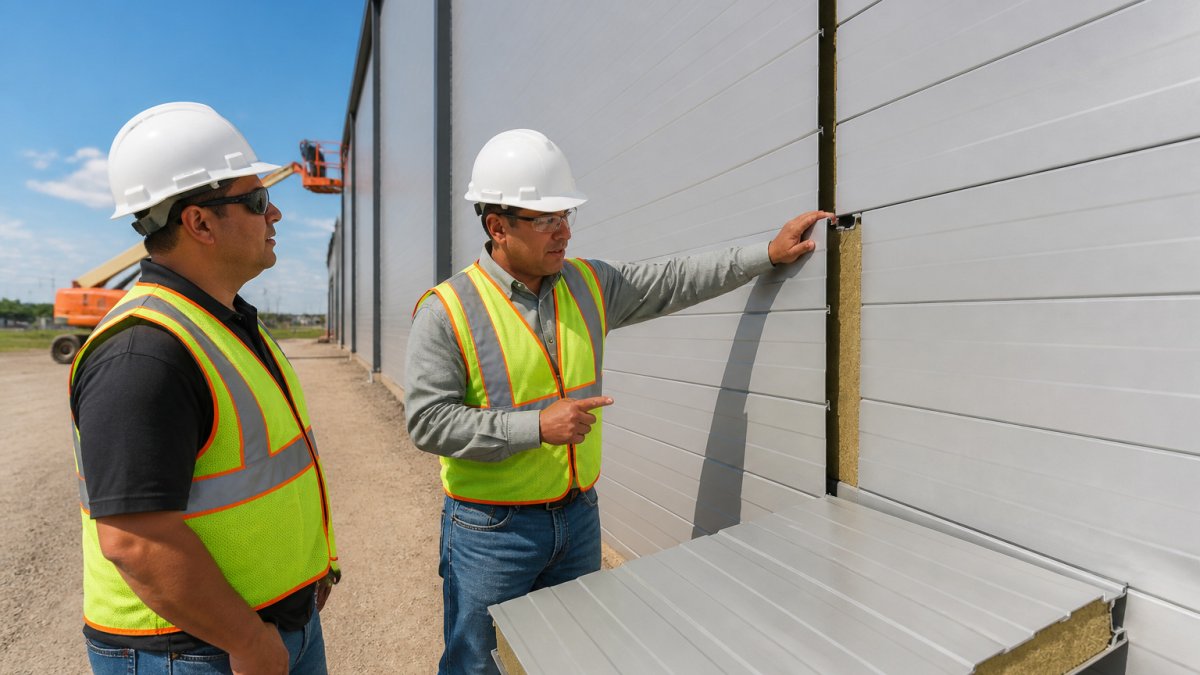
When you specify insulated metal panels, confirm the core type, the face material and the tested assembly name. Changing any one of these can change the rating, so substitutions during procurement should be reviewed before installation.
Reading ASTM E84 Fire Ratings for Metal Siding
ASTM E84 is the standard test method for surface burning characteristics of building materials, commonly called the Steiner tunnel test. A sample is mounted in a horizontal tunnel, exposed to a controlled flame at one end, and observed for how far flame spreads along its surface and how much smoke is produced.
For metal wall cladding, the practical takeaway is that E84 describes surface behavior under a specific laboratory exposure, not the fire resistance of the wall.
What the Indices Actually Mean
Class A (sometimes written Class 1) generally corresponds to a flame spread index of 0-25. Class B covers 26-75, and Class C covers 76-200. Many commercial building codes reference these classes when regulating interior finishes and, in some cases, exterior wall surfaces.
Smoke developed index matters too, especially where egress or life safety is a concern. A product can have a low flame spread index and still produce significant smoke, and some code sections regulate smoke separately.
Where E84 Stops and Assembly Tests Begin
E84 is a material-surface test (E84 Standard Test Method for Surface Burning Characteristics of Building Materials). It does not evaluate:
- Whether a wall assembly achieves a one-hour or two-hour fire-resistance rating (that is the domain of ASTM E119, which tests complete assemblies under a time-temperature curve)
- Whether an exterior wall with combustible components limits vertical fire spread (that is the domain of NFPA 285, which applies to exterior wall assemblies with foam plastic insulation or other combustible elements)
- How joints, cavities, insulation and penetrations behave under fire exposure
A metal panel can carry a Class A E84 result and still be part of an assembly that fails an NFPA 285 evaluation if the core, insulation or detailing is wrong. Conversely, a non-combustible mineral-wool-core panel may satisfy E84 easily while the assembly-level rating depends entirely on the tested configuration.
Do not accept an E84 report as proof of fire resistance. Ask for the specific assembly test report (ASTM E119 or NFPA 285, as applicable) that matches the wall build-up you intend to install.
How to Read the Report Before You Approve a Submittal
When a supplier sends an E84 report, check these items:
- The exact product name and thickness tested, not a family of products
- The substrate and coating system, since a different finish can change results
- The FSI and SDI values, and which class they correspond to
- The test date and the edition of ASTM E84 referenced
- Whether the report covers the panel as installed or only a bare metal sample
If the report covers a bare or primed sample but the project specifies a textured or high-build coating, ask for documentation on the finished product. Most manufacturers test the finished panel, but the report should say so explicitly.
The Assembly-Level Question E84 Cannot Answer
This is the gap most product literature glosses over: a non-combustible metal skin does not, by itself, give a wall assembly a fire-resistance rating. Ratings are earned by the complete tested construction, studs or girts, sheathing, insulation, membranes, cladding, fasteners and joints, evaluated as a system.
ASTM E84 standard scope and test method overview
The article breaks down what each E84 index and class means and what the test does not cover.
| Item | Value | Note |
|---|---|---|
| Class A flame spread index | 0-25 | Rapid flame spread resisted in the tunnel |
| Class B flame spread index | 26-75 | Intermediate flame spread |
| Class C flame spread index | 76-200 | Highest spread class listed |
| Test method | ASTM E84 | Steiner tunnel, surface behavior only |
| Assembly fire-resistance test | ASTM E119 | Evaluates complete wall assemblies |
| Exterior wall propagation test | NFPA 285 | Applies to assemblies with combustible components |
Commercial Building Fire Code Requirements You Need to Verify
Fire requirements for exterior walls are not set by a single national rule. They come from the model code adopted in your jurisdiction, most commonly the International Building Code (IBC) or, in some areas, NFPA 5000, plus any state or local amendments, and they vary by occupancy, construction type, building height, distance to property lines and whether the wall is rated.
The Variables That Drive Exterior Wall Requirements
When a designer or contractor asks whether a given metal cladding system is acceptable, the answer depends on several interacting factors:
- Construction type, Type I and II construction generally require noncombustible exterior walls; Type III, IV and V allow more combustible elements, subject to limits.
- Fire separation distance, The distance from the exterior wall to the property line, an adjacent building or a public way determines how much fire resistance the wall needs and whether openings and combustible elements are restricted.
- Building height and area, Taller and larger buildings face stricter requirements, and height is often measured to the average roof height.
Model Code Provisions That Commonly Apply
In IBC-based jurisdictions, Chapter 26 governs exterior wall construction and Chapter 14 covers exterior wall finishes. Key concepts include:
- Noncombustible exterior walls for Type I and II construction, with limited exceptions
- Fire-resistance-rated exterior walls where fire separation distance is small, expressed in hours (often 1-hour or 2-hour)
- NFPA 285 evaluation for exterior wall assemblies containing foam plastic insulation or certain other combustible components in buildings of Type I-IV construction above a specified height
NFPA 285 is the test most often overlooked. It evaluates the fire propagation characteristics of an exterior wall assembly, including how fire spreads vertically and laterally across the face, within the cavity, and through joints, and it applies to assemblies, not individual products. A metal panel with a foam core may be acceptable on a low building with generous separation, yet require an NFPA 285-tested assembly on a taller building closer to the property line.
Ask the manufacturer for the NFPA 285 report by assembly name, not just the panel name. The report should identify the insulation, sheathing, membrane and attachment details that were tested together.
A Practical Verification Workflow
Rather than relying on a single data sheet, work through these steps before finalizing a specification:
- Confirm the adopted code and edition with the authority having jurisdiction (AHJ). Many jurisdictions publish their amendments online.
- Identify the construction type and fire separation distance from the architectural drawings.
- Determine whether the wall must be noncombustible, fire-resistance-rated, or both, and in what hourly rating.
- Check whether NFPA 285 applies based on building height, construction type and combustible components in the assembly.
- Match the proposed assembly to a tested configuration, ASTM E119 for fire-resistance ratings, NFPA 285 for exterior propagation, ASTM E84 for surface classification.
- Document the assembly by name and test report number in the specification and submittal.
- Review substitutions, a different insulation, membrane or fastener can invalidate the tested assembly even if the metal face is identical.
Where Requirements Vary Most
Wildfire-prone areas and urban-wildland interface zones often add requirements beyond the base code, sometimes through state or local ordinances referencing ignition-resistant construction standards. Historic districts and certain occupancy types can also carry amendments. Because these vary by jurisdiction, confirm current local requirements with the AHJ and have the design team, manufacturer and cladding installer review the assembly together before procurement.
What to Hand the AHJ
A clean submittal package typically includes the code section being satisfied, the tested assembly designation, the applicable test reports (E119, NFPA 285, E84), the manufacturer’s installation instructions, and a statement that the proposed build-up matches the tested configuration. Providing this up front shortens review and reduces the chance of a mid-project redesign.
International Code Council overview of the International Building Code
Wildfire Exposure, Heat Limits and Failure Points to Check Before You Specify
Metal cladding can help resist ember ignition, but embers can still enter through gaps, vents, soffits and damaged seals. Even non-combustible panels can be compromised if surrounding details are vulnerable. Heat exposure also affects coatings, sealants and fasteners, which may degrade before the metal itself.
Before specifying, check the following points:
- Confirm the complete tested assembly, not just the panel product
- Review vent, soffit and penetration details for ember entry paths
- Inspect sealant and gasket compatibility with expected heat exposure
Planning Your Next Metal Cladding Project With Total Cladding and Roofing
Fire performance is a system question, and the right answer for one building may not suit another. If you are new to hiring for this work, learn what insulated metal panel contractors do and what to expect from them. Review our Texas commercial roofing services for inspections, repairs and replacement, and how to request a review or quote.
If you are evaluating metal wall cladding for a Texas project, contact Total Cladding and Roofing LLC for a review of your requirements. Pricing depends on project size, panel selection, site conditions and schedule, so request a quote through the Total Cladding and Roofing LLC website for current pricing.
Frequently Asked Questions
Which type of cladding is the most fire-resistant?
Metal cladding, particularly aluminum and steel panels, is generally classed as non-combustible at the material level. Fire resistance of the complete wall, however, depends on the core and the assembly. Insulated metal panels with mineral wool cores typically perform better than panels with foam cores. Before choosing, ask the manufacturer for tested fire ratings for the specific panel and assembly you plan to use, and confirm they match your local code requirements.
Do insulated metal panels meet fire safety standards?
Insulated metal panels can meet fire safety standards, but compliance depends on the specific product, core material and how the wall is assembled. Many manufacturers publish test results for their panels, including ASTM E84 surface burning characteristics and, for some systems, fire resistance ratings for full wall assemblies. Review the test reports and confirm the listing covers your exact configuration, because a rating for one assembly does not automatically apply to another.
How does metal cladding perform in wildfire-prone areas?
Metal cladding resists ignition from flying embers and radiant heat better than many combustible siding materials, which is why it is frequently specified in wildfire-prone areas. Performance still depends on the full wall, including sheathing, insulation, vents, gaps and trim, since embers can enter through openings even when the panel face does not burn. Review the wall assembly details and any applicable California WUIC or local wildland-urban interface requirements for your site.
What is the difference between wall cladding and metal cladding?
Wall cladding is the general term for any exterior layer applied to a building wall to protect it and improve its appearance, and it can be made from brick, stone, fiber cement, wood or metal. Metal cladding refers specifically to cladding made from metal panels, usually aluminum or steel. Metal is valued for durability, low maintenance and, in many cases, non-combustibility, but it still needs to be evaluated as part of a complete wall system for fire performance.

To upload drawings, specs and plans please go to the form on our contact page.
Get in Touch