

Last Updated: November 1, 2026
Quick Summary
The clearest signs of clogged commercial roof scuppers are standing water within roughly 10 feet of the scupper that lingers more than 48 hours after rain stops, visible debris packed into the opening, and overflow scuppers running during normal rainfall. Water stains on the parapet below the outlet and ponding that spreads further with each storm also point to a blockage.
- A roof that drains well in light rain can still fail in a storm, signaling a partial blockage.
- Overflow scuppers sit a few inches above the primary outlet and only carry water when the main path fails.
- Standing water is too long when it remains more than 48 hours after rain stops.
- Clear screens and openings quarterly, and run a full drainage inspection before storm season.
- A scupper that never keeps up in heavy rain is a sizing problem, not a blockage.
Table of Contents
- How Commercial Roof Drainage Systems Work
- What Roof Scuppers Are and Where They Sit
- Scupper Types and Configurations on Flat Roofs
- Signs of Clogged Roof Scuppers: A Symptom Checklist
- Standing Water on a Flat Roof: How Long Is Too Long?
- How to Inspect Commercial Roof Drainage Systems Safely
- How to Unclog a Roof Drain and Clear a Scupper
- Roof Scupper Maintenance: Schedule and Seasonal Checklist
- Frequently Asked Questions
How Commercial Roof Drainage Systems Work
Water always finds the low point.
On flat and low-slope roofs, water can collect faster than it drains while the roof carries the load.
A commercial roof drainage system is the planned path water takes from the roof surface to the ground. It has three parts:
- Collection points: scuppers, roof drains, and gutters that catch water
- Slope: the pitch of the roof surface that pushes water toward those points
- Overflow routes: secondary outlets that take over when the primary path blocks
Most flat roofs slope only slightly toward their outlets. That shallow pitch means flow depends on an open, unobstructed opening.
The Whole Building Design Guide on roof drainage explains that drainage planning belongs in the original roof design, not added later.
Watch out: a roof that drains well in light rain can still fail in a storm.
What Roof Scuppers Are and Where They Sit
A roof scupper is an opening at the roof edge, or through a parapet wall, that lets water leave the roof surface and drop into a gutter or leader below.
You will usually find scuppers in three places:
- Cut through a parapet wall at the low edge of the roof
- At the roof edge above a gutter or downspout
- Paired with an overflow scupper set slightly higher than the primary one
The exact size of a scupper depends on roof area and expected rainfall.
Scuppers differ from roof drains in one key way. A roof drain sits inside the roof field and connects to internal piping.
Scupper Types and Configurations on Flat Roofs
Open scuppers are the simplest type: a plain opening in the parapet with no screen or grate.
Screened scuppers add a metal or plastic screen across the opening.
Overflow scuppers sit a few inches above the primary outlet. They stay dry in normal rain and only carry water when the main path fails.
Other configurations you will see:
- Box scuppers: a fabricated metal box that channels water through a thick wall
- Through-wall scuppers: a sleeve that passes water through the wall to an outside leader
- Spout scuppers: a short projecting lip that throws water clear of the wall face
Each type clogs differently. Screens collect surface debris. Open scuppers collect debris deeper inside the opening.
Signs of Clogged Roof Scuppers: A Symptom Checklist
The clearest signs of clogged commercial roof scuppers show up in a predictable order. Catch them early and you avoid the expensive ones. The checklist below is scupper-specific: each item points to the outlet itself, not to a general drainage problem.
Scupper-specific symptom checklist
- Standing water within roughly 10 feet of the scupper that lingers more than 48 hours after rain stops
- Water stains or dark streaks running down the parapet or wall directly below the outlet
- Visible debris packed into the opening, sitting on the screen, or mounded on the roof within a few feet of the outlet
One symptom alone is a prompt to look closer. Two or more together mean the scupper is likely blocked now, not later.
How to tell a blocked scupper from other drainage problems
A wet roof edge does not always mean a clogged scupper. Use these distinctions before you schedule a cleaning:
| What you see | Likely cause | How to confirm |
|---|---|---|
| Water pools near the scupper, drains slowly after you clear the opening | Blocked scupper | Flow test: pour a bucket at the outlet; if it drains fast after clearing, the scupper was the problem |
| Water pools in the middle of the roof, far from any outlet | Poor roof slope or a blocked internal drain | Check whether water reaches the scupper at all; if it never arrives, the scupper is not the cause |
| Water backs up at a roof drain strainer while the scupper runs clear | Blocked internal drain or piping | Compare flow at the drain and the scupper during the same rain event |
| Water overflows the gutter below the scupper while the scupper runs clear | Blocked gutter or leader, not the scupper | Look down at the gutter and leader from the roof edge |
| Scupper runs clear in light rain but overflows in heavy rain | Undersized scupper, not a blockage | Compare opening size to roof area and local rainfall; a scupper that never keeps up is a sizing problem |
| Scupper opening is clear but water stains the wall below | Damaged scupper, failed seal, or cracked parapet | Inspect the scupper sleeve and wall face for cracks, gaps, or rust-through |
A scupper that looks clear at the surface can still be blocked deeper in. Debris often packs behind the wall face where you cannot see it from the roof edge. Always test flow, not just appearance.
Urgency guide: when to act now versus schedule a fix
Not every clogged scupper is an emergency, but some are. Use this severity guide to decide whether to clear it yourself, call a contractor, or escalate immediately.
- Act now (same day): active leak into the building, water flowing over the parapet cap, rapidly rising ponding during a storm, or visible roof distress (sagging, deflection, cracking) near the outlet. These point to structural load or water intrusion that gets worse by the hour.
- Schedule within the week: standing water that lingers more than 48 hours after rain, overflow scuppers running in normal rain, or recurring ponding at the same outlet. These are drainage failures that will damage the membrane if left.
- Monitor and plan: a single symptom (light staining, minor debris) with no active leak. Clear the outlet at the next scheduled maintenance visit and recheck after the next storm.
If ponding from a blocked scupper is a recurring issue, it is worth having a professional assess the cause.
Standing Water on a Flat Roof: How Long Is Too Long?
Standing water on a flat roof is too long when it remains more than 48 hours after rain stops. That is the practical threshold most roof professionals use, and it matches the general guidance in NRCA roof maintenance resources on ponding and drainage.
Water that sits for days works its way into seams, fasteners, and membrane laps, and adds weight: even a shallow layer across a large roof adds real structural load. See this guide on how to prevent water ingress in flat roofs to reduce that risk.
A roof that holds water for a day after a storm is a drainage problem. A roof that holds water for a week is a structural concern.
How to Inspect Commercial Roof Drainage Systems Safely
Safe inspection starts before you climb anything. Check the weather, check the access route, and check that someone knows you are on the roof. A wet or debris-covered roof surface is a slip hazard on its own, and falls remain the leading cause of serious injury in roof work.
Before you go up, review your site’s safety procedures for commercial roof access.
Tools to bring
- Flashlight or headlamp (to look into the opening, not just at it)
- Stiff brush and a scraper or rod
- Work gloves
Step-by-step inspection
- Photograph each outlet before you touch it, so you have a record of conditions.
- Check the roof surface around each scupper for standing water, soft spots, and debris mounding.
- Look into the opening with a flashlight, not just at it. Debris often packs behind the wall face.
- Test flow by pouring a bucket of water at the outlet and watching how fast it drains. Note the time.
- Check the overflow scuppers and note whether they show signs of recent flow (staining, water lines, debris lines).
- Look down at the gutter or leader below the scupper to confirm water is reaching it.
- Record everything with photos and a short written note per outlet, including the date and the flow-test result.
Stop-work conditions
Stop the inspection and leave the roof if any of these apply:
- Lightning within earshot or visible in the area
- Sustained winds strong enough to affect balance or dislodge tools
- Standing water deep enough to hide surface defects or create a slip hazard
If you cannot access the roof safely, an inspection method that does not require roof access may be an option to discuss with a qualified contractor. Drone roof inspections are one alternative worth considering for checking drainage without climbing.
Verify flow after inspection
A flow test is only useful if you record the result: how fast the bucket drained, whether water reached the gutter or leader below, and whether the overflow scupper showed recent flow.
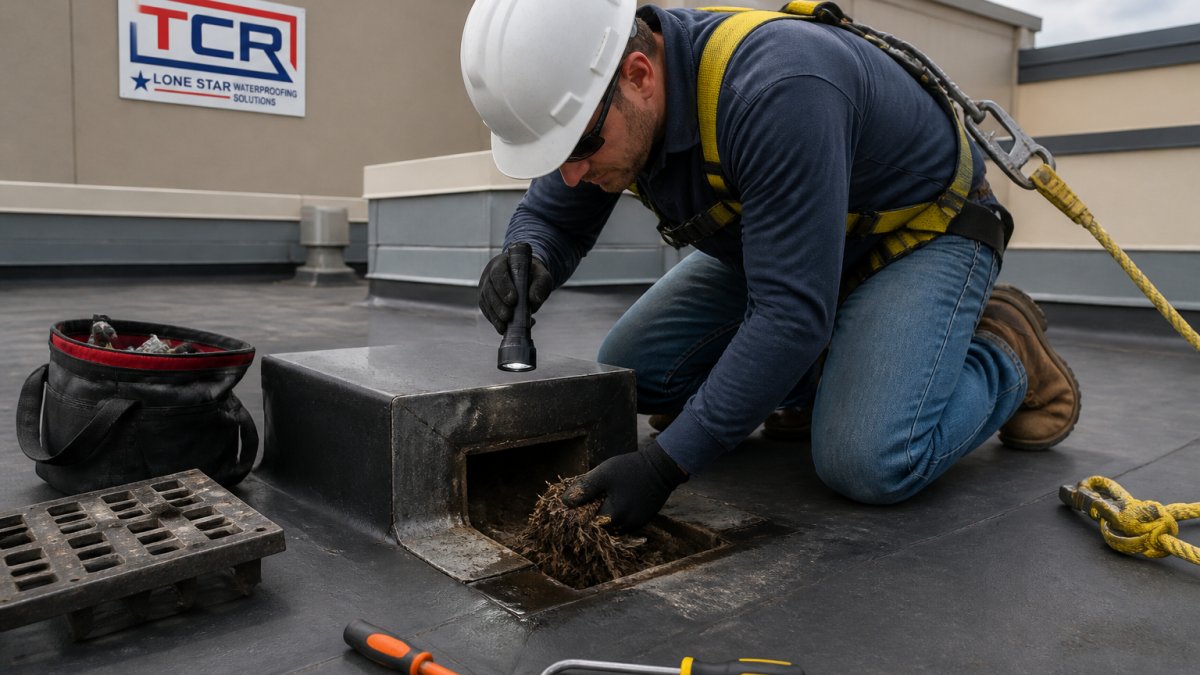
How to Unclog a Roof Drain and Clear a Scupper
Clearing a scupper is simple work, but the sequence matters. Start at the opening, work inward, and confirm flow before you leave.
Follow these steps:
- Remove surface debris by hand or with a stiff brush. Wear gloves.
- Lift the screen if there is one, and clear it separately.
- Reach into the opening with a scraper or rod to break up packed debris.
- Flush with water from a bucket or hose, working from the high side of the opening.
- Check the gutter or leader below for the water you just sent through.
- Repeat until flow is clear and fast, then refit the screen.
- Photograph the cleared outlet and note the date.
For a roof drain, the process is similar but the opening is smaller: remove the strainer, clear the bowl, and flush. If water still backs up, the blockage is in the internal piping, a job for a contractor.
If a scupper keeps blocking, or the opening is too small for the roof area it serves, the fix is a repair or resize, not another cleaning. For commercial gutter repair, box gutter lining and replacement in Texas, including overflow drainage sizing for heavy rain, a qualified roofing contractor can assess the cause.
Roof Scupper Maintenance: Schedule and Seasonal Checklist
Roof scupper maintenance works best on a fixed schedule, not a reaction basis. Set the dates and keep them.
A practical schedule for most commercial roofs:
| Frequency | Task | Why It Matters |
|---|---|---|
| Monthly | Visual check from ground level | Catches overflow flow and wall stains early |
| Quarterly | Clear screens and openings | Prevents debris build-up before storm season |
| Before storm season | Full drainage inspection | Confirms capacity ahead of peak rainfall |
| After major storms | Check all outlets | Storms deposit debris fast |
| Annually | Full roof and drainage review | Catches undersized or damaged outlets |
Seasonal timing matters. Clear scuppers in late winter before spring storms, again in early summer, and once more before fall.
A wider maintenance schedule can help keep a roof performing between inspections.
Blocked scuppers are one of the cheapest roof problems to fix and one of the most expensive to ignore.
Frequently Asked Questions
How can you tell if a commercial roof scupper is clogged?
Look for standing water near the roof edge, water stains or discoloration around the scupper opening, and visible debris like leaves or gravel blocking the flow. After a heavy rain, check whether water drains within 48 hours. If water remains or you see streaks down the building facade, the scupper is likely clogged and needs clearing.
How quickly should standing water drain from a commercial roof?
Most flat roofs should shed standing water within 48 hours after rain stops. Water that lingers longer, especially deeper than 1/2 inch, signals a drainage problem. Persistent ponding adds structural load and speeds membrane damage. If water remains past two days, inspect the scuppers and roof drains for blockages or poor slope.
Can a clogged roof scupper cause a roof leak?
Yes. When a scupper is blocked, water backs up and can seep under flashing, around fasteners, or through seams in the roof membrane. Over time, this leads to interior leaks and water damage. Clearing clogged roof scuppers promptly and scheduling regular roof scupper maintenance helps prevent leaks and extends the roof’s service life.
How often should commercial roof drainage systems be inspected?
Inspect commercial roof drainage systems at least twice a year, ideally in spring and fall, and after major storms. Facilities with heavy tree cover may need quarterly checks. Regular inspections catch debris buildup early, verify that scuppers and drains flow freely, and help you plan roof scupper maintenance before small blockages turn into costly water damage.

To upload drawings, specs and plans please go to the form on our contact page.
Get in Touch