

TPO Roofing in Austin, TX

TPO for manufacturing, R&D, office and distribution roofs

Austin low-slope roofing

Membrane roofs that carry a building's equipment

Manufacturing plants, R&D and flex buildings, and offices in Austin put a lot of equipment on their roofs, and TPO roofing handles that kind of roof well. Its flashings are welded to the field membrane around curbs, pipes and supports, so the details become part of the same sheet. Our work here covers new roofs, full tear-offs and recover projects on these buildings and on the distribution warehouses lining I-35 and SH 130.

Total Cladding and Roofing treats each roof as a coordinated system of deck, insulation, cover board, single-ply membrane and details, backed by 20+ years of commercial roofing experience. Equipment-heavy roofs reward that approach, because most of the labor and most of the risk sit at the penetrations.
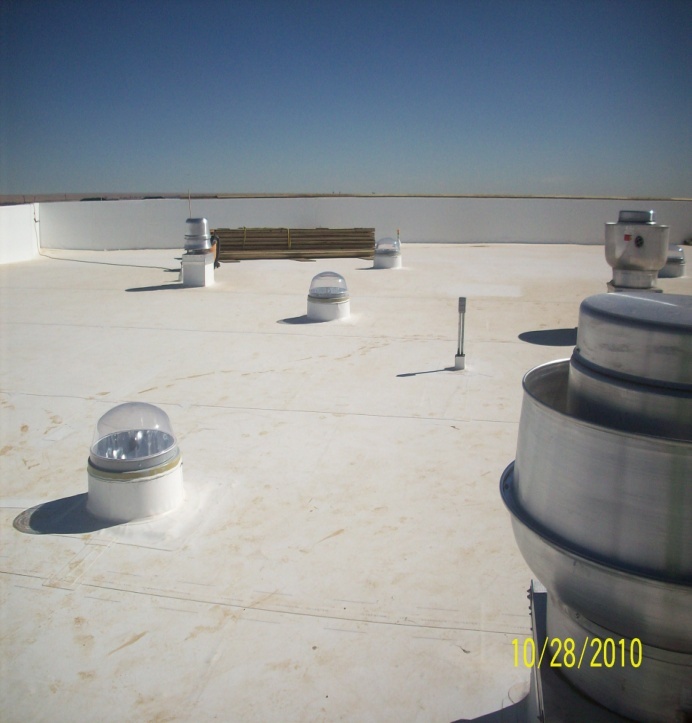

White TPO roof membrane around roof vents and skylights
White TPO roof membrane around roof vents and skylights.

Manufacturing and tech buildings

Manufacturing and tech buildings around Austin often carry process exhaust fans, makeup air units, dust collectors and gas piping across the roof. Before we specify a membrane, we find out what comes out of every stack. TPO handles ordinary rooftop exposure well, but some process exhausts carry oils or solvents that call for a protected zone or a different detail around the outlet.

These buildings rarely tolerate a shutdown. We work out with the plant team which zones sit over production lines, clean areas or stored product, then sequence the roof so those areas are opened for the shortest possible time and protected while they are.

Roofs crowded with rooftop equipment

On a dense roof, every curb, pipe support, conduit run and roof hatch is a penetration that needs its own flashing. We survey and number each one before pricing, so the proposal shows exactly what is being flashed, raised or removed. Pre-molded TPO pipe boots and corners cover standard pipes and curb corners, and larger or irregular penetrations get field-fabricated flashings welded in place.

New insulation lifts the roof surface, so curbs that were tall enough before often end up too short. We raise curbs to keep flashing height above the finished roof, set pipe and conduit on supports that rest on protection pads rather than on bare membrane, and lay walkway pads along the routes technicians actually use.

R&D, flex and office buildings

R&D and flex buildings in Round Rock, Cedar Park and Pflugerville mix labs, offices and light production under one roof, often for several tenants. Office buildings add another factor: outside-air intakes that pull whatever is on the roof straight into occupied floors.

That is why attachment choice matters here. Mechanically attached and induction-welded systems need no field adhesive across the roof, so they avoid solvent odor near intakes. Where an adhered system is the right call, we use low-odor adhesives and schedule work near the intakes with the building engineer, who can close the dampers while it is underway.

Details we plan on an Austin TPO roof

Equipment curbs

Each curb is measured against the new roof surface and raised where needed, so the TPO flashing turns up to its full height and finishes under the unit’s counterflashing rather than short of it.

Service walkways

Walkway pads welded to the membrane mark the routes from the roof hatch to each unit. They concentrate foot traffic where the roof is protected and keep tools and parts off open membrane.

Pipe and conduit supports

Gas lines, condensate lines and conduit sit on support blocks with protection pads underneath. Nothing is strapped down through the membrane, and nothing rests directly on its surface.

Air intakes and exhausts

We map every intake and exhaust before work starts. Adhesive work and welding fumes are kept clear of the intakes, and process exhausts get a protected zone of membrane around their outlets.

Distribution along I-35 and SH 130

The distribution and logistics buildings along SH 130 east of Austin, and down I-35 through Kyle and San Marcos, are largely newer tilt-wall buildings with broad, simple roofs. On a new building we price and install the roof package for the general contractor and coordinate it with the deck, drains and rooftop units.

Big new roofs leave no room for drainage shortcuts. We confirm the taper layout, drain sizes and overflow scuppers before the insulation order goes in, because correcting slope on a finished roof means taking it apart.

Central Texas sun and storms on Austin roofs

Austin summers put long hours of high sun on every roof. White TPO reflects that heat rather than storing it, which matters most on buildings packed with server rooms, labs or production equipment that already generate their own heat. A cooler roof means the rooftop units start each afternoon with less heat to remove.

Spring brings hail and short, intense downpours. Equipment-heavy roofs suffer most from the rain, because every curb and pipe support acts as a dam that slows water. We place crickets on the high side of large curbs to split water around them and keep drains clear of equipment. A firm cover board under the membrane is our standard defense against hail.

TPO roof replacement or recover on an older Austin building

Some older office and flex buildings around Georgetown and Round Rock still carry their original built-up or modified bitumen roofs, or an early single-ply sheet that has pulled away from its flashings. Each is a candidate for TPO, but the route depends on what the roof is hiding.

When the old roof is dry and it is the only covering, a TPO recover over a new recover board is usually the efficient answer. When a moisture survey and test cores find widespread wet insulation, or a second roof is already in place, we tear off to the deck. Building code does not permit a third roof layer, and wet insulation sealed under new membrane keeps degrading the roof from below.

Working in Austin from Bulverde

Our office in Bulverde is about an hour and 20 minutes from central Austin on a typical drive, and closer to San Marcos and Kyle on the southern edge of the metro. We book surveys and site meetings ahead of time so each visit covers everything the project needs.

Our TPO roofing service page covers the full system in detail. For buildings nearer our office, see TPO roofing in San Antonio, and for every service we offer here, visit the Austin commercial roofing hub. If your plant or warehouse has a failing metal roof rather than a flat one, a metal roof retrofit in Austin is often the better answer.

Talk through your Austin roof

Call (210) 775-0995 or share your roof plan and equipment list through our project inquiry form, and we will plan the first site visit.

Frequently asked questions

TPO Roofing in Austin, TX FAQs

Do you take on TPO roofing projects in Austin from your Bulverde office?

Yes. Austin and its suburbs are one of our two core markets. Central Austin is about an hour and 20 minutes from our Bulverde office on a typical drive, and San Marcos and Kyle are closer still. Site surveys, roof walks and progress meetings are booked in advance.

We searched TPO roofing contractors near me from Pflugerville. Does your area include us?

Yes. Pflugerville, Round Rock, Georgetown and Cedar Park all sit within the Austin metro we serve. We survey, design and install TPO roofs on manufacturing, R&D, office and distribution buildings throughout the area, from single-tenant plants to multi-tenant flex parks.

How do you handle a roof with dozens of rooftop units?

We survey and number every unit, curb, pipe and support before pricing. Each penetration gets its own flashing detail, curbs are raised to suit the new roof height, and walkway pads lead from the hatch to each unit. Unit shutdowns are scheduled with your mechanical contractor.

Will adhesive odors reach our offices or labs?

Not if the roof is planned around the intakes. We favor mechanically attached or induction-welded TPO near outside-air intakes because neither needs field adhesive. Where adhesive is required, we use low-odor products and work near intakes only after your building engineer has closed the dampers.

Can TPO handle exhaust from a manufacturing process?

TPO stands up to typical rooftop exposure, but oils, solvents and grease from some process exhausts can damage it. We identify what each stack discharges before specifying the roof, then add protection around the outlet or change the detail so the membrane is not exposed.

Can you work with our general contractor on a new building?

Yes. On new construction in Pflugerville, Kyle or elsewhere in the metro, we price and install the roof package for the general contractor and coordinate it with the deck, drains, rooftop units and wall panels. Taper and drainage are confirmed before insulation is ordered.

Should an older Austin office roof be recovered or replaced?

A dry, single-layer roof over a sound deck is a good recover candidate. If the moisture survey and cores find widespread wet insulation, or a second roof is already in place, replacement is the right call. We walk you through the survey results so the choice is clear.

What TPO thickness suits a roof with heavy service traffic?

We recommend 80 mil on roofs where technicians are up most weeks servicing equipment. The added thickness gives more material above the reinforcing scrim, so the membrane stands up better to foot traffic, dropped tools and long sun exposure. Walkway pads on the main routes do the rest.

Does a white roof help an Austin building with heavy internal heat?

Yes. Buildings with labs, server rooms or production equipment already generate heat inside. A white TPO membrane keeps the roof from adding much more on top, so the rooftop units have less work to do through long Austin summers. Adding insulation at the same time compounds the benefit.

What should we gather before you visit an Austin building?

A roof plan or photos that show the equipment layout help most, along with the address, roof size, existing membrane and any earlier survey reports. Tell us which areas hold production, labs or tenants that cannot be disturbed. Our number is (210) 775-0995, or write to us through the contact form.

UK refurbishment experience, a Texas office

Metal roof retrofit

A new metal roof above a suitable existing covering, with subframing, insulation and details considered together.

TPO roofing

New TPO roof systems, TPO roof replacement and TPO recover for warehouses, retail, offices and industrial buildings.

R-panel and insulated panels

R-panel roofing and wall cladding, and insulated metal panels for roofs and walls on new builds and refurbishments.

Protective metal coatings

Preparation, rust and cut-edge treatment, and compatible protective finishes for metal roofs and cladding.

Roofing and cladding systems

Roofing systems and materials for Texas facilities

Rustoleum Logo
Sika Logo
Kingspan Logo
Morin Logo
American WeatherStar Logo
GAF Logo
TAMKO Logo
PAC-CLAD Logo
1

Tell us about the building

Start with the address and the roof or cladding problem. Photographs are helpful if you already have them.

2

Arrange a site visit

We review the affected areas and discuss how you use the building and what you want the work to achieve.

3

Review the quotation

Your quotation explains the proposed metal roof or cladding work, the areas included and the price.

4

Agree the work plan

We discuss timing, access, deliveries and protection with your site contact before work begins.

5

Complete the work

We carry out the agreed work and discuss any changes needed if opening the roof reveals additional damage.

6

Handover

We review the completed work and provide the care information and documents included in your project.