

TPO Roofing in San Antonio, TX

TPO replacement and recover for warehouses, flex space and retail

San Antonio single-ply roofing

Big flat roofs on buildings that stay busy

We install TPO roofing in San Antonio on the large flat roofs that keep the city’s logistics and shopping running: distribution centers and warehouses along I-35 and I-10, flex buildings off Loop 410 and Loop 1604, and neighborhood retail centers. Most of that work is TPO roof replacement or a recover on a roof that has worn out while the building below stays busy.

Total Cladding and Roofing looks at the whole single-ply roof before pricing it: the deck, the insulation, the drainage and the edges, not just the membrane on top. Owners and facility managers get a straight answer on whether a roof should be recovered, replaced or switched to metal, backed by more than 20 years in commercial roofing.
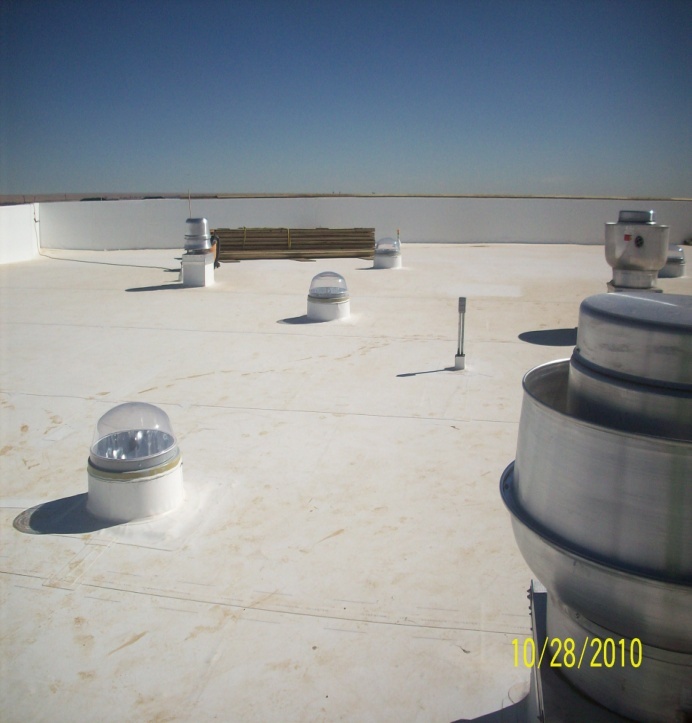

White TPO roof membrane around roof vents and skylights
White TPO roof membrane around roof vents and skylights.

Distribution and warehouse roofs on I-35 and I-10

The warehouse belt running northeast on I-35 toward Schertz and New Braunfels, and east on I-10 toward Seguin, is lined with tilt-wall and steel-framed buildings whose roofs are measured in acres. Those roofs are simple in shape but unforgiving in scale. One weak perimeter detail repeats along hundreds of feet of edge.

On roofs this size we usually specify mechanically attached TPO in wide sheets, which cuts the number of seams and goes down quickly over a steel deck. Perimeter and corner zones get tighter fastening for wind uplift. Tapered crickets between drains stop the shallow ponding that big flat roofs develop as the structure deflects under load.

Flex buildings along Loop 410 and Loop 1604

Flex and light industrial buildings off the two loops usually house several businesses under one roof, each with its own rooftop units, exhaust fans and hours. A roof project there is as much about tenants as it is about membrane. We map the roof by suite, agree a sequence with the property manager, and give each tenant notice of when crews will be overhead.

Years of tenant build-outs leave these roofs dotted with abandoned curbs, cut-in penetrations and patched openings. Where the owner agrees, we remove dead curbs and infill the deck, which takes those penetrations off the roof for good and simplifies the new membrane layout.

Recover or replace a big flat roof

On a large warehouse roof, the recover-or-replace decision carries real money, so we base it on data rather than a walk across the surface. We grid the roof for a moisture survey, cut test cores where the readings change, and map exactly which zones hold wet insulation.

If the wet areas are limited and the deck is sound, we cut out and replace the wet zones, then recover the whole roof with a recover board and new TPO. If moisture is widespread, the deck is rusting, or two roofs are already stacked on the deck, which is the most code allows before a tear-off, we recommend a full flat roof replacement.

What goes into a San Antonio TPO proposal

Moisture map

A grid survey with core cuts shows where the existing insulation is dry and where it is wet. It decides whether a recover is sound and how much removal the price needs to carry.

Tapered insulation

Crickets and tapered panels set slope toward every drain so water clears after a downpour. On older warehouses that pond, this is the change that makes the biggest difference to the finished roof.

Edge metal and wind zones

Coping, drip edges and gutters tie the membrane to the walls. Corners and perimeters get closer fastener spacing because uplift peaks there, and the edge metal is secured to match that design.

Dock canopies and low roofs

Loading dock canopies and lower attached roofs collect runoff from the main roof. We detail those transitions and their drainage so water from the high roof does not overwhelm the low one.

Retail centers and restaurant tenants

Neighborhood retail centers present a different job: parapet walls, storefront canopies, and a restaurant, salon or medical office under each bay. Shoppers need clear entrances, so we stage materials at the rear, keep crane lifts away from customer parking during store hours, and phase the roof one block of tenants at a time.

Restaurant exhaust is the detail most often missed. Grease from kitchen fans attacks TPO, so we fit grease containment at each kitchen exhaust and add protection pads around it. Parapet flashings run up and over the wall to the coping instead of stopping partway up.

San Antonio sun, heat and spring hail

A dark roof over a poorly insulated warehouse turns the top of the racking into an oven every summer. A white TPO membrane sends most of the sun back, which keeps the roof surface and the air under the deck noticeably cooler and takes load off the rooftop units. Adding insulation during a replacement or recover builds on that gain.

San Antonio’s spring thunderstorms throw hail at roofs and then dump rain faster than undersized drains can take it. We lay a high-density board beneath the TPO so impact meets a hard surface instead of crushable foam, and we specify 60 or 80 mil TPO depending on how much traffic and equipment the roof carries. Scuppers and overflow drains are checked so a cloudburst has somewhere to go.

Working out of Bulverde

Central San Antonio is a typical 30-minute drive from our Bulverde base down US 281. Boerne sits a short run to the west, and the I-35 corridor through Schertz and New Braunfels is close at hand, which keeps site visits, surveys and project meetings easy to arrange.

If you have been searching for TPO roofing contractors near me from a distribution building in Schertz or a retail center in Seguin, send us the address and we will set up a survey of the roof.

When metal is the better roof

A lot of the industrial stock around San Antonio is metal buildings with ribbed, through-fastened roof panels rather than membrane roofs. When that metal roof fails, TPO is rarely our first recommendation. A metal roof retrofit in San Antonio sets new panels on sub-purlins fastened through the old roof into the purlins, and fills the space between the two roofs with insulation.

For the full system detail, see our commercial TPO roofing service. Projects further north are covered on TPO roofing in Austin, and the San Antonio commercial roofing hub lists every service we offer in the area.

Talk to our team

Discuss your San Antonio TPO roof

Call (210) 775-0995 or use our project inquiry form to book a moisture survey and roof walk on your San Antonio building.

Request a project quote

Frequently asked questions

TPO Roofing in San Antonio, TX FAQs

Do you install TPO roofing on San Antonio warehouses and distribution centers?

Yes. Warehouse and distribution roofs along I-35, I-10 and the two loops suit TPO well, and we handle new systems, full tear-offs and recovers on them. Each phase is planned around docks, stock and shift patterns so freight keeps moving while the roof is renewed.

Are you one of the TPO roofing contractors near me if my building is in New Braunfels?

Yes. New Braunfels is a short drive from our Bulverde office, as are Schertz, Boerne and Seguin. We survey, price and install TPO roofs on commercial buildings throughout the San Antonio area, from big-box distribution space to small retail strips.

Can you recover a warehouse roof instead of tearing it off?

Often, yes. If the moisture survey shows the existing insulation is mostly dry, the deck is sound and the building has only one roof covering, we cut out the wet areas and install a recover board and new TPO over the old roof. The building stays weathertight and most of the old roof never has to be hauled away.

How far is your office from San Antonio?

We are based in Bulverde, just north of the city. The usual run into central San Antonio takes about 30 minutes via US 281, so site surveys, progress meetings and roof walks with your facility team are simple to schedule.

Can a multi-tenant flex building be reroofed one suite at a time?

Yes. We divide the roof along tenant lines, agree the order with the property manager, and close each section watertight before moving on. Every tenant gets notice before crews work overhead, and rooftop unit shutdowns are booked with the tenant's mechanical contractor.

How does hail affect a TPO roof in San Antonio?

Hail can fracture membrane laid over soft insulation, because the surface below gives way on impact. Putting a high-density board right beneath the TPO stiffens that base, and a thicker sheet adds margin. We build both into new roofs, replacements and recovers alike.

Is a white TPO roof worth it on a San Antonio warehouse?

On a large warehouse under a South Central Texas sun, yes. A white membrane reflects sunlight that a dark roof would absorb, so the deck and the air under it stay cooler and the rooftop units work less. Pair it with added insulation and the building holds a steadier temperature.

What TPO thickness do you recommend for a distribution center roof?

For most distribution roofs we specify 60 mil. Where the roof sees heavy service traffic, frequent equipment changes or an owner planning a long hold, we move to 80 mil, which puts more weathering material above the reinforcement. We rarely recommend 45 mil on a building of this size.

Can you work on a retail center roof while the stores stay open?

Yes. We stage materials behind the building, keep lifts away from customer parking during store hours, and phase the roof by tenant block. Restaurant tenants get grease containment at their kitchen exhaust fans so cooking grease stays off the new membrane.

What should I send for a San Antonio TPO quote?

The address, roof size and current roof type get us started. Add any core or moisture survey reports, drawings and photos, and note the docks, tenants or production areas that must stay open. Call (210) 775-0995 or use our contact form, and we will arrange a site survey.

UK refurbishment experience, a Texas office

Metal roof retrofit

A new metal roof above a suitable existing covering, with subframing, insulation and details considered together.

TPO roofing

New TPO roof systems, TPO roof replacement and TPO recover for warehouses, retail, offices and industrial buildings.

R-panel and insulated panels

R-panel roofing and wall cladding, and insulated metal panels for roofs and walls on new builds and refurbishments.

Protective metal coatings

Preparation, rust and cut-edge treatment, and compatible protective finishes for metal roofs and cladding.

Roofing and cladding systems

Roofing systems and materials for Texas facilities

Rustoleum Logo
Sika Logo
Kingspan Logo
Morin Logo
American WeatherStar Logo
GAF Logo
TAMKO Logo
PAC-CLAD Logo
1

Tell us about the building

Start with the address and the roof or cladding problem. Photographs are helpful if you already have them.

2

Arrange a site visit

We review the affected areas and discuss how you use the building and what you want the work to achieve.

3

Review the quotation

Your quotation explains the proposed metal roof or cladding work, the areas included and the price.

4

Agree the work plan

We discuss timing, access, deliveries and protection with your site contact before work begins.

5

Complete the work

We carry out the agreed work and discuss any changes needed if opening the roof reveals additional damage.

6

Handover

We review the completed work and provide the care information and documents included in your project.