
Table of Contents
- Why Insulation Choice Matters for Texas Industrial Buildings
- Quick Comparison: 5 Best Insulation for Texas Industrial Buildings
- 1. Closed-Cell Spray Foam: Best for Condensation Control
- 2. Insulated Metal Panels for Industrial Buildings: Best for New Builds and Retrofits
- 3. Fiberglass Batts and Blankets: Best Insulation for Metal Buildings on a Budget
- 4. Rigid Foam Board: Best for Wall and Roof Assemblies
- 5. Reflective and Double-Bubble Insulation: Best for Radiant Heat
- Warehouse Insulation for Heat and Condensation: Matching Material to Facility Use
- Frequently Asked Questions
Last Updated: October 17, 2026
Why Insulation Choice Matters for Texas Industrial Buildings
Choosing the right insulation for Texas industrial buildings is less about hitting a target R-value and more about surviving a climate that attacks a building envelope from two directions. Summer heat pushes inward for months, and humid Gulf air condenses on any cold metal surface it can find. The wrong material handles one problem and fails the other.
At Total Cladding and Roofing LLC, we assess existing roof and wall assemblies before recommending anything, because the building’s current condition usually decides the answer. A warehouse fighting condensation needs a different material than a barn that just needs to slow heat gain.
Below, we rank five insulation options by what they actually do well. Each entry covers cost, performance, and where it falls short.
Quick Comparison: 5 Best Insulation for Texas Industrial Buildings
| Option | Best For | Typical Material Cost | Main Tradeoff |
|---|---|---|---|
| Closed-cell spray foam | Condensation control | $1.50-$3.50/sq ft installed | Highest cost |
| Insulated metal panels | New builds and retrofits | Project-quoted | Needs skilled crews |
| Fiberglass batts and blankets | Budget metal buildings | $0.30-$1.50/sq ft | Weak moisture control |
| Rigid foam board | Wall and roof assemblies | Project-quoted | Seam detailing |
| Reflective and double-bubble | Radiant heat | Project-quoted | Low conductive R-value |
Costs reflect material and installed ranges reported in industry guides; U.S. Department of Energy insulation guidance recommends confirming R-values against your climate zone before you buy.
1. Closed-Cell Spray Foam: Best for Condensation Control
Closed-cell spray foam is the strongest single answer to condensation in a metal building. It expands into gaps, bonds to the substrate, and forms its own vapor barrier, so humid air stops reaching the cold panel surface where condensation starts.
That price buys air sealing and moisture control in one step, which matters in a warehouse holding moisture-sensitive products.
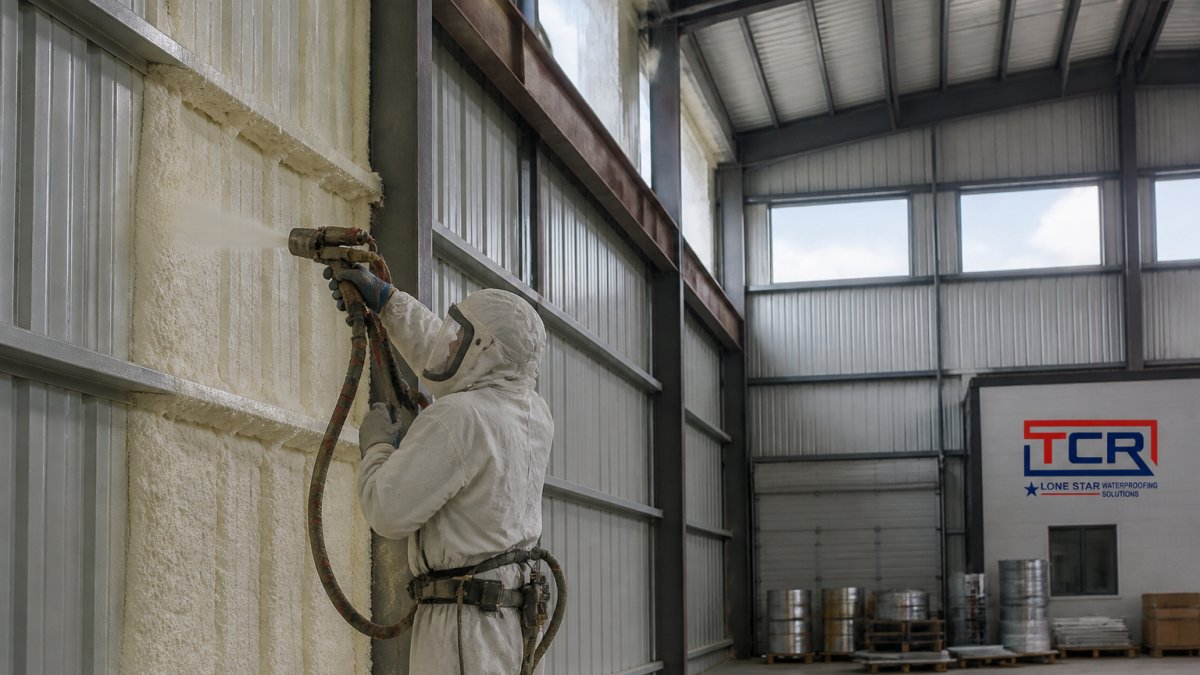
Where it falls short: the upfront number is the highest on this list, and spraying requires the space to be cleared. Plan application around stored goods and production schedules.
Ask the applicator to confirm the foam’s fire-performance rating for your occupancy type before work starts. Closed-cell foam varies by product, and the spec sheet, not the sales pitch, is what your inspector will read.
2. Insulated Metal Panels for Industrial Buildings: Best for New Builds and Retrofits
Insulated metal panels for industrial buildings combine cladding and thermal insulation in a single factory-made unit. A foam core sits bonded between two steel skins, giving you a finished wall or roof with predictable thermal performance and no separate insulation step.
For new construction, panels go up as the envelope goes on, which shortens the schedule. For retrofits, they can overclad a failing wall, so you fix leaks and thermal performance together.
The catch is coordination. Panel systems demand accurate setting-out, correct sealants, and crews who understand the joint details. Poor installation shows up later as air leakage at the seams.
3. Fiberglass Batts and Blankets: Best Insulation for Metal Buildings on a Budget
Fiberglass batts and blankets are a path to thermal insulation in a metal building. Blanket systems are made for metal buildings specifically, running across purlins and behind the panels.
Here’s what most guides miss: fiberglass insulates well but controls air poorly. Vapor passes through it, so in a humid climate the vapor barrier and the seal at every penetration decide whether the assembly works. In a metal building, that means the facing, the vapor retarder bonded to the blanket, is doing as much work as the glass itself. A common pattern in humid regions is a blanket installed with the facing on the wrong side, or with the facing laps unsealed, and the result is condensation on the interior panel surface that the insulation was supposed to prevent.
A second mechanism matters on metal roofs: the purlin thermal bridge. Every purlin is a direct path for heat to move between the panel and the interior, and a blanket compressed over the purlin loses R-value exactly where the building needs it most. Systems that use a thermal break, a separate spacer block or a higher-density strip at each purlin, preserve the rated R-value across the bridge. Skipping that detail is one of the most common reasons a metal building underperforms its insulation spec.
Compression is the other silent failure. Squashed fiberglass loses R-value, and crews routinely compress batts to fit around bracing, obstructions, and at the eave. The fix is specifying the correct thickness for the cavity and detailing the transitions rather than forcing material into gaps.
Skipping the vapor barrier on a fiberglass system in a humid climate invites condensation inside the wall cavity. The result is wet insulation, corroded fasteners, and stained interior finishes, and the fix costs far more than the barrier would have.
Where fiberglass fits best: budget-driven warehouses and workshops where the envelope is new or in good condition, the vapor retarder can be installed and sealed correctly, and the facility does not hold moisture-sensitive goods. It is a poor fit for cold storage, wash-down areas, or any building where interior humidity is high and sustained.
On lifecycle cost, fiberglass is the lowest first cost and the highest maintenance risk. Blankets can sag over time, facings can be damaged by stored goods or forklift traffic, and once the vapor retarder is compromised the assembly’s performance drops. Budget for periodic inspection of the facing and the eave details, and treat any tear as a repair item rather than cosmetic damage.
4. Rigid Foam Board: Best for Wall and Roof Assemblies
Rigid foam board delivers solid thermal performance in a thin profile, which makes it useful where wall thickness is tight. Boards install over purlins or sheathing and hold a consistent R-value with no settling. That combination, high R-value per inch and no sag, is why rigid board shows up in industrial retrofits where the existing structure cannot absorb a thicker blanket system.
The category is not one product, and the differences matter in a hot, humid climate. Polyisocyanurate (polyiso) offers the highest R-value per inch of the common boards and is the usual choice for roof assemblies, but its performance drifts in cold weather and it needs a protective cover in exposed applications.
That moisture behavior is the part most guides skip. Rigid foam is a vapor retarder, not a vapor barrier, and its permeance varies by product and thickness. In a hot-humid climate, placing a low-permeance board on the wrong side of the assembly can trap moisture in the cavity rather than keep it out.
The weak point is the seams. Every joint between boards is a potential air leak, so taping and staggered layout are not optional. On a retrofit, fitting board around existing penetrations takes patience and a detail-minded crew.
Fire performance deserves a line of its own. Foam plastics in walls and roofs are regulated, and many board products require a thermal barrier or specific assembly detailing to meet code for the occupancy. Confirm the assembly, board plus covering plus attachment, against the manufacturer’s published listings before you order material, because the board alone is rarely the whole story.
Where rigid board fits best: wall and roof assemblies where thickness is constrained, phased retrofits where the building stays occupied, and hybrid assemblies that pair board with spray foam or blanket insulation. It is a poor standalone choice for a building with heavy condensation risk, where closed-cell spray foam or insulated panels do the moisture work more reliably.
On lifecycle cost, rigid board sits between fiberglass and spray foam. The material is more expensive than blanket insulation but cheaper than closed-cell foam, and the installed cost depends heavily on how much detailing the seams and penetrations require. The payback case rests on consistent R-value over time and on avoiding the moisture damage that plagues under-detailed fiberglass assemblies.
5. Reflective and Double-Bubble Insulation: Best for Radiant Heat
Double-bubble insulation pairs reflective foil with a bubble core, and it targets radiant heat rather than conductive heat. In a Texas summer, a metal roof radiates serious heat inward, and a reflective layer bounces much of it back out.
Its conductive R-value is modest, so it works best as part of an assembly, not a standalone solution. Common installations put it under roof panels or over existing insulation as a radiant barrier.
Reflective insulation earns its place in hot, sunny conditions where roof heat gain dominates. It will not solve condensation on its own, and it does little for cold-weather performance.
Warehouse Insulation for Heat and Condensation: Matching Material to Facility Use
Warehouse insulation for heat and condensation should follow what the building stores and how it operates, not a generic R-value target. The right material depends on the facility’s actual conditions.
Use this decision path:
- Moisture-sensitive stored goods or heavy humidity exposure: closed-cell spray foam first, insulated panels second.
- New build with a fixed schedule: insulated metal panels, installed as part of the envelope.
- Tight budget on an existing metal building: fiberglass blankets with a properly sealed vapor barrier.
- Thin wall cavities or a phased retrofit: rigid foam board with taped seams.
- Radiant heat dominated by a metal roof: double-bubble as a radiant layer within a broader assembly.
Two more factors decide the final call. First, code: commercial energy codes set minimum envelope performance by climate zone, and your local authority enforces it, so confirm requirements before ordering material. Second, lifecycle cost. The cheapest material per square foot can cost more over time if moisture damages it, while a higher upfront spend on spray foam or panels can extend the assembly’s service life and cut energy costs.
Retrofit disruption deserves equal weight. Spray foam and panel overclad both require access to the building envelope, and we plan that work around site operations so business continues. If you are weighing options across a portfolio, ASHRAE energy standards for commercial buildings is the reference our industry uses for envelope performance targets.
Picking insulation for a Texas industrial building comes down to balancing heat, humidity, budget, and how much disruption your operation can absorb. Total Cladding and Roofing LLC assesses roof and wall assemblies, explains suitable options, and coordinates insulation, cladding, and drainage work around your site. Our team brings UK refurbishment experience to Texas metal roofing, flat roof systems, and insulated metal panels. Get started with Total Cladding and Roofing LLC and protect your building’s performance for the long run.
Frequently Asked Questions
Which insulation works best for metal industrial buildings in Texas?
Closed-cell spray foam and insulated metal panels handle Texas heat and humidity best because both control air movement and moisture. Closed-cell spray foam seals gaps that let humid air reach cold metal. Insulated metal panels combine cladding and insulation in one panel and suit new builds and full retrofits. Fiberglass batts need a separate vapor barrier to stop condensation.
How much does industrial insulation installation cost per square foot?
Material costs vary widely by type. Those figures cover material, not labor, scaffolding, or removal of old insulation. Installation cost also depends on roof height, access, and whether work happens around operating equipment. Request a site-specific quote before budgeting.
How does insulation prevent condensation in a warehouse?
Condensation forms when warm, moist air meets a cold metal surface. Insulation with a vapor barrier keeps that moist air away from the panel. Closed-cell spray foam does this in one step because it bonds directly to the metal and blocks air movement. Fiberglass needs a separate vapor barrier installed on the warm side. In a humid climate, air sealing matters as much as R-value, so gaps at purlins, fasteners, and penetrations need closing.
Can I add insulation to an existing metal building without a full roof replacement?
Yes in many cases. Rigid foam board, spray foam, and reflective insulation can be installed under existing roof and wall panels during a retrofit. Insulated metal panels can also go over an existing substrate when the structure supports the added weight. The right approach depends on the condition of the current panels, roof pitch, and whether leaks have caused corrosion. A building investigation before work starts shows which route avoids unnecessary replacement.
To upload drawings, specs and plans please go to the form on our contact page.
Get in Touch