Table of Contents
- Refurbishment vs. Replacement: The Core Decision
- Metal Roof Restoration Cost and When It Makes Sense
- Commercial Roof Replacement Cost Per Square Foot
- The 50% Rule and Building Code Requirements
- Tax Benefits of Roof Restoration vs Replacement
- Factors That Influence Roof Lifespan and ROI
- Making Your Decision: Refurbishment or Full Replacement
- Frequently Asked Questions
Last Updated: October 4, 2026
Refurbishment vs. Replacement: The Core Decision
When your commercial roofing system fails, you face a fundamental choice: refurbish or replace. This decision determines whether you’ll spend tens of thousands extending service life or hundreds of thousands on complete replacement.
The roof refurbishment vs replacement cost question depends on three factors: damage extent, building code requirements, and realistic service-life extension. At Total Cladding and Roofing LLC, we’ve assessed hundreds of commercial properties across Texas to determine which approach delivers better ROI.
Refurbishment costs less upfront but requires sound substrate and localized damage. Replacement is costlier but provides modern materials and full warranty. The key question is ROI: which protects your inventory, minimizes disruption, and makes financial sense for your situation.
Refurbishment restores performance of an existing system. Replacement removes the old roof and installs new materials. This distinction affects timeline, disruption, and long-term value.
Metal Roof Restoration Cost and When It Makes Sense
Metal roof restoration extends system life through targeted repairs, coatings, and reinforcement. Viability depends on metal type, coating system, and substrate condition.
Understanding Metal Roof Types and Restoration Compatibility
Commercial metal roofs typically fall into three categories: standing seam metal (SSM), metal shingles, and metal panels. Each responds differently to restoration.
Standing seam metal roofs are excellent restoration candidates because seams, not the metal, fail first. Restoration involves resealing seams, replacing fasteners, and applying coatings. If your roof is 15-20 years old with isolated seam failures, restoration can extend service life another 15-20 years.
Metal shingle roofs are challenging to restore. Widespread coating failure or substrate corrosion often requires replacement because substrate access is labor-intensive and costly.
Metal panel systems can be recoated, but fastener corrosion or panel perforation makes restoration less cost-effective because you’re treating symptoms, not structural deterioration.
Coating System Selection for Restoration
The coating must be compatible with existing metal and previous coatings. Incompatible combinations fail prematurely due to poor adhesion. Professional contractors conduct adhesion testing and specify matched coatings.
Common restoration coatings include Acrylic, Silicone, and Polyurethane. Choose based on facility needs and desired service life.
Coating choice directly impacts service-life extension. Evaluate cost per year of extended service, not cost alone.
Substrate Assessment and Restoration Viability
Restoration only works if the substrate is structurally sound. Professional contractors use moisture mapping and thermal imaging to detect deterioration. If testing reveals saturation or corrosion, restoration will fail and replacement is necessary.
When Restoration Makes Financial Sense
Restoration delivers better ROI when: roof is 12-18 years old with isolated failures, substrate is sound, building operates 15+ more years, and mid-to-premium coatings (silicone or polyurethane) are used.
For critical operations (manufacturing, data centers, cold storage), restoration minimizes downtime. Standing seam restoration takes 3-4 weeks with minimal disruption; replacement requires 6-8 weeks and substantial access restrictions.
Restoration extends an aging system without resetting the clock. Ongoing maintenance remains necessary and replacement will eventually be unavoidable. For budget-constrained facilities, properly specified restoration can buy 15-20 additional years.
Commercial Roof Replacement Cost Per Square Foot
Replacement involves complete removal, disposal, and new installation, resulting in a fully warranted system. Cost per square foot depends on system type, substrate condition, site access, and labor rates. Specialized systems cost more than standard flat roofs.
Replacement is necessary for extensive substrate damage, multiple simultaneous failures, or code mandates. Catastrophic weather damage, widespread ponding, or multiple seam failures across zones make replacement more valuable than restoration.
Replacement provides certainty: full warranty, predictable maintenance, and known service life. This simplifies asset management and capital planning for property managers.
The 50% Rule and Building Code Requirements
The 50% rule: if repairs exceed 50% of replacement cost in 12 months, building codes require full replacement. This reflects that repeated repairs become more expensive and less reliable than replacement.
Understanding your local building code requirements is essential before committing to refurbishment. Some jurisdictions have stricter interpretations of the 50% rule. Others have additional requirements around energy efficiency, drainage systems, or insulation that may force replacement even if damage is below the 50% threshold. Total Cladding and Roofing LLC conducts detailed code reviews as part of every assessment, ensuring your decision aligns with regulatory requirements and protects your facility from future compliance issues.
The 50% rule also reflects a practical reality: once a roof system starts failing in multiple locations, the underlying causes, substrate deterioration, membrane fatigue, drainage failure, are typically system-wide. Patching one area while ignoring others is temporary. Replacement addresses root causes and prevents recurring problems.
Tax Benefits of Roof Restoration vs Replacement
Roof restoration and replacement receive fundamentally different accounting treatment, which creates a significant financial impact beyond simple tax deductions. Understanding the distinction between operating expenses (OPEX) and capital expenditures (CAPEX) is essential for making a decision that aligns with your company’s financial reporting and cash flow strategy.
Restoration as Operating Expense (OPEX)
Roof restoration typically qualifies as a repair or maintenance expense under IRS guidelines, classified as an operating expense. This means the full cost is deductible in the year the work is performed, reducing your taxable income immediately. For companies managing cash flow tightly or those with strong current-year earnings, this immediate deduction improves your bottom line in the year of work.
Operating expenses also avoid the depreciation schedule entirely. There’s no multi-year write-down; the deduction happens once. This is advantageous for companies that need current-year tax relief or those with fluctuating earnings where timing the deduction matters.
Replacement as Capital Expenditure (CAPEX)
Roof replacement is capitalized as a building improvement and depreciated over the asset’s useful life. For commercial property, the IRS allows depreciation over 27.5 years using the straight-line method. This means instead of a $200,000 deduction in year one, you claim approximately $7,273 annually across 27.5 years.
However, Section 179 expensing and bonus depreciation provisions can accelerate this timeline. Under current tax law, qualified property may be eligible for 100% bonus depreciation in the year placed in service, allowing you to deduct the full replacement cost immediately despite the capital nature of the work.
The Accounting Impact on Financial Statements
Beyond tax deductions, the OPEX vs. CAPEX distinction affects how the work appears on your balance sheet and income statement. Restoration expenses reduce net income in the current year but don’t create a new asset.
For companies with debt covenants tied to financial ratios, this distinction matters. A large CAPEX expenditure may temporarily worsen your debt-to-equity ratio, while an OPEX expense avoids balance sheet impact. Conversely, companies with strong cash positions may prefer the long-term depreciation benefit of CAPEX to spread deductions across multiple years.
Practical Decision Framework
Consult with your tax advisor and CFO before committing to either approach. The decision should account for: (1) your company’s current tax bracket and expected future earnings, (2) whether bonus depreciation is available for your specific roof system, (3) your balance sheet objectives and any debt covenants, and (4) your multi-year capital planning.
Factors That Influence Roof Lifespan and ROI
Several factors determine whether your roof system will deliver 20+ years of service life or fail in 10. Understanding these variables helps you predict when replacement will become necessary and whether refurbishment can realistically extend performance.
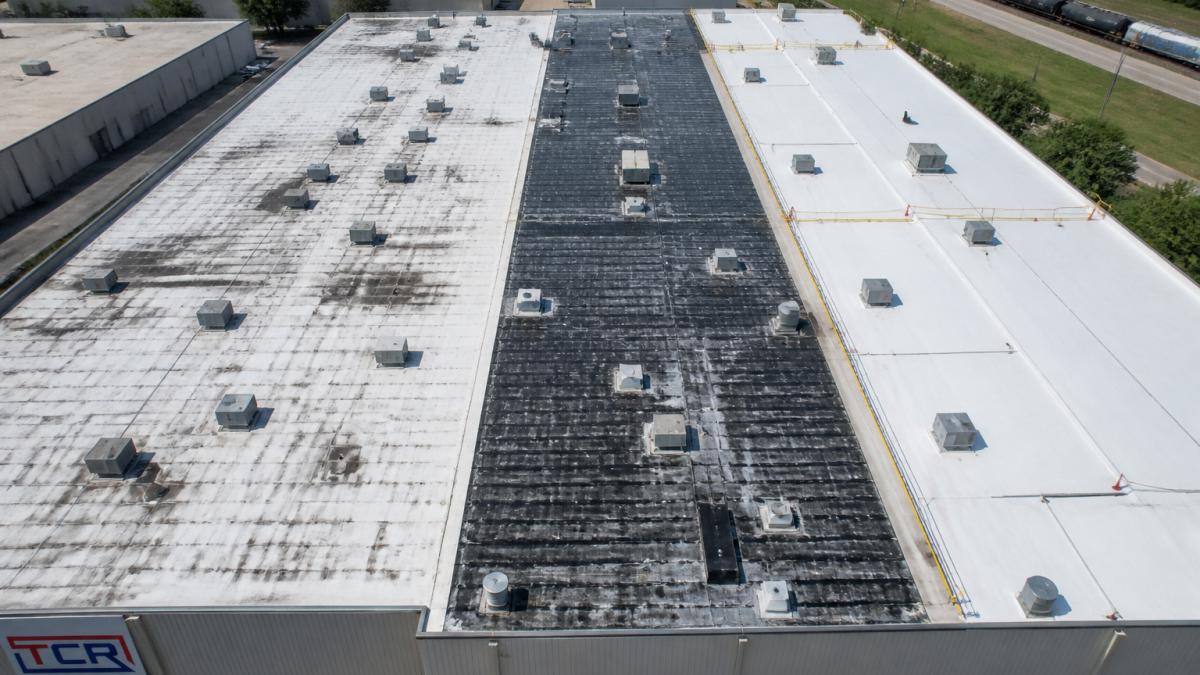
Substrate condition is the foundation of every refurbishment decision. If the structural deck beneath your roofing membrane has deteriorated, rusted, or developed structural cracks, restoration will fail. The substrate must be capable of supporting new coatings and materials for another 15+ years. Detailed inspection, including moisture testing and structural assessment, reveals whether substrate condition supports refurbishment or demands replacement.
Maintenance history directly impacts ROI. Facilities with consistent preventative maintenance programs see roofs last 25-30 years. Neglected roofs fail in 15-18 years regardless of material quality. If your facility has deferred maintenance for years, refurbishment may extend life only 8-10 years before replacement becomes necessary anyway. In these cases, replacement offers better long-term value because you reset maintenance requirements and warranty coverage.
Climate stress accelerates roof aging. Texas heat, humidity swings, and occasional hail create extreme conditions that degrade membranes faster than temperate climates. A roof system rated for 25 years in mild conditions might realistically deliver only 18-20 years in Texas. This reality influences refurbishment decisions: if your roof is already 12-15 years old and showing stress, refurbishment may only buy 5-7 additional years before replacement becomes necessary.
Operational requirements matter too. Facilities with critical inventory protection needs, data centers, pharmaceutical storage, electronics manufacturing, can’t tolerate roof failures. For these operations, replacement provides certainty that refurbishment cannot match. The cost of a single inventory loss often exceeds the difference between refurbishment and replacement costs.
Making Your Decision: Refurbishment or Full Replacement
The choice between roof refurbishment vs replacement cost comes down to answering specific questions about your facility’s condition, timeline, and financial priorities.
Start with a detailed assessment. You need to know substrate condition, extent of membrane damage, presence of ponding water or structural settlement, and compliance with current building codes. This isn’t something you can estimate from ground level. Professional inspection using moisture mapping, structural testing, and code review provides the data you need to make an informed decision.
Calculate the total cost of refurbishment including all repairs, coatings, disposal, and contingencies. Then calculate replacement cost including tear-off, disposal, new materials, installation, and any code-compliance upgrades. Compare these numbers against your facility’s remaining useful life. If refurbishment extends your roof 12-15 years at 40% of replacement cost, it’s usually the right choice.
Consider operational disruption. Refurbishment typically requires 2-4 weeks of work with minimal site access disruption. Replacement requires 4-8 weeks and substantial operational impact. For facilities where downtime is expensive, this factor alone may justify refurbishment even if replacement offers slightly better long-term value.
Evaluate your capital budget and tax situation. If you need to expense costs immediately for tax purposes, refurbishment’s repair classification offers advantages. If you’re looking to spread capital expenditure across multiple years, replacement’s depreciation treatment may align better with your financial strategy.
At Total Cladding and Roofing LLC, we assess each facility’s unique circumstances and explain which path delivers better ROI for your specific situation. Our UK refurbishment experience means we’ve worked on aging systems across diverse climates and building types. We understand when restoration extends service life meaningfully and when it’s a temporary patch that delays inevitable replacement.
The decision between refurbishment and replacement isn’t one-size-fits-all. It depends on your building’s condition, your operational needs, your budget timeline, and your long-term asset management strategy. Getting a comprehensive assessment from experienced professionals ensures you make the choice that protects your inventory, minimizes disruption, and delivers real financial value.
Your commercial roofing system is one of your building’s most critical assets. The difference between a refurbishment decision that extends service life and one that merely delays replacement can cost tens of thousands of dollars.
Frequently Asked Questions
What is the 50% rule for commercial roofing?
The 50% rule states that if damage or deterioration affects more than 50% of your roof’s surface area, building codes typically require full replacement rather than repair or refurbishment. This rule protects building integrity and ensures compliance with current safety standards. Check your local building codes, as enforcement varies by jurisdiction. A professional roof inspection can determine whether your facility falls under this threshold and what options remain available.
How long does a commercial roof restoration last compared to a new roof?
A properly executed roof restoration typically extends service life by 15-20 years, while a new roof system generally lasts 20-30 years depending on material and maintenance. Restoration works best on roofs with sound structural substrates and manageable wear. The key difference is that restoration preserves existing infrastructure while a new roof replaces the entire system. Preventative maintenance after restoration significantly impacts actual lifespan achieved.
Does roof restoration qualify as a capital improvement or maintenance expense for tax purposes?
Roof restoration often qualifies as a capital improvement under IRS guidelines, allowing you to depreciate the cost over time rather than deduct it immediately. This can provide substantial tax benefits when the work extends useful life or improves building performance. However, routine repairs and maintenance are typically deductible as operating expenses. Consult your tax advisor to determine the classification for your specific project, as the distinction depends on scope, cost, and whether the work extends the roof’s useful life beyond its original estimate.
What factors most influence whether refurbishment or replacement makes financial sense?
The primary factors are roof age, extent of existing damage, substrate condition, remaining useful life, and your facility’s operational timeline. A roof nearing end-of-life with extensive membrane failure typically favors replacement. Newer roofs with isolated problems or manageable wear are candidates for refurbishment. Building code compliance, insurance requirements, and your capital expenditure budget also affect the decision. A detailed structural assessment by a qualified contractor reveals which option delivers better ROI for your specific building and climate conditions.
To upload drawings, specs and plans please go to the form on our contact page.
Get in Touch