


Last Updated: November 14, 2026
Quick Summary
Plan insulated metal panel delivery by building a phased schedule backward from the erection sequence, splitting the order into three to five batches sized to two to three working days of installation. Each batch needs a required-on-site date, an arrival window outside peak trade traffic, and a maximum storage footprint, with a one-working-day buffer per phase.
- Walk the truck route with a tape measure to check gate width, overhead wires, and turning space.
- Size each batch to what the crew can install in two to three working days.
- Build a buffer of one working day per phase, extended to two for long-lead panels.
- Book and confirm unloading equipment before the truck leaves the supplier.
- Inspect every bundle on arrival and photograph exceptions before signing the ticket.
Table of Contents
- Start With a Delivery Plan Before You Schedule the Truck
- Build an Insulated Metal Panel Delivery Schedule Around Site Constraints
- Jobsite Access, Truck Routing and Traffic Control
- Choose Insulated Metal Panel Unloading Equipment Before Delivery Day
- Insulated Metal Panel Storage and Handling on a Live Site
- Jobsite Delivery Coordination for Construction Materials Across Trades
- Delivery-Day Checklist and Contingency Steps
- Walk Your Panel Delivery Plan With Total Cladding and Roofing
- Frequently Asked Questions
Start With a Delivery Plan Before You Schedule the Truck
Insulated metal panel delivery succeeds or fails on paper long before the first truck arrives. A written plan tells the driver where to go, the crew what to expect, and the site superintendent who is in charge of the gate. A carrier should not be booked until that plan exists.
What Belongs in the Delivery Plan
A complete plan covers six items:
- Panel schedule with lengths, widths, and core type
- Truck count and estimated arrival windows
- Approved staging area with dimensions
- Unloading method and equipment list
- Named receiving contact and backup
- Site access route and gate clearance
Walk the route yourself with a tape measure. Gate width, overhead wires, and turning space decide which truck can enter. The OSHA materials handling guidance also sets expectations for safe lifting and load control that belong in the plan. Our insulated metal panels library lists the official files we hold for each panel, which helps you confirm handling needs before the order ships.
Build an Insulated Metal Panel Delivery Schedule Around Site Constraints
Your insulated metal panel delivery schedule should follow the building, not the trucker’s calendar. Panels arrive in the order the crew can install them, and nothing else. That one rule prevents most of the congestion on a live site, but it only works if you translate it into a phased schedule with named batches, arrival windows, and a storage limit for each phase.
Start With the Installation Sequence, Not the Order Date
Build the schedule backward from the erection sequence. List the building in the order the crew will close it in: structural steel and deck complete, then roof panels, then wall panels by elevation, then trim and closures.
For each batch, record four fields on one schedule sheet:
- Batch name and panel types (roof, wall, trim, closures)
- Required-on-site date, driven by the installation sequence
- Arrival window, set outside peak trade traffic
- Maximum storage footprint the batch may occupy on the laydown yard
That last field is the one most schedules omit, and it is the one that keeps a live site from turning into a parking lot for panels.
Match Batch Size to Available Storage and Crane Windows
Phased drops beat one large shipment on an active jobsite, but the right batch size depends on two constraints: how much covered, level storage you can protect, and when the lifting equipment is available. If the crane is shared with the steel crew, your roof-panel batch has to land in a window the crane can serve, not simply when the panels are manufactured.
A practical method is to size each batch to what the crew can install in two to three working days. That keeps the storage footprint small, limits double handling, and means a single damaged bundle does not stall the whole building. Where storage is tight, reduce the batch and increase the frequency of drops rather than stacking panels higher than the manufacturer allows.
Build Buffers and Confirm Windows the Day Before
Just-in-time delivery carries risk. One late truck stalls the crew, and one early truck blocks the laydown yard. Build a buffer of one working day per phase and confirm the carrier’s window the afternoon before.
Watch out: a batch scheduled to arrive the same morning the steel crew is still squaring the frame will sit in the access route and block both trades.
Jobsite Access, Truck Routing and Traffic Control
Truck access is the detail most delivery plans skip, and it causes the most failed deliveries. Measure the route from the public road to the staging area before you order.
Check these points:
- Gate width against trailer width plus mirror clearance
- Turning radius at every corner
- Overhead lines, tree limbs, and canopy heights
- Ground bearing strength on the route
- A separate path for workers and other trades
Set a delivery window outside peak trade traffic. Post a spotter at the gate. The FHWA work zone traffic guidance offers useful principles for controlling vehicle movement around people on foot.
Choose Insulated Metal Panel Unloading Equipment Before Delivery Day
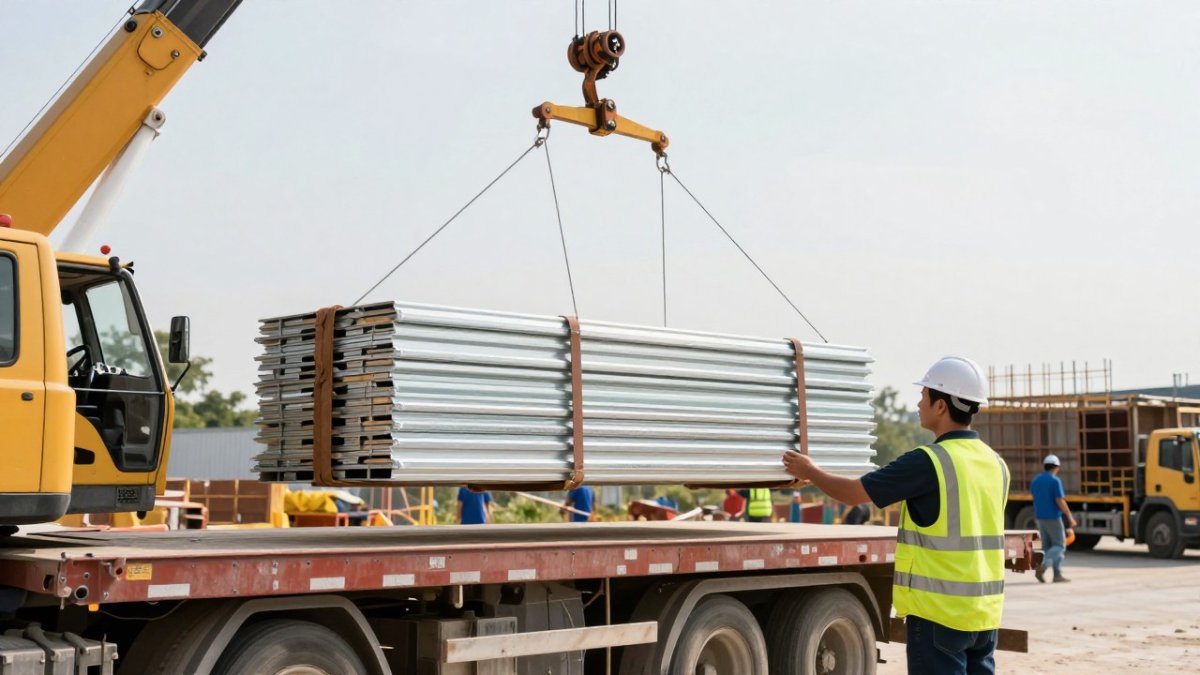
Insulated metal panel unloading equipment must be booked and confirmed before the truck leaves the supplier. Panels arrive in long bundles, and a crew that improvises unloading damages product and risks injury.
Match the equipment to the bundle weight and reach:
- Forklift with long forks: flat, firm ground and open access
- Telehandler: uneven ground and moderate reach
- Crane with spreader bar: long panels and tight sites
- Vacuum lifters: finished faces that must stay unmarked
Confirm the operator’s certification and the lift plan. If your order is Kingspan, our Kingspan certified installer page covers brand-specific handling. For All Weather panels, see our AWIP installer details.
Insulated Metal Panel Storage and Handling on a Live Site
Insulated metal panel storage and handling decides whether the panels go up clean or go back on a truck. On a live site, the storage area is shared space, so claim it early and mark it clearly.
Pick a level, compacted surface that drains. Block the bundles off the ground on dunnage. Keep the stack under the manufacturer’s recommended height and never stack panels on their edges.
Weather Protection and Damage Control
Moisture is the enemy of a foam core. Keeping water out of wrapped bundles calls for the same care when receiving heavy exterior doors, where Arizona Door Store offers a related perspective on protecting materials before installation.
Watch out: leaving bundles wrapped and sealed in direct sun traps condensation. Vent the wrap or add a loose cover instead.
Inspect every bundle on arrival. Photograph dents, scratches, and crushed edges before you sign. A signed clean ticket is hard to dispute later.
Jobsite Delivery Coordination for Construction Materials Across Trades
Jobsite delivery coordination for construction materials only works when one person owns the schedule. On a busy site, the roofer, the steel crew, and the glazing team all want the same gate and the same laydown space.
Run one short coordination meeting each week. Confirm three things:
- Which deliveries land this week
- Who receives each load
- Where each trade stages material
Share a single contact list with the carrier. If you are still choosing your installation partner, our guide to insulated metal panel contractors explains how responsibilities split between trades.
Delivery-Day Checklist and Contingency Steps
A delivery-day checklist is only useful if it names who does what and what happens when a step fails. Use this sequence on the morning of every drop, and assign a name to each line before the truck rolls.
Morning-of Checklist With Named Roles
- Receiving contact confirms the carrier’s arrival window and driver cell number
- Spotter walks the gate-to-staging route and clears obstructions
- Staging area marked, dunnage staged, and lifting gear positioned
- Crane or telehandler operator confirms the lift plan and certification
- Weather and wind speed checked against the lift and panel-handling limits
- Panel schedule and packing list printed and matched to the batch
One person owns the receiving log for the whole drop. That person signs the ticket, records quantities against the packing list, and photographs any exception before the driver leaves the gate.
Receiving Inspection and Damage Documentation
Inspect every bundle on arrival, not after the truck leaves. Check bundle count and panel quantities against the packing list, then look for dents, scratches, crushed edges, torn wrap, and signs of moisture inside the bundle.
Watch out: a signed clean ticket is hard to dispute later. If the driver will not wait for a full inspection, sign only for the count, write “subject to inspection” on the ticket, and complete the condition check within the agreed window.
Contingency Decisions for Weather, Delays, and Blocked Access
Plan for failure before it happens, and write the decision rule into the delivery plan:
- High wind or lightning: stop crane lifts at the manufacturer’s or lift-plan limit, cover exposed bundles, and reschedule the lift rather than the delivery where storage allows.
- Late truck: hold the crew on the next installable task, confirm the new ETA with the carrier, and release the spotter only when the truck is within a set distance of the gate.
- Blocked access or occupied gate: route the driver to the pre-agreed holding area, notify the superintendent, and do not let the truck idle in a fire lane or pedestrian path.
- Lifting equipment unavailable: keep the truck on site only if a confirmed lift window exists; otherwise reschedule the drop rather than unload by hand.
- Damaged or short load: refuse the damaged bundle, document it, call the supplier the same hour, and confirm whether a replacement ships with the next batch.
Keep a wet-weather cover on hand and a rescheduled window agreed with the carrier in advance. The goal is not a perfect delivery day; it is a delivery day where every failure has an owner and a next step.
Write the decision rule into the delivery plan so every failure has an owner and a next step.
| Situation | Action |
|---|---|
| High wind or lightning | Stop crane lifts at limit, cover bundles, reschedule lift |
| Late truck | Hold crew on next installable task, confirm new ETA |
| Blocked access or occupied gate | Route driver to pre-agreed holding area, notify superintendent |
| Lifting equipment unavailable | Keep truck only with confirmed lift window, else reschedule |
| Damaged or short load | Refuse damaged bundle, document, call supplier same hour |
Walk Your Panel Delivery Plan With Total Cladding and Roofing
A delivery plan is only as good as the people who walk it.
Total Cladding and Roofing LLC works with metal roofing, flat roof systems and insulated metal panels on commercial and industrial properties across Texas.
Get started with Total Cladding and Roofing LLC and hand off your panel delivery planning with confidence.
A smooth delivery comes down to one habit: plan the truck the same way you plan the install.
Frequently Asked Questions
How far in advance should an insulated metal panel delivery be scheduled?
Book the delivery once panel dimensions, quantities and the installation sequence are confirmed, and give the supplier a firm window rather than a single date. On an active jobsite, aim to lock the slot at least two to three weeks out so the truck, crane and crew can be aligned. Confirm again 48 hours before arrival and re-check site access, gate hours and any trade activity that could block the drop zone.
What equipment is needed to unload insulated metal panels?
Most bundles are unloaded with a crane or telehandler using a spreader bar and nylon slings rated for the load. A forklift with extended forks works for smaller bundles on firm, level ground. You also need a spotter, traffic control such as cones or barricades, and a marked laydown area. Confirm lifting points and bundle weights with the supplier before delivery day so the right equipment is on site.
How should insulated metal panels be stored before installation?
Store bundles on compacted, level ground with dunnage underneath to keep them off the surface and allow drainage. Keep panels under cover or a secured tarp, tilted slightly so water runs off, and never stack them directly on soil. Leave protective packaging in place until installation and keep the storage area clear of vehicle traffic. Inspect bundles on arrival and document any moisture, scratches or crushed edges immediately.
How can panel deliveries be coordinated with other trades on an active jobsite?
Hold a short coordination meeting with the general contractor and affected trades before the delivery window. Agree on the drop zone, gate access, crane swing radius and any areas that must be cleared. Publish the delivery time on the site schedule so concrete pours, roofing work and material drops do not collide with it. Assign one person to control the delivery and give them authority to pause unloading if conditions change.

To upload drawings, specs and plans please go to the form on our contact page.
Get in Touch