Table of Contents
- What Industrial Roof Asset Management Actually Means
- Building an Industrial Roof Inspection Checklist
- Creating a Commercial Roof Asset Management Plan
- Roof Repair Versus Replacement: Making the Right Call
- Roof Lifecycle Cost Planning for Long-Term Budgets
- Coordinating Multiple Building Systems During Refurbishment
- Measuring Success: Tracking Performance and ROI
- Frequently Asked Questions
Last Updated: October 8, 2026
What Industrial Roof Asset Management Actually Means
Industrial roof asset management is the systematic approach to tracking, maintaining, and extending the service life of roofing systems across commercial and industrial properties. It combines regular inspections, preventative maintenance, strategic repairs, and lifecycle planning to protect your building envelope while controlling costs.
Industrial roof asset management flips that model. You document the condition of your roof, establish baseline performance metrics, and make informed decisions about when to repair, when to refurbish, and when to replace. This approach typically extends the usable life of existing systems by several years and reduces the total cost of ownership.
The distinction matters because industrial facilities operate on tight margins. A roof failure means production downtime, potential damage to inventory or equipment, and emergency contractor premiums. Asset management prevents that scenario by giving you visibility into roof condition before problems escalate.
Building an Industrial Roof Inspection Checklist
A solid inspection checklist is the foundation of any asset management program. Without documentation, you’re managing from memory and guesswork. Your checklist should capture the current state of the roof in enough detail that you can track changes over time and spot deterioration before it becomes critical.
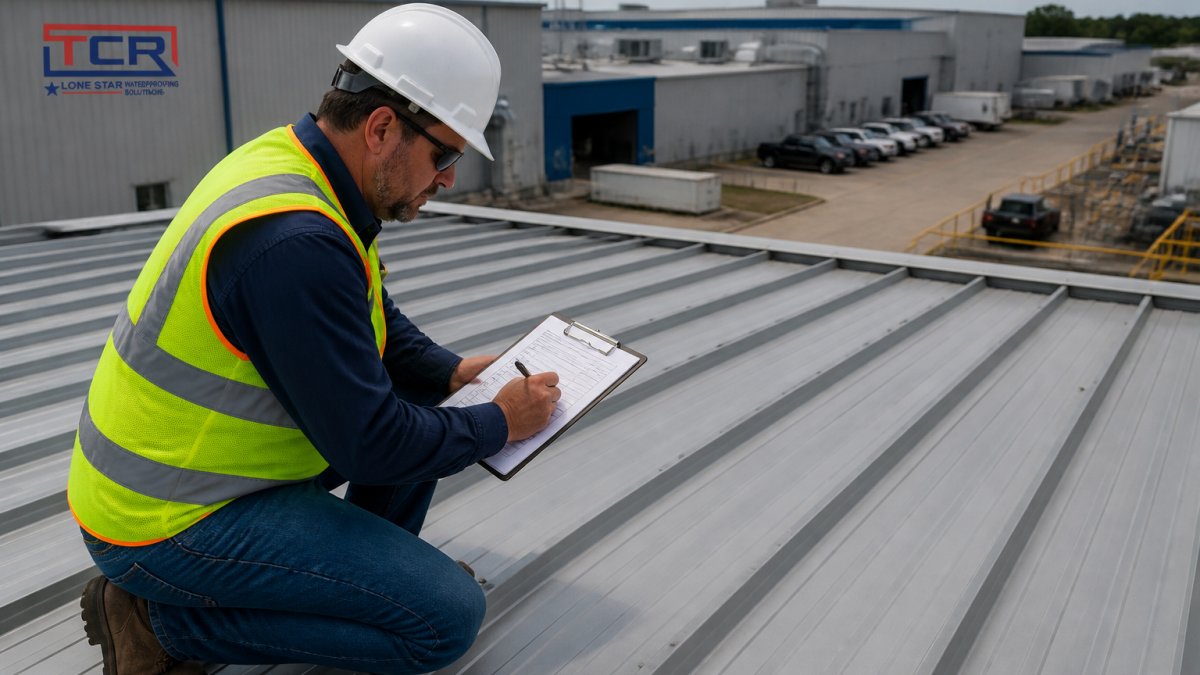
The checklist should include visual assessment of membrane condition, fastener integrity, flashing details, drainage systems, and any visible damage. Document the location of problem areas using photos and measurements. Record weather exposure (sun, wind, hail history), any previous repairs, and the age of major components. Note the presence of standing water, which indicates drainage failure. Check for punctures, tears, blistering, or separation at seams. For metal roofing, inspect for rust, panel distortion, and fastener corrosion. Flat roof systems require particular attention to seams, penetrations, and edge details where leaks commonly begin.
The key is consistency. Use the same checklist format for every inspection so you can compare conditions year over year. Many facility managers photograph the roof during inspections, this visual record becomes invaluable when you need to justify a maintenance budget or explain deterioration to leadership.
Creating a Commercial Roof Asset Management Plan
Your industrial roof asset management plan translates inspection data into a roadmap for maintenance and investment decisions. It answers the central question: what condition is this roof in, what does it need, and when should we act?
Start by documenting the roof’s age, original installation date, material type, and any major repairs or coatings applied. Establish the current condition baseline from your inspection. Then define performance thresholds, the point at which you’ll take action. For example, if you find active leaks in more than 5% of the roof area, or if membrane degradation affects more than 10% of the surface, you’ve crossed into refurbishment territory.
Your plan should identify which systems are interdependent. A leaking roof often causes damage to insulation and wall panels below. If you’re planning roof work, it makes sense to assess whether insulation, cladding, or drainage systems need coordinated attention. Total Cladding and Roofing LLC evaluates the entire building envelope and plans repairs that address multiple systems simultaneously, minimizing disruption and improving overall performance.
The plan should also account for climate-specific risks. Industrial facilities in areas with severe hail, high wind, or extreme temperature swings face different degradation patterns than those in milder climates. Your maintenance frequency and repair priorities should reflect those realities.
Roof Repair Versus Replacement: Making the Right Call
The decision to repair or replace is where industrial roof asset management becomes strategic. A repair might buy you three to five more years of service life at a fraction of the replacement cost. But if the roof is nearing the end of its serviceable life or if repairs are becoming frequent, replacement may be more economical over the long term.
Use these benchmarks to guide the decision. If the roof is less than halfway through its expected service life and damage is localized, repair is usually the right choice. If the roof is past the midpoint and you’re seeing widespread deterioration, refurbishment or replacement becomes more attractive. If you’re making the same repair in the same location multiple times, that’s a signal the underlying condition is failing, repair the root cause or prepare for replacement.
The cost comparison should account for downtime. An emergency roof repair might cost less upfront than a planned replacement, but if it disrupts operations, the true cost is much higher. A planned replacement during a scheduled maintenance window may actually be more economical when you factor in operational continuity.
Total Cladding and Roofing LLC can help you evaluate this decision through a detailed building investigation. We assess the actual condition of your roof, insulation, and supporting systems to determine whether targeted refurbishment extends service life cost-effectively or whether replacement is the better path forward.
Roof Lifecycle Cost Planning for Long-Term Budgets
Lifecycle cost planning removes the guesswork from budgeting for roof maintenance and replacement. Instead of treating roof expenses as unpredictable emergencies, you project costs over the expected service life of the system and plan funding accordingly.
Start by establishing the expected service life for your current roof based on its material type and age. Multiply that remaining service life by your average annual maintenance cost to project total preventative spending. Then estimate the cost of a full replacement when that service life expires.
This projection becomes your budgeting baseline. You can now allocate funds across multiple years, reducing the shock of a large unexpected expense. If your analysis shows a replacement is likely within five years, you can begin planning for financing or phasing the work across your portfolio.
The calculation also highlights the value of preventative maintenance. Spending $5,000 per year on inspections and minor repairs to extend the roof’s life by five years is often far cheaper than an emergency replacement. Document these savings in your asset management plan, they justify ongoing maintenance budgets to finance and operations teams.
Coordinating Multiple Building Systems During Refurbishment
One of the most common mistakes in industrial roof asset management is treating the roof in isolation. Roofing, insulation, wall cladding, and drainage systems are interdependent. When you refurbish one, you often need to coordinate work on the others.
If your roof is leaking, water is likely compromising insulation below. If you’re replacing the roof without addressing the insulation, you’re leaving moisture damage in place. If you’re installing new wall cladding, coordinating that work with roof refurbishment eliminates the need for multiple site mobilizations and reduces overall disruption.
Total Cladding and Roofing LLC specializes in this coordination. We assess your roof, insulation, and cladding as an integrated system and plan work that addresses all three simultaneously. This approach minimizes downtime and ensures compatibility between systems.
Coordination also matters for site logistics. Multiple contractors on site at once creates congestion, safety risks, and scheduling conflicts. Planning the work as a single coordinated project, with one team managing the overall timeline and sequencing, is more efficient and less disruptive to your operations.
Measuring Success: Tracking Performance and ROI
Industrial roof asset management only works if you measure results. Define metrics that matter to your business: roof condition score, leak frequency, maintenance cost per square foot, and days of downtime due to roof-related issues.
Condition score should be tracked at each inspection. A simple 1-10 scale (1 = critical failure, 10 = like-new) gives you a visual trend line. If your condition score is improving year over year despite aging infrastructure, your maintenance strategy is working. If it’s declining, you need to increase investment or accelerate replacement timelines.
Leak frequency is straightforward, count the number of water intrusion events per year. A declining leak count shows your maintenance is effective. An increasing count signals that the roof is degrading faster than anticipated and intervention is needed.
Cost per square foot tracks maintenance spending relative to the size of your roof. This metric helps you benchmark spending across multiple facilities and identify which roofs are consuming disproportionate resources.
Days of downtime captures the operational impact. If roof problems are shutting down production regularly, the financial case for refurbishment or replacement becomes much stronger, even if the upfront cost is high.
Industrial roof asset management transforms roofing from an unpredictable expense into a planned, controlled investment. By combining regular inspections, strategic maintenance, and lifecycle planning, you extend the service life of existing systems, minimize operational disruption, and make better decisions about when to repair and when to replace.
Total Cladding and Roofing LLC helps property managers and facility teams implement this approach. We conduct detailed building investigations to establish baseline conditions, develop maintenance and refurbishment plans tailored to your climate and operational needs, and coordinate work across roofing, insulation, and cladding systems to minimize disruption. Contact us for an assessment of your facility’s roof condition and a customized asset management strategy.
Frequently Asked Questions
What is the difference between reactive and proactive industrial roof asset management?
Reactive management waits for leaks or failures to occur, then responds with emergency repairs, expensive and disruptive. Proactive management uses regular inspections, preventative maintenance, and planned refurbishment to catch deterioration early, extend roof life, and avoid unplanned downtime. Proactive approaches typically cost less over the building’s lifecycle because they prevent the compound damage that emergency repairs address.
How often should an industrial roof be inspected as part of asset management?
Most facilities benefit from formal inspections twice per year, spring and fall, to catch seasonal damage. High-traffic areas, regions with severe weather, or roofs over 15 years old may warrant quarterly inspections. After major weather events (hail, high winds, heavy snow), schedule immediate inspections. Document all findings in a centralized system so patterns emerge over time and inform long-term planning.
What should be included in an industrial roof asset management plan?
A comprehensive plan documents current roof condition (from detailed inspection), identifies remaining service life, outlines preventative maintenance tasks and schedules, establishes repair versus replacement criteria, projects lifecycle costs over 10-20 years, and assigns ownership for inspections and maintenance tasks. The plan should also address drainage systems, insulation, wall cladding, and coordination with other building systems to avoid siloed decisions.
When is roof repair the better choice over full replacement?
Repair is typically justified when the roof has 5+ years of remaining service life, damage is localized (under 20% of roof area), and the cost of repair is less than 50% of replacement cost. Refurbishment, coating, patching, and insulation upgrades, can extend life by 10-15 years on aging systems. However, if the roof is nearing end-of-life, experiencing widespread deterioration, or failing in multiple locations, replacement becomes the more cost-effective long-term solution.
How can facility managers budget for roof maintenance and replacement over time?
Use lifecycle cost planning to project total cost of ownership over 20-30 years, factoring in annual maintenance, periodic repairs, and eventual replacement. Allocate a percentage of the building’s replacement cost (typically 1-2% annually) to a dedicated roof reserve fund. Track actual spending against projections and adjust allocations as inspections reveal condition changes. This approach prevents budget surprises and justifies investment in preventative work that saves money later.
Can refurbishment and extended service life strategies work in harsh climates like Texas?
Yes. Texas heat, humidity swings, and hail present specific challenges, but proper refurbishment, including high-reflectivity coatings to reduce thermal stress, upgraded drainage to handle intense rainfall, and reinforced fastening to resist wind, directly addresses these conditions. Metal roofing and insulated metal panels perform well under Texas weather when properly installed and maintained. The key is detailed inspection to understand how your specific roof responds to local conditions, then tailoring refurbishment to those findings.
What information should a professional roof inspection report include?
A thorough inspection report documents roof age and material type, visible damage (cracks, punctures, seam failures), water infiltration evidence, drainage system condition, fastener condition and corrosion, insulation integrity, photographs of problem areas, remaining estimated service life, recommended maintenance tasks, and prioritized repair or replacement recommendations. The report should be clear enough for budget justification and detailed enough to guide actual work planning.
How does coordinating roof refurbishment with wall panels and drainage reduce overall project costs?
Bundling roof, cladding, and drainage work into a single project avoids multiple mobilizations, reduces labor overhead, and allows crews to work efficiently across related systems. For example, upgrading roof drainage while replacing wall panels prevents water from bypassing new cladding. Integrated planning also identifies opportunities (like insulation upgrades during roof work) that cost less when done together.
To upload drawings, specs and plans please go to the form on our contact page.
Get in Touch