Last Updated: November 2, 2026
Quick Summary
Structural failure in industrial cladding usually begins with small signs such as bowing or buckled panels, widening gaps, pulled-away edges, and rusting fasteners. Spotting these during a routine walk-around lets facility teams act before the wall loses its ability to protect the building.
- Check for buckling, bowing, gaps and lifted edges during a routine walk around the building.
- Inspect fastener heads for rust stains, loose fit and missing or cracked washers.
- Look for dents, cracked coatings and scratches that expose bare metal.
- Photograph and date each finding so changes can be tracked over time.
- Act on small repairs early, since they are usually far less disruptive than larger failures.
Table of Contents
- Visible Signs of Structural Failure in Industrial Cladding
- Metal Wall Panel Damage Inspection: What to Look For
- Loose Cladding Panels and Fastener Corrosion
- Common Causes of Structural Failure in Industrial Cladding
- Diagnostic Methods: How Professionals Confirm Failure
- Industrial Building Envelope Inspection Checklist for Facility Teams
- Scheduling Cladding Repair and Replacement Before Damage Spreads
- Frequently Asked Questions
Structural failure in industrial cladding rarely announces itself with a dramatic collapse. It usually starts small: a panel that bows slightly after a hard windstorm, a seam that opens a few millimeters, or a fastener that has started to rust at the edge. For facility managers, property managers and asset managers at Total Cladding and Roofing LLC’s Texas client sites, these early signs matter because they often point to a wall that is losing its ability to protect the building.
Industrial wall panels take a lot of punishment. Texas buildings deal with intense summer heat that makes metal expand and contract daily, hailstorms that dent and crack coatings, and humidity swings that can leave moisture trapped behind panels. Over time, these forces loosen connections and wear down the finish.
The good news is that most warning signs can be spotted during a routine walk around the building. This guide walks through what to look for, why it happens and how to plan the next step. For broader envelope maintenance guidance for manufacturing plants, see envelope maintenance for manufacturing plants.
Visible Signs of Structural Failure in Industrial Cladding
The first clues are usually visual. A panel that looks slightly out of line from a distance is worth a closer look. Start at ground level and scan each wall from a few angles, especially near corners, doors and loading bays where stress concentrates.
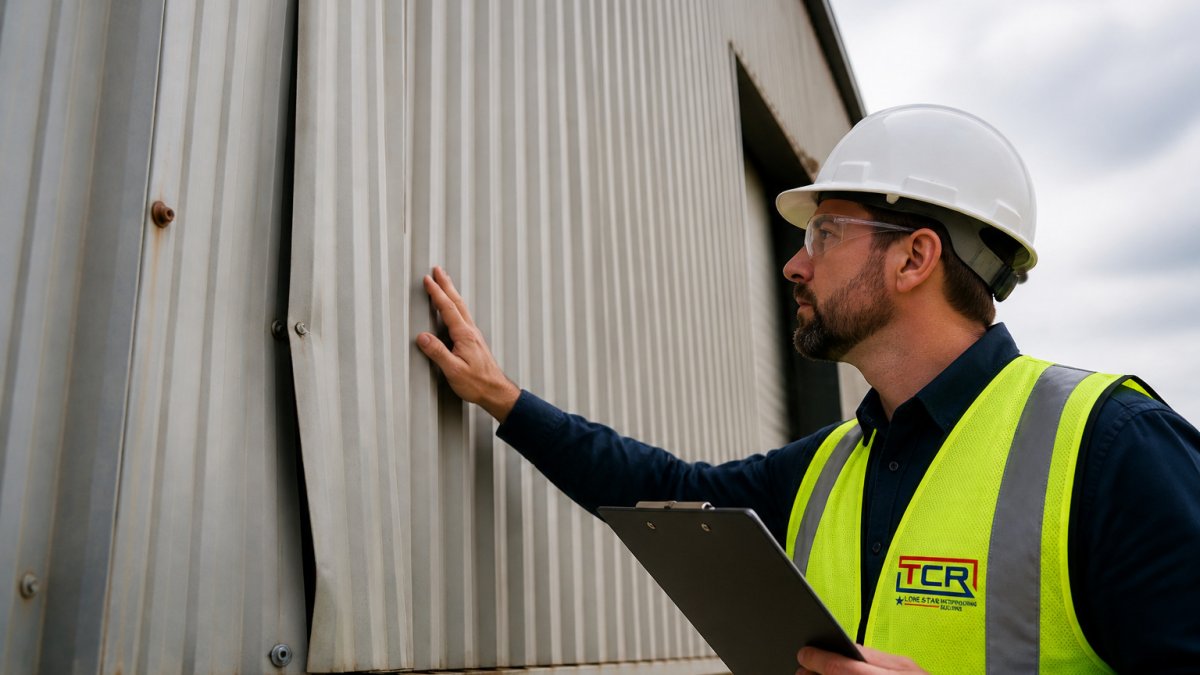
Buckling and Bowing Panels
Buckling appears as a wavy or sagging surface where the panel should be flat. Bowing is a gentler curve across a wide section. Both mean the panel is no longer held evenly by its supports.
Look for:
- Ripples that run parallel to the panel ribs
- A bulge that changes shape when viewed from the side
- Shadows that fall unevenly across a wall at certain times of day
A small bow may be harmless for a while, but it often signals that fasteners have pulled out or that the framing behind the panel has shifted.
Gaps, Movement and Pulled-Away Edges
Gaps between panels, or between a panel and a trim piece, are a common sign that the cladding is moving more than it should. Check the vertical and horizontal joints. Gaps that were tight at installation and now let light through, or that catch debris, deserve attention.
Edges that have lifted or pulled away from the trim are especially important. Water and wind can enter these openings and get behind the panel, where it can damage insulation and the structure.
Metal Wall Panel Damage Inspection: What to Look For
A closer inspection goes beyond the overall shape of the wall. It focuses on the panel surface, the seams and the attachments. Many teams find it helpful to walk the building with a simple checklist and photograph anything unusual, so changes can be tracked over time.
Key items to check:
- Surface dents and punctures from hail, equipment or impact
- Cracked or chalked coatings that expose bare metal
- Scratches that reach the substrate, which invite corrosion
- Stained or streaked panels that suggest water is running from a failed seal
- Sealant that has cracked, shrunk or separated at joints and penetrations
Each of these findings can start a chain reaction. A small dent may not affect strength on its own, but it can crack the coating and start corrosion. Corrosion then weakens the metal at the point where fasteners and seams need it most.
Loose Cladding Panels and Fastener Corrosion
Fasteners hold the entire system together, so their condition tells you a lot about the wall. Loose panels are often the result of fasteners that have backed out, lost their grip in the framing or rusted through.
Signs to watch for:
- Fastener heads that stand proud of the panel surface
- Rust stains or rust bleeding from around screw heads
- Washers that are cracked, missing or no longer seated flat
- Panels that rattle or move when pushed by hand
Fastener corrosion is especially common in areas where the coating has been damaged or where moisture collects. A pattern of fastener failures across the wall suggests a broader problem with materials, coating or installation.
Common Causes of Structural Failure in Industrial Cladding
Knowing why panels fail makes it easier to prevent the next failure. Several causes come up again and again in industrial buildings:
- Thermal movement. Metal expands in the heat and contracts at night. Fixed connections that do not allow for this movement can crack or distort over time.
- Wind loads. Strong gusts push and pull on the panels. Poorly spaced or undersized fasteners are more likely to fail under repeated loading.
- Hail and impact. A single storm can dent panels, crack coatings and loosen attachments across an entire wall.
- Trapped moisture. Condensation or leaks behind the panel can rot insulation and corrode the framing.
- Poor original installation. Incorrect fastener spacing, over-tightened screws or misaligned panels can cause problems years later.
- Lack of maintenance. Clogged gutters, unsealed penetrations and unrepaired damage let small problems grow.
Many failures involve more than one of these causes at the same time. To compare which warehouse exterior cladding performs best once you understand these failure causes, see best warehouse exterior wall cladding. That is why a single visible defect is often a clue to a larger issue behind the surface.
The article lists several causes that repeatedly lead to cladding failure in industrial buildings.
| Cause | Effect | Prevention |
|---|---|---|
| Thermal movement | Cracks or distortion at fixed connections | Allow for daily expansion and contraction |
| Wind loads | Fastener failure under repeated loading | Use correct fastener spacing and size |
| Hail and impact | Dents, cracked coatings, loose attachments | Inspect and repair after storms |
| Trapped moisture | Rotted insulation and corroded framing | Find and stop leaks behind panels |
| Poor original installation | Problems years later | Check spacing, torque and alignment |
| Lack of maintenance | Small problems grow | Clear gutters and seal penetrations |
Diagnostic Methods: How Professionals Confirm Failure
A visual inspection can identify warning signs, but confirming the cause and extent of a failure usually takes more detailed work. Professionals typically combine several methods:
- Detailed visual survey. Mapping every visible defect, with photographs and measurements, to find patterns across the wall.
- Fastener testing. Checking pull-out resistance and corrosion on a sample of fasteners to see whether the problem is isolated or widespread.
- Moisture investigation. Using moisture meters or thermal imaging to find water trapped behind the panels.
- Seam and sealant assessment. Examining joints, flashing and penetrations for cracks, gaps and deterioration.
- Structural review. Confirming that the framing and supports still meet the load they were designed to carry.
Together, these steps help separate cosmetic wear from real structural risk, so the right repair can be chosen.
Industrial Building Envelope Inspection Checklist for Facility Teams
Facility teams can build a simple routine that catches problems early. Consider a checklist that covers the following each season, and after any major storm:
- Walk the full perimeter and note any bowing, buckling or gaps
- Check fasteners for loose heads, rust stains and missing washers
- Look for dents, cracked coatings and exposed metal
- Inspect joints, trims and penetrations for sealant failure
- Note any water staining, streaking or interior moisture
- Photograph and date each finding so changes are easy to compare
- Record the location of each issue on a building plan
Keeping these records makes it easier to spot slow changes and to explain priorities to decision-makers or contractors.
Scheduling Cladding Repair and Replacement Before Damage Spreads
Once a problem is confirmed, timing matters. Small repairs such as resealing joints, replacing a few fasteners or fixing a localized dent are usually far less disruptive than waiting for a larger failure. Total Cladding and Roofing LLC works with property owners, developers and facility managers across Texas, and plans its services around site operations to help clients manage disruption.
For walls where damage has spread, reviewing options for repair or replacement of R-panel and wall cladding in the Texas market can help you compare approaches. Where the envelope needs a broader upgrade, external wall cladding and reclad options for commercial buildings may be the better path. If corrosion is concentrated at sheet edges, laps and fasteners, metal roof rust and cut-edge corrosion treatment can be considered alongside a retrofit.
Contact Total Cladding and Roofing LLC directly for current pricing or a site-specific quote. Acting on early warning signs is the most practical way to keep a small defect from becoming a costly rebuild.
Frequently Asked Questions
What are the signs of structural failure in industrial cladding?
The most common signs are panels that bow or buckle, visible gaps at seams or edges, fasteners that have backed out or corroded, and water staining on interior walls near the envelope. Any of these can indicate that the cladding is no longer held securely to the structure. Water entering through cladding joints is a particular concern because it can damage insulation and framing over time. A visual walkaround after severe weather, and periodic inspections at least once a year, help catch these conditions early before repairs become larger.
How can you tell if metal wall panels are loose or failing?
Check for panels that move, rattle or flex when pushed by hand, especially at corners and near openings. Look at the lap joints and trim for separation, and examine fasteners for rust, missing washers or elongated holes. Sealant that has cracked or pulled away from flashing is another indicator. A panel that shows more than minor movement or has multiple damaged fasteners in one area should be documented with photos and reviewed by a qualified contractor before it is considered safe.
Is water leaking through cladding a sign of structural failure?
Water leaking through cladding is not always structural failure, but it is a strong warning sign. It can result from failed sealant, damaged fasteners, or panels that have shifted out of alignment. Persistent leaks can rot wood framing, corrode steel and degrade insulation, which weakens the building over time. Any recurring leak should be traced to its source and evaluated, rather than treated only as a surface problem.
When should damaged industrial cladding be inspected by a professional?
A professional inspection is recommended after storms or high-wind events, when panels show visible bowing or movement, when leaks recur after repair, or when corrosion is found at fasteners or connections. Facility managers should also schedule periodic inspections as part of routine maintenance. A qualified roofing and cladding contractor can assess the condition, determine whether repair or replacement is appropriate, and help plan the work around ongoing operations.

To upload drawings, specs and plans please go to the form on our contact page.
Get in Touch