
Table of Contents
- Why Building Envelope Maintenance Matters for Manufacturing Plants
- Industrial Wall Panel Maintenance Tips and Best Practices
- Signs of Moisture Intrusion in Metal Buildings
- Preventative Maintenance Checklist for Industrial Roofing
- Building Envelope Inspection and Commissioning
- Emergency Repair Protocols and Downtime Minimization
- Extending Service Life Through Refurbishment
- Frequently Asked Questions
Last Updated: September 28, 2026
Why Building Envelope Maintenance Matters for Manufacturing Plants
A manufacturing facility’s building envelope, the physical barrier separating interior climate-controlled space from the outside environment, is under constant stress. Temperature swings, humidity fluctuations, wind pressure, and weather events all work against the structural integrity of roofs, walls, and connections. When the building envelope fails, operational disruption follows immediately. Production lines halt for emergency repairs, equipment sits idle, and what started as a small leak becomes a facility-wide crisis.
At Total Cladding and Roofing LLC, we’ve seen this pattern repeat across industrial sites throughout Texas. The facilities that maintain their building envelope proactively experience far fewer emergencies. Those that wait until failure occurs pay exponentially more in both repair costs and lost productivity. Building envelope maintenance for manufacturing plants isn’t optional, it’s the difference between controlled, budgeted work and crisis management.
The stakes are particularly high in manufacturing because downtime compounds. A single hour of unplanned shutdown can mean thousands in lost production. Moisture infiltration that goes undetected spreads to insulation, structural framing, and electrical systems. What might have been a $5,000 repair becomes a $50,000+ restoration project when water damage spreads unchecked.
This guide covers the specific maintenance strategies, inspection protocols, and emergency procedures that keep manufacturing facilities operational. We’ll address the warning signs you need to catch early, the preventative approaches that extend service life, and the refurbishment options that can restore aging envelopes without full replacement.
Industrial Wall Panel Maintenance Tips and Best Practices
Metal wall panels on industrial buildings require systematic attention because they’re exposed to direct weather impact and thermal cycling. Unlike roofing systems that shed water downward, wall panels must resist wind-driven rain, direct sun exposure, and temperature differentials that create stress at fasteners and seams.
The most common failure point on industrial wall panels is the fastener connection. Over time, thermal expansion and contraction, particularly in Texas where temperature swings between 30°F and 95°F are routine, creates micro-movements at each fastener. These movements degrade sealants, loosen fasteners, and create pathways for water infiltration. Preventative maintenance addresses this before water enters the building.
Inspect fasteners and sealants annually, ideally in spring before peak summer heat stress. Look for:
- Sealant that has cracked, separated, or lost elasticity
- Fasteners that have backed out or show corrosion
- Rust staining below fasteners (indicates water is flowing past the seal)
- Gaps between panels where they overlap or meet vertical columns
When sealant fails, water doesn’t just leak through, it travels along the fastener, down the interior of the panel, and into the building’s thermal envelope. Catching and resealing these connections before that happens prevents moisture damage that would otherwise require panel replacement.
For metal panels with existing rust or surface degradation, coating systems can extend service life significantly. Modern industrial coatings protect against further corrosion and can restore the panel’s weather-shedding capability. This approach costs a fraction of panel replacement while maintaining the existing structural system.
Schedule fastener and sealant inspection during spring. This timing lets you address degradation before summer heat accelerates thermal movement and increases the likelihood of new failures.
Signs of Moisture Intrusion in Metal Buildings
Moisture intrusion in metal buildings follows predictable patterns. Early detection prevents the cascade of damage that occurs when water reaches insulation, structural steel, and electrical systems.
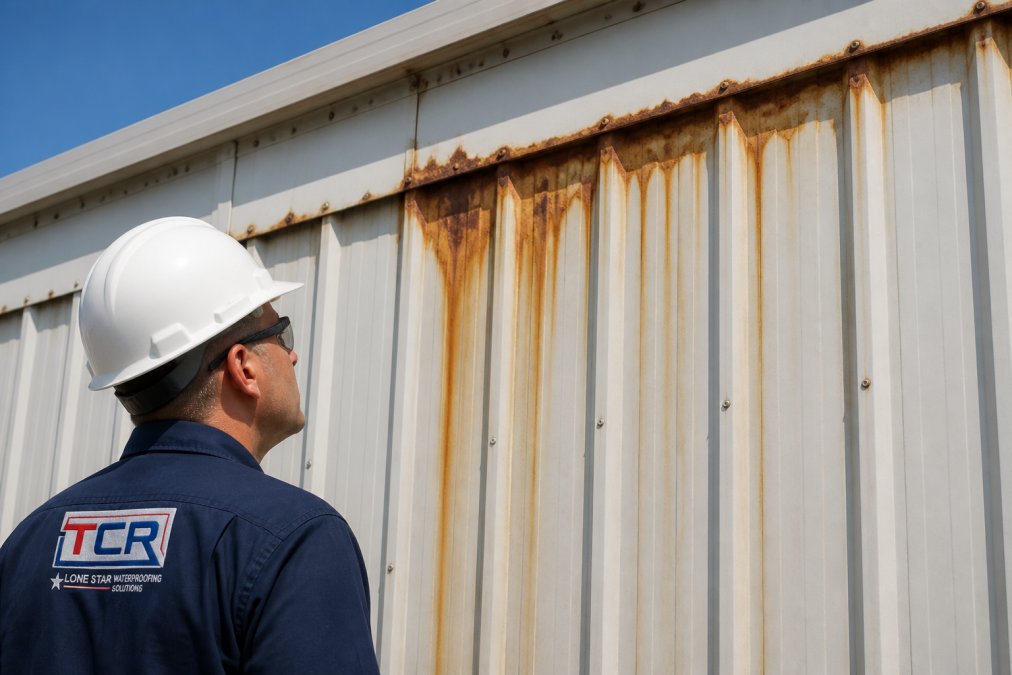
The first visible sign is often rust staining on the exterior. Water flowing down the outside of metal panels leaves rust trails that mark the water’s path. These stains indicate that sealants have failed and water is moving across the metal surface. If you see rust staining, water is already entering somewhere, either through fasteners, seams, or compromised sealant.
Interior signs appear later but indicate more serious water penetration. Look for:
- Water stains on interior walls or ceilings (indicates water has traveled through the building envelope and is dripping inside)
- Soft or discolored insulation (water has saturated the thermal barrier)
- Rust on interior structural steel (water has penetrated deep enough to reach the primary structure)
- Mold or mildew growth on interior surfaces (indicates sustained moisture)
- Efflorescence (white mineral deposits on interior concrete or masonry)
The critical insight most facility managers miss: by the time you see interior water damage, moisture has already been present for weeks or months. The building envelope has already failed. Interior damage is a late-stage indicator that preventative maintenance should have caught at the exterior.
Condensation inside the building, particularly on metal surfaces or in corners, signals that the building’s thermal envelope isn’t performing properly. This occurs when warm, humid interior air contacts cold metal or poorly insulated areas. Condensation creates the perfect environment for corrosion and mold growth.
Preventative Maintenance Checklist for Industrial Roofing
A structured preventative maintenance program for industrial roofing catches problems before they become emergencies. The checklist below outlines the frequency and scope of inspections that keep roofing systems performing.
| Maintenance Task | Frequency | What to Check |
|---|---|---|
| Visual roof inspection | Spring & Fall | Membrane condition, seams, fasteners, debris accumulation |
| Flashing inspection | Spring & Fall | Sealant condition, rust staining, gaps at roof penetrations |
| Drain and gutter cleaning | After storms, quarterly | Blockages, debris, water flow paths |
| Fastener walk-down | Annually | Backed-out fasteners, corrosion, sealant degradation |
| Thermal imaging | Every 2-3 years | Moisture in insulation, thermal bridging at seams |
| Full membrane inspection | Every 3-5 years | Detailed assessment of membrane integrity and remaining service life |
For metal roofing systems, fastener integrity is the priority. Metal roofing panels are held down by fasteners that penetrate the membrane. Each fastener is a potential water entry point. A single backed-out fastener can allow water under the panel, where it travels laterally across the roof deck and enters the building far from the actual fastener location.
Walk the roof quarterly and tighten any fasteners that have backed out. Check sealant around fasteners for cracking or separation. In areas with high wind exposure, fasteners experience more movement and may need more frequent attention.
For flat roof systems, the membrane itself is the primary barrier. Inspect for:
- Blistering or bubbling (indicates moisture trapped in or under the membrane)
- Cracks or tears in the membrane
- Separation at seams
- Ponding water that doesn’t drain within 48 hours (indicates structural sag or drainage failure)
Debris accumulation accelerates membrane degradation. Leaves, dirt, and organic material trap moisture against the membrane and promote algae and mold growth. Clear debris quarterly and after storms.
Backed-out fasteners are the most common cause of unexpected leaks in metal roofing. Water enters under the panel and travels laterally, sometimes 10-20 feet from the actual fastener. This is why visual inspection from the roof surface often misses the problem, the water entry point and the leak location are completely different.
Building Envelope Inspection and Commissioning
A comprehensive building envelope inspection identifies existing problems and establishes a baseline for ongoing maintenance. Commissioning, the process of documenting the envelope’s condition and performance, creates the foundation for predictable, budgeted maintenance.
Building envelope inspections should include:
- Exterior visual survey of all surfaces (roof, walls, penetrations, flashing)
- Interior survey for signs of moisture, condensation, or thermal performance issues
- Thermal imaging to identify moisture in insulation and thermal bridging at seams
- Fastener and sealant assessment
- Documentation of repair history and previous work
The inspection creates a detailed report that lists deficiencies by severity and priority. This becomes your maintenance roadmap.
Emergency Repair Protocols and Downtime Minimization
When the building envelope fails during operation, the response protocol determines how quickly production resumes. Emergency repairs that are planned and coordinated minimize downtime. Those that are improvised often create additional problems.
Establish an emergency repair protocol before you need it. The protocol should identify:
- Who to call first (your roofing and cladding contractor)
- What information to provide (location, severity, impact on operations)
- Temporary containment measures (tarping, interior water collection, equipment protection)
- Timeline expectations (emergency response window, temporary vs. permanent repair timeline)
Extending Service Life Through Refurbishment
Full roof or wall replacement is expensive and disruptive. Refurbishment, targeted work to restore aging systems, extends service life at a fraction of replacement cost. The decision to refurbish versus replace depends on the envelope’s current condition and remaining useful life.
Refurbishment approaches include:
- Membrane coating systems that restore weather-shedding capability to aging membranes
- Fastener replacement and re-securing to address fastener degradation
- Sealant replacement at all seams, penetrations, and flashing
- Insulation restoration or replacement in localized areas where moisture damage has occurred
- Structural repairs to address rust, corrosion, or mechanical damage
Frequently Asked Questions
What is included in a building envelope inspection for industrial facilities?
A thorough building envelope inspection examines roofing systems, wall cladding, insulation, thermal bridging points, vapor barriers, anchor points, and drainage systems. Inspectors check for moisture infiltration, air leakage, structural integrity, and thermal performance issues. For manufacturing plants, this includes assessment of HVAC integration, expansion joints, and areas prone to operational stress. Documentation of findings informs whether preventative maintenance or refurbishment is appropriate.
Why is preventative maintenance critical for manufacturing plant envelopes?
Preventative maintenance reduces operational downtime and extends the lifecycle cost of your building envelope. Regular inspections catch moisture infiltration, thermal bridging failures, and cladding deterioration before they require emergency repairs. For manufacturing facilities, unplanned downtime from roof leaks or envelope failures is costly. Scheduled maintenance protects your asset, maintains energy efficiency, and allows you to plan repairs around production schedules rather than reacting to crises.
What are the common signs of failure in insulated metal panels?
Watch for visible rust, paint peeling, fastener corrosion, and gaps where panels meet. Interior signs include cold spots on walls, condensation buildup, and musty odors indicating moisture intrusion. Metal panels may show visible denting or deformation from impact or thermal stress. If you notice inconsistent thermal performance in sections of your facility or drafts near panel seams, panels may be failing. Early detection prevents moisture from compromising insulation and structural components beneath the cladding.
How does building envelope commissioning improve energy efficiency?
Commissioning identifies and seals air leakage points, verifies insulation performance, and ensures HVAC systems integrate properly with the building envelope. Thermal bridging issues are corrected, vapor barriers are validated, and thermal performance is measured. For manufacturing plants, proper commissioning reduces heating and cooling costs by preventing energy loss through the envelope. It also establishes baseline performance data, enabling you to track whether maintenance and repairs are sustaining efficiency gains over time.
To upload drawings, specs and plans please go to the form on our contact page.
Get in Touch