RubberGard MAX
- Manufacturer
- Elevate
- Product
- RubberGard MAX
- Status
- Current
- Market
- United States
- Latest file date
- September 4, 2025
- Last verified
- September 20, 2026
Overview
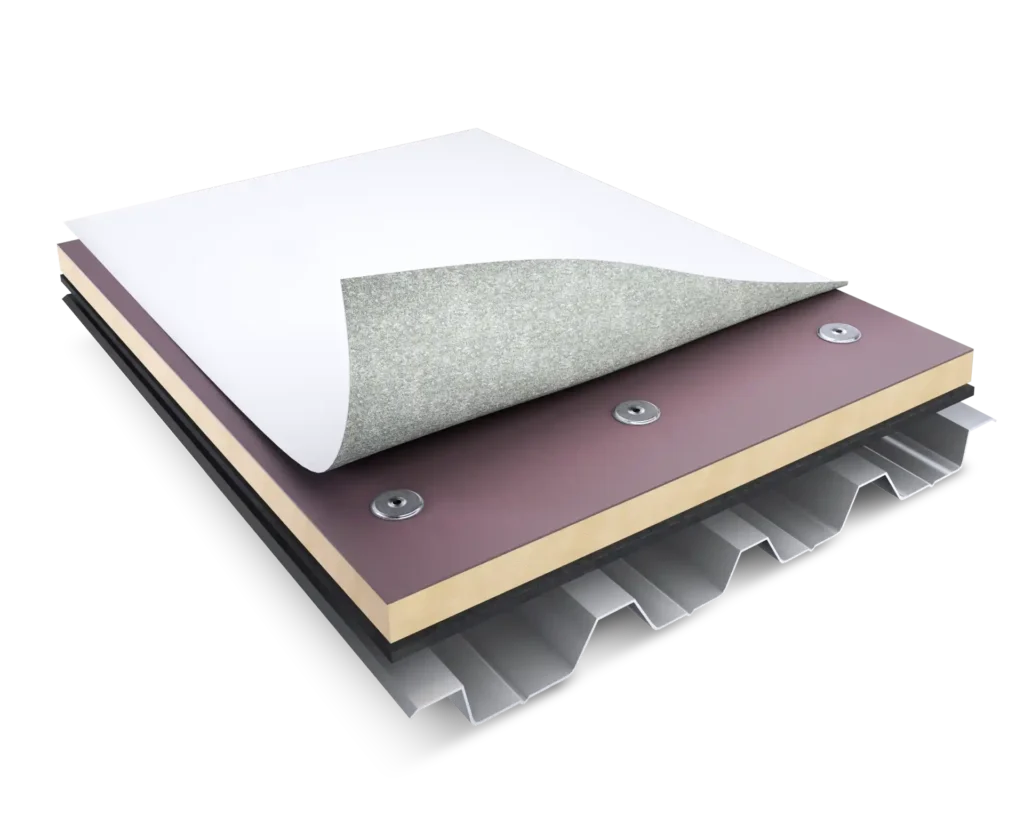
RubberGard MAX is an internally reinforced, cured single-ply EPDM roofing membrane in the Elevate RubberGard family. It uses a 9 x 9, 1,000 denier polyester weft-inserted reinforcing scrim. The technical information sheet is TIS 104, dated September 4, 2025, and covers the membrane under ASTM D4637, Type II scrim-reinforced EPDM single-ply roofing membranes.
The membrane is made in Prescott, Arkansas. It is designed with fire retardants and can meet qualification for UL Class A for slopes up to 3 inches (76 mm), depending on the roofing assembly.
Published range data
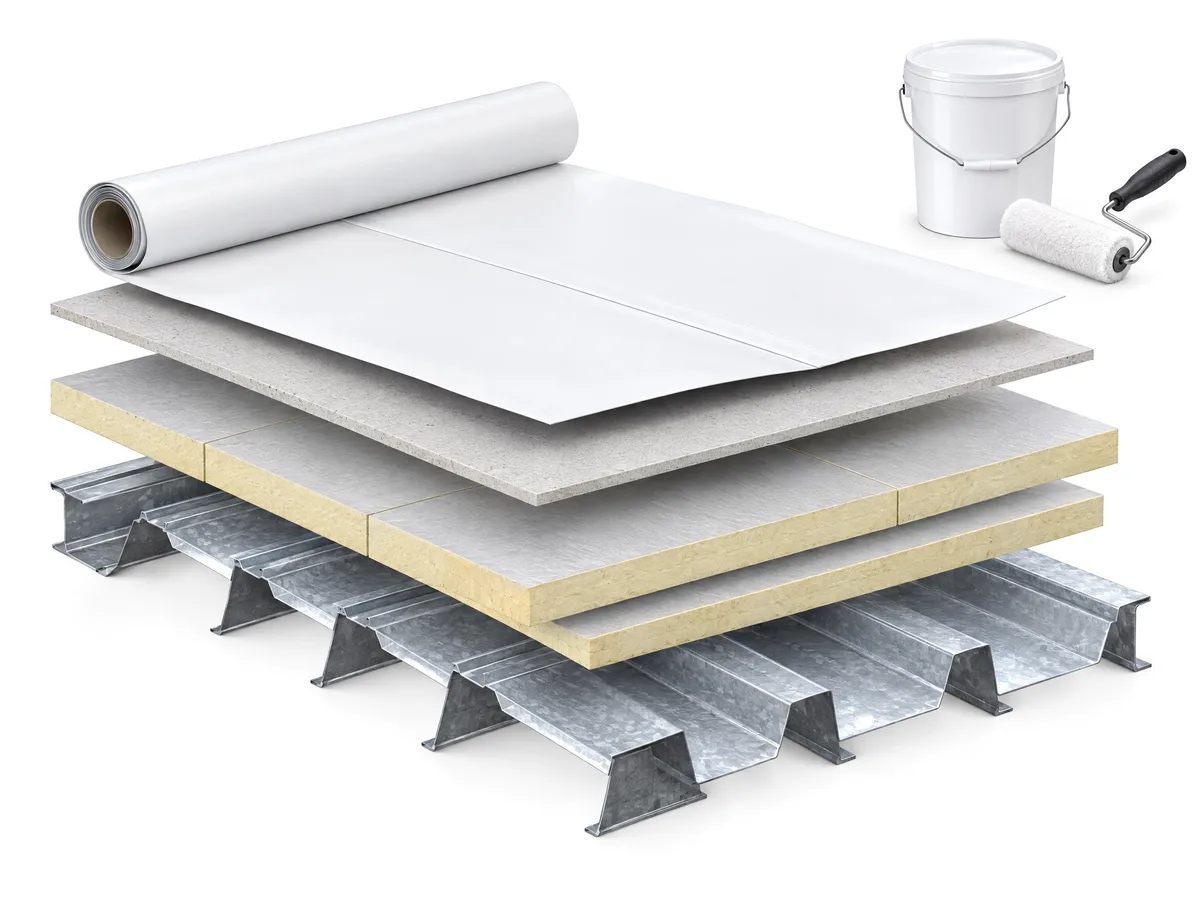
The product page describes the membrane as an internally reinforced cured single-ply roofing membrane offered in 45, 60 and 75 mil. The range listing shows black, with attachment by adhered, mechanically attached or ballasted systems or QuickSeam R.M.A. strips, and a pre-taped option. Applications named are commercial, government, hospital and university roofs. Companion products are insulation, QuickSeam accessories and EPDM adhesives.
Data sheets and technical documents
Current product files and retained historical revisions.
Current files
Archived files
No older reviewed revisions are archived for this product yet.
Thicknesses, sizes and weights
RubberGard MAX is available in three thicknesses. Panels are no-fold, 10 ft (3.05 m) wide and 100 ft (30.5 m) long.
- 0.045 inch (1.14 mm): 0.32 lb/ft² (1.6 kg/m²).
- 0.060 inch (1.52 mm): 0.42 lb/ft² (2.1 kg/m²).
- 0.075 inch (1.91 mm): 0.55 lb/ft² (2.7 kg/m²). Lead time for this thickness is arranged through a sales or customer service representative.
A pre-taped version, MAX PT, is offered in widths up to 10 ft and thicknesses up to 75 mil, with 3 inch or 6 inch tape options. MAX reinforced EPDM is available in adhered, mechanically attached and ballasted systems.
Typical properties
Typical values for the 45, 60 and 75 mil sheets, in that order, against the ASTM D4637 minimum:
- Thickness (D412): 0.046 inch (1.168 mm), 0.058 inch (1.473 mm) and 0.077 inch (1.956 mm).
- EPDM coating over scrim (D7635): 0.022 inch (0.559 mm), 0.030 inch (0.762 mm) and 0.033 inch (0.838 mm); minimum 0.015 inch (0.38 mm).
- Breaking strength (D751 grab method): 218 lbf (969.7 N), 198 lbf (880.7 N) and 239 lbf (1063.1 N); minimum 90 lbf (400 N).
- Elongation at fabric break: 26.7 percent MD and 35.2 percent CD at 45 mil; 28.0 percent MD and 30.2 percent CD at 60 mil; 27.1 percent MD and 36.3 percent CD at 75 mil; minimum 15 percent.
- Tear strength (D751, B-tongue tear): 116 lbf (516.0 N), 116 lbf (516.0 N) and 112 lbf (498.2 N); minimum 10 lbf (45 N).
- Ultimate elongation of the EPDM alone (D412, Die C): 577 percent at 45 mil; minimum 250 percent.
- Dynamic puncture resistance at 10 J (D5635) and static puncture resistance at 25 kg (D5602): pass on all three.
- Brittleness point (D2137): pass at the maximum -45 °C (-49 °F).
- Ozone resistance with no cracks (D1149): pass.
Heat aging and weathering
The aging test runs for 166 hours at 240 °F (116 °C). The 45 mil sheet retains a breaking strength of 241 lbf (1072.0 N) against a minimum of 80 lbf (356 N), an ultimate elongation of 517 percent against a minimum of 200 percent, and a linear dimensional change of -0.8 percent against plus or minus 1 percent. Water absorption by mass is +1.0 percent against +8 / -2 percent. Factory seam strength is not applicable because the membrane has no factory seams.
Xenon-arc exposure under ASTM G151 and G155 uses a 176 °F (80 °C) black panel, 50 percent relative humidity and de-ionized spray water, with an exposure of 10,080 kJ/(m²·nm) at 340 nm. Visual inspection afterward passes on all three thicknesses.
Installation notes
Substrates are clean, dry and smooth, free of sharp edges, fins, loose or foreign material, oil and grease. Roughened surfaces are repaired and voids wider than ¼ inch (6 mm) are filled with an acceptable fill material.
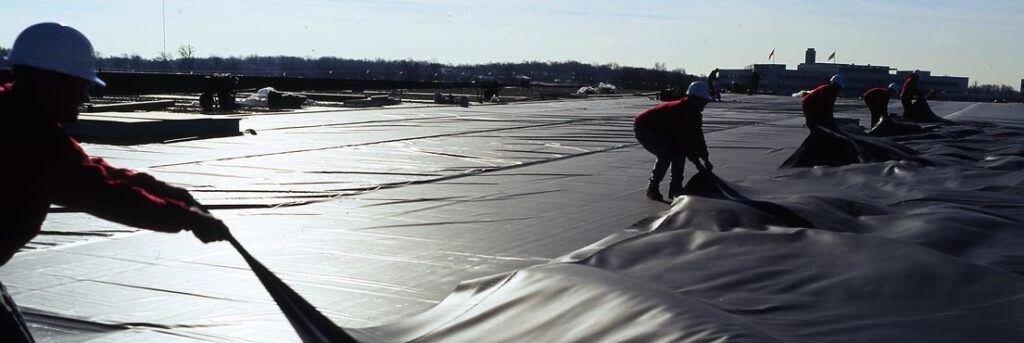
The membrane is installed under current RubberGard specifications, details and workmanship requirements. The side of the sheet printed with This Side Down goes against the substrate to meet test agency compliance. Waste products such as petroleum products, greases, oils and animal fats are kept away from the membrane. The membrane burns when exposed to open flame and is stored away from ignition sources and puncture hazards.
Environmental information
The LEED information lists 0 percent post-consumer and 0 percent post-industrial recycled content, with a manufacturing location of Prescott, AR. For use as a component of an air barrier assembly, the sheet refers to Regional Technical Coordinator, code agency or authority having jurisdiction. This product belongs to the EPDM roofing range.
Installing this in San Antonio or Austin?
We install TPO roof systems on commercial and industrial buildings from our Bulverde office.