
Table of Contents
- When Industrial Roof Insulation Repair Makes Financial Sense
- Industrial Roof Repair vs Replacement: The Core Decision Framework
- Identifying Wet Roof Insulation Signs Before They Become Costly
- Commercial Roof Inspection Checklist for Insulation Assessment
- Roof Insulation Replacement Cost vs. Repair Economics
- Lifecycle Cost Analysis: Why Upfront Price Isn’t the Full Picture
- Conclusion: Making the Repair-or-Replace Decision for Your Facility
- Frequently Asked Questions
Last Updated: October 17, 2026
When Industrial Roof Insulation Repair Makes Financial Sense
The decision to repair or replace industrial roof insulation isn’t just about the immediate cost. It’s about understanding what condition your roof is actually in and whether a repair will genuinely extend its service life or simply delay the inevitable. We assess this question systematically: by examining the extent of damage, the age of the system, and the realistic economics of each path forward.
Industrial roof insulation repair makes sense when three conditions align. First, the damage is localized, affecting roughly 25 to 30 percent or less of the total roof area. Second, the underlying roof structure remains sound and isn’t compromised by widespread deterioration. Third, the remaining service life of the system justifies the investment in repairs rather than a complete teardown and replacement.
When these conditions don’t hold, you’re looking at a different calculation entirely. A roof with wet insulation across 50 percent of its surface, for example, isn’t a repair candidate. Neither is a system that’s already 20 years into a 25-year design life. The cost of repair approaches replacement costs, and you gain little in return.
The real challenge is knowing which category your roof falls into. That requires a methodical inspection, not a quick walkthrough, but a detailed assessment that identifies the true extent of insulation damage, moisture penetration, and structural integrity. This is where most facility managers make their first mistake: they accept a contractor’s estimate without understanding what the inspector actually found.
Industrial Roof Repair vs Replacement: The Core Decision Framework
The choice between repair and replacement hinges on a single fundamental question: Is the existing roof system worth saving?
Repair becomes the logical choice when damage is concentrated in specific areas. A leak in one section of the roof, failed flashing around a skylight, or compressed insulation in a corner zone can often be addressed without disturbing the rest of the system.
Replacement becomes necessary when the damage is systemic. If wet insulation has spread across the majority of your roof, if the metal deck or substrate shows corrosion, or if multiple failure points suggest the system itself is failing, repairs are temporary patches on a failing foundation.
The age of your roof matters here too. A 15-year-old metal roof system with localized damage is a candidate for repair. A 22-year-old system with the same damage profile is not. The remaining service life doesn’t justify the repair investment.
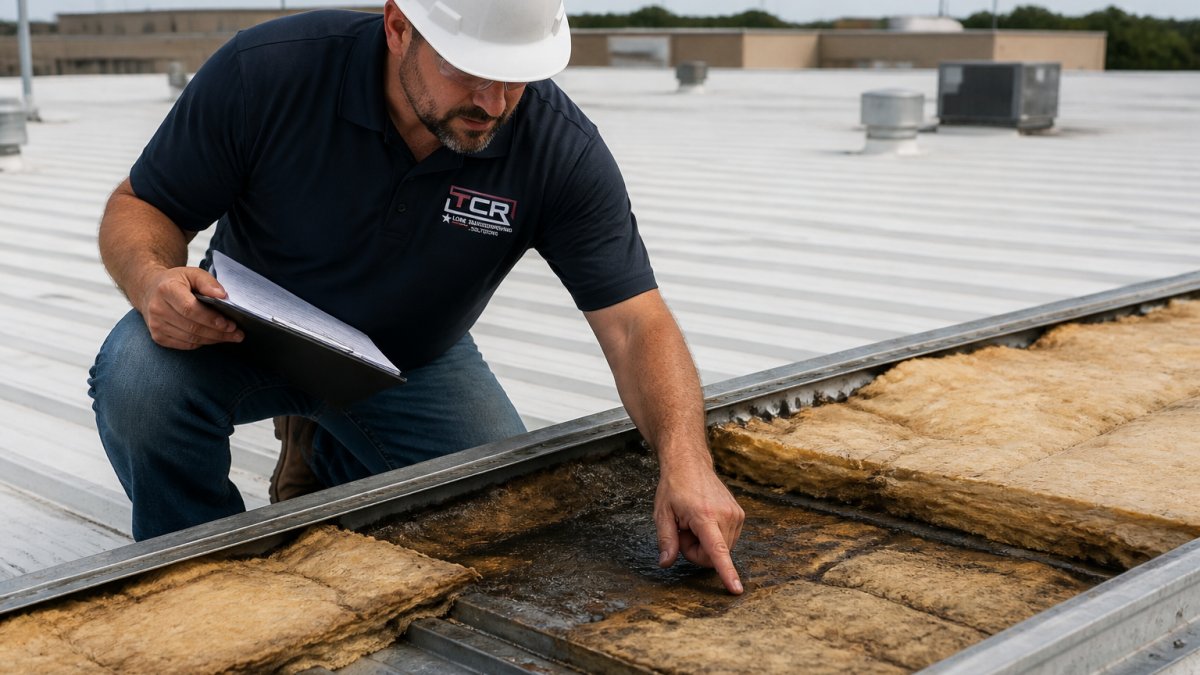
This is where lifecycle cost analysis, not just upfront price, determines the real economics. A repair that costs $15,000 today but requires a $450,000 replacement in three years is far more expensive than a $300,000 replacement today that will last another 20 years.
Identifying Wet Roof Insulation Signs Before They Become Costly
Wet insulation is the silent killer of industrial roofs. Unlike a visible leak or obvious damage, moisture trapped inside your insulation layer degrades performance gradually, compresses under its own weight, and creates conditions for mold and structural decay. By the time you notice the problem, it’s often already extensive.
The first sign is usually performance loss. Your heating and cooling costs climb even though outdoor temperatures haven’t changed dramatically. A roof system that once maintained consistent interior temperatures now shows hot spots in summer and cold zones in winter.
Visual inspection reveals the second set of signs. Look for soft spots or spongy areas when you walk the roof. Compressed insulation feels different from intact material. Staining or discoloration on the underside of the roof (visible from inside the building) indicates water has penetrated the system.
The most reliable indicator is moisture testing. Infrared thermography can identify wet insulation by detecting temperature differences, wet areas cool differently than dry ones. Calcium chloride testing measures actual moisture content.
Many facility managers wait too long because early-stage wet insulation doesn’t announce itself loudly. The roof still sheds water. The building still stands. But inside, the material is degrading. By the time visible damage appears, repair options have narrowed considerably. The insulation may need complete replacement rather than targeted repair.
Commercial Roof Inspection Checklist for Insulation Assessment
A proper commercial roof inspection for insulation assessment follows a systematic protocol. You’re not just looking for leaks; you’re evaluating whether the insulation system can be repaired or must be replaced.
Start with the roof surface. Document the condition of the membrane, metal panels, coatings, or other weatherproofing layer. Look for punctures, seams that are separating, areas where the coating is peeling, or corrosion on metal surfaces.
Next, examine the perimeter and penetrations. Flashing around vents, skylights, and equipment is where most leaks begin. Poor seals, deteriorated sealant, or flashing that’s pulling away from the roof deck create pathways for water to enter the insulation layer.
Move to the interior inspection. From inside the building, look at the underside of the roof. Any staining, rust marks, or visible moisture indicates water has already penetrated the insulation. Document the location and extent. Take photos.
Check the insulation itself where accessible. If you can see or reach the insulation layer, feel it. Is it dry and firm, or soft and compressed? Does it smell musty? These are signs of moisture saturation.
Perform moisture testing if the visual inspection is inconclusive. This is the most accurate way to determine the true extent of wet insulation. Thermal imaging and calcium chloride testing reveal moisture you can’t see.
Document everything: location of damage, extent of affected area, condition of underlying structure, age of the system, and results of any moisture testing. This documentation becomes the foundation for your repair-versus-replace analysis.
Roof Insulation Replacement Cost vs. Repair Economics
The financial comparison between repair and replacement isn’t straightforward because it depends on the scope of work, the extent of damage, and the remaining life of your system. However, understanding the cost structure helps you evaluate proposals intelligently.
Repair costs are typically localized. Patching a small leak, resealing a joint, or replacing compressed insulation in a specific zone costs considerably less than full replacement. For small-scale damage affecting under 25 percent of the roof, repair often costs considerably less than full replacement.
Replacement costs scale with the total roof area and the system type. Metal roofs with insulation, flat roof systems with built-up insulation, and insulated metal panels all have different cost profiles. The tearoff process itself, removing the old system, is labor-intensive and generates significant waste disposal costs.
The critical insight is that repair costs rise sharply as the damage extent increases. At 25 to 30 percent damage, repair remains cost-effective. At 50 percent damage, repair costs approach replacement costs but without the benefit of a new 20-year system.
This is where lifecycle thinking matters. A $15,000 repair on a 20-year-old roof that extends service life by three years costs $5,000 per year of extended life. A $300,000 replacement that provides 20 years of service life costs $15,000 per year.
Age of the system is the overlooked variable. A repair on a 10-year-old roof is an investment in a system with significant remaining life. A repair on a 22-year-old roof is delaying inevitable replacement.
Lifecycle Cost Analysis: Why Upfront Price Isn’t the Full Picture
Lifecycle cost analysis compares the total cost of ownership across the lifespan of each option. It’s the framework that separates smart decisions from penny-wise, pound-foolish ones.
For industrial roof insulation systems, the calculation includes initial cost, maintenance and repair costs over time, operational costs (heating and cooling), and the cost of eventual replacement.
Consider a concrete example. Suppose you have two paths forward. Path A: Repair the wet insulation in the affected zone for $18,000. Path B: Replace the entire roof system for $320,000.
The repair addresses the immediate problem but doesn’t solve the underlying issue: the roof is 20 years old and approaching the end of its design life. In two years, another section fails. You spend another $12,000 on repairs. In four years, the system deteriorates further.
By year five, you’ve spent $45,000 in repairs and endured higher operational costs, and you still need a replacement. The total cost of the “cheap” repair path exceeds the cost of the replacement option.
The replacement path costs more upfront but eliminates future repair costs, reduces operational expenses through improved insulation performance, and provides a 20-year warranty. The total cost of ownership is lower, and the operational certainty is far higher.
This analysis requires honest assessment of your roof’s condition and remaining service life. A roof that’s only 10 years old with localized damage has a different lifecycle profile than a 22-year-old roof with the same damage. The age of the system fundamentally changes the economics.
Conclusion: Making the Repair-or-Replace Decision for Your Facility
The decision to repair or replace industrial roof insulation comes down to three measurable criteria: the extent of the damage, the age and condition of the underlying system, and the total cost of ownership across both options. Localized damage on a relatively young roof system is a repair candidate. Systemic damage on an aging roof is a replacement decision.
Total Cladding and Roofing LLC specializes in this exact assessment. We conduct detailed building investigations to identify the true extent of insulation damage, evaluate the condition of your roof structure, and analyze the lifecycle costs of repair versus replacement. Our integrated approach to roof, insulation, and drainage planning ensures you’re making decisions based on complete information, not contractor guesses. We help you extend the service life of sound systems through targeted repair and restoration, or guide you toward replacement when that’s the more cost-effective path forward.
The worst decision is making no decision, letting a failing roof deteriorate until emergency replacement becomes your only option. The best decision is understanding your actual condition and evaluating both paths with full financial clarity. The Roofing Contractors Association of Texas provides guidance on selecting qualified contractors for roof assessments. Get a detailed inspection and lifecycle cost analysis from a contractor experienced in industrial roof systems. That clarity is worth far more than the cost of the assessment.
Frequently Asked Questions
Is it worth repairing old industrial roof insulation if the roof is still structurally sound?
Repair becomes worthwhile when the underlying roof structure is intact and insulation damage is localized, typically affecting less than 25-30% of the system. If the building envelope remains sound and moisture intrusion is limited to specific areas, targeted repair can extend service life cost-effectively. However, if compression, widespread moisture, or air leaks affect large sections, replacement often delivers better long-term performance and energy efficiency. A professional inspection determines whether your specific situation favors repair or replacement.
What are the signs of wet roof insulation under a commercial roof?
Wet insulation typically shows visible moisture staining, soft or compressed material, mold growth, or a musty odor when accessed. From inside the building, watch for water stains on ceilings, unexplained increases in heating and cooling costs, or condensation on interior surfaces during temperature swings. Thermal imaging during an inspection reveals cold spots indicating moisture-saturated insulation. In industrial settings, wet insulation also reduces the R-value, compromising the building envelope’s thermal performance and driving up operational costs.
How much does roof insulation replacement typically cost compared to repair?
Repair costs vary depending on the extent of damage, while full-system overlay or restoration also has a range of costs. Complete replacement is significantly higher but provides a fresh warranty and extended service life. Actual pricing depends on roof size, insulation type, system complexity, and site conditions. Contact a qualified contractor for a detailed quote, as costs vary by facility and regional labor rates.
What should a roof inspection include before deciding to repair or replace insulation?
A thorough inspection should assess the roof’s structural integrity, measure insulation R-value and compression, test for moisture using thermal imaging or moisture meters, check for air leaks and gaps, evaluate membrane condition, and document the extent of any damage. The inspector should also assess drainage performance, check flashings and penetrations, and review the roof’s age and remaining service life. This data, gathered during a professional inspection, forms the basis for a repair-versus-replacement recommendation tailored to your building’s actual condition.
| Decision Factor | Repair is Better | Replacement is Better |
|---|---|---|
| Damage extent | Under 25-30% of roof | Over 50% of roof |
| Roof age | Under 15 years | Over 20 years |
| Underlying structure | Sound, no corrosion | Deteriorated, corroded |
| Cost comparison | Repair is 30-50% of replacement | Replacement cost justified by remaining life |
| Moisture extent | Localized, under 20% of insulation | Widespread, over 50% of insulation |
To upload drawings, specs and plans please go to the form on our contact page.
Get in Touch