Table of Contents
- Why Commercial Roof Asset Management Matters
- Establishing a Commercial Roof Inventory Across Your Portfolio
- Conducting Systematic Commercial Roof Inspection Checklist Reviews
- Building a Commercial Roof Maintenance Plan That Works
- Prioritizing Repairs Across Your Roof Portfolio
- Commercial Roof Capital Planning and Budget Forecasting
- Extending Roof Service Life Through Condition-Based Decisions
- Implementing Technology and Standardized Data Governance
- Frequently Asked Questions
Last Updated: October 5, 2026
Why Commercial Roof Asset Management Matters
Managing large scale commercial roof assets differs from maintaining a single building.
The core challenge is visibility. Most property managers lack a standardized view of roof conditions across sites, so they react to emergencies rather than plan.
This guide covers the practical framework: building an inventory, conducting inspections that inform decisions, planning maintenance across sites, and implementing technology that turns scattered data into actionable intelligence.
Establishing a Commercial Roof Inventory Across Your Portfolio
A roof inventory is a living database tracking every property’s roof system, condition, age, and maintenance history. Without it, you manage from memory; with it, you decide based on data.
Start by documenting what you have. For each property, record the roof system type (flat membrane, metal panel, single-ply, built-up tar and gravel), square footage, installation year, and warranty details.
What to Document in Your Inventory
Your inventory should capture these essential fields for every commercial roof asset:
- Roof system type and material composition, determines maintenance approach and replacement cost
- Square footage and footprint dimensions, required for budget estimates and material ordering
- Installation date and age, critical for lifecycle planning and warranty status
- Membrane condition rating, current assessment (excellent, good, fair, poor) from most recent inspection
- Drainage system condition, flat roofs require functional drainage; ponding water indicates problems
- Maintenance and repair history, dates, costs, and contractor performance notes
- Warranty information, manufacturer coverage details and expiration dates
- Adjacent building systems, HVAC equipment, skylights, penetrations that affect water intrusion risk
- Climate exposure factors, sun exposure, wind load zones, hail risk, humidity levels
Include previous contractor contacts and knowledge about problem areas. Document recurring leaks, and flag properties in high-risk storm zones.
Tools for Tracking Multiple Properties
Spreadsheets work initially but don’t scale. As your portfolio grows, they fragment: team members update different sheets, version control breaks down, and data gets duplicated or lost.
Cloud-based asset management platforms solve this by centralizing data, enforcing consistent entry, and generating reports automatically.
Many property managers start with a spreadsheet template, then migrate to dedicated software past 5-6 properties.
Conducting Systematic Commercial Roof Inspection Checklist Reviews
Inspections are the foundation of everything that follows.
Schedule inspections annually for most commercial roof assets, and twice yearly for roofs over 15 years old or in high-risk environments. Spring and fall are ideal, after winter stress and before summer heat cycling.
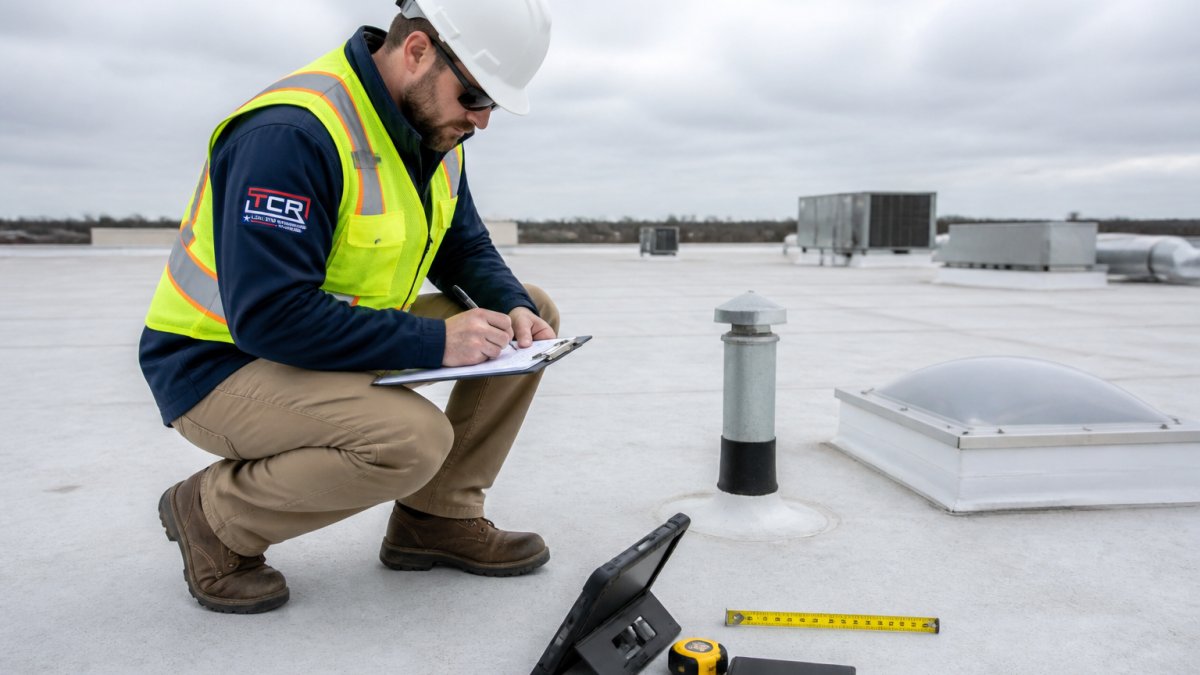
What to Inspect at Each Property
Start at the perimeter.
For flat roofs, drainage is critical.
Examine membrane seams and penetrations. HVAC curbs, skylights, vent pipes, and electrical conduits are common leak sources, so check sealant around each.
Assess overall membrane condition. Older membranes become brittle and lose flexibility, while newer ones should be pliable when pressed.
Document any storm damage.
Documenting Condition Data and Photographic Records
Photographs are your proof, letting you share assessments with contractors, justify budget requests, and track changes over time.
For each photo, record the roof location (north side, southeast corner, near skylight #3) and date.
Document condition data in your inventory system immediately after the inspection. Record the condition rating, defects observed, estimated repair costs, and next steps, plus the inspector’s name and date.
Building a Commercial Roof Maintenance Plan That Works
Maintenance plans prevent emergencies, but only if you follow them, so they must be realistic and integrated with your operational schedule.
The core distinction is preventive maintenance versus emergency repairs. Preventive work is scheduled and slows deterioration; emergency repairs fix unexpected failures. A good plan maximizes the former and minimizes the latter.
Preventive Maintenance vs. Emergency Repairs
Preventive maintenance includes debris removal, drainage clearing, sealant reapplication, and minor repairs, all low-cost, low-disruption, and highly effective.
Emergency repairs are expensive and disruptive. A leak discovered during business hours demands immediate action at premium rates, often with rushed work.
The financial case for preventive maintenance is straightforward. Even accounting for repairs that happen anyway, the ROI is substantial.
Scheduling Maintenance Across Multiple Sites
Coordinate maintenance across your portfolio to smooth contractor demand and negotiate better pricing.
Assign responsibility clearly. Designate one maintenance coordinator per property with authority to approve routine work and escalate issues, preventing “I thought someone else was handling it” delays.
Document all maintenance work: what was done, who did it, how long it took, and what materials were used.
Prioritizing Repairs Across Your Roof Portfolio
Not all repairs are equally urgent. A prioritization framework ensures you spend your budget on the repairs that matter most.
Risk Scoring and Portfolio-Wide Prioritization
Develop a simple scoring system that ranks repairs by impact and urgency. Consider these factors:
- Immediate failure risk, Does this defect create an imminent collapse or safety hazard? Rate high if yes.
- Water intrusion probability, How likely is this defect to cause a leak? Assess based on location, defect type, and weather exposure.
- Operational impact, If this area fails, what happens to your business? A leak over a data center is higher priority than a leak over storage.
- Cost to repair now vs. cost to repair later, Some defects worsen rapidly. Early repair costs less than delayed repair.
- Repair cost, Budget constraints matter. A $50,000 repair may need to wait if a $5,000 repair is also urgent.
Score each repair 1-10 per factor, weighted by importance to your business. A manufacturing facility might weight operational impact heavily; a warehouse might weight cost. Total the scores and rank repairs accordingly.
This scoring system prevents fixing the most visible problem while ignoring the most damaging one. Scoring forces prioritization by impact, not visibility.
Addressing Urgent vs. Planned Work
Urgent repairs address immediate safety or severe operational impact and are non-negotiable. Budget emergency reserves, typically 10-15% of your annual maintenance budget, for unexpected failures.
Planned repairs are scheduled by prioritization score.
Communicate your prioritization logic to stakeholders. When a facility manager asks why their repair isn’t immediate, explain the scoring system and show where it ranks. This transparency builds confidence in your decisions.
Commercial Roof Capital Planning and Budget Forecasting
Capital planning is where commercial roof asset management delivers the most value: instead of reacting to failures, you forecast them years ahead and budget accordingly.
Lifecycle Cost Modeling for Refurbishment vs. Replacement
Every roof has a service life. Flat membrane roofs typically last 15-20 years, metal roofing 30-50 years, and built-up tar and gravel 15-25 years.
At some point repairs become uneconomical: you’re spending thousands on patches when replacement costs only slightly more. Lifecycle cost modeling identifies that inflection point.
Calculate total cost of ownership for each roof: original installation cost, annual maintenance, and historical repair costs, projected against typical service life.
Refurbishment, restoring a roof through coatings, patching, or system upgrades, can extend service life.
Multi-Year Budget Scenarios
Build a 5-year capital plan forecasting roof replacements and major repairs.
Create budget scenarios: what if one roof fails early, or material costs rise 10%? Scenario planning reveals your financial flexibility and which roofs are most critical to monitor.
Share this forecast with finance and executive leadership. A 5-year plan showing $500,000 in roof capital work lets them budget appropriately; without this visibility, roof failures become budget shocks.
Extending Roof Service Life Through Condition-Based Decisions
The difference between a 15-year roof and a 20-year roof is often maintenance discipline: consistent preventive maintenance outlasts neglect until failure.
Condition-based decisions mean choosing repair or replacement based on actual condition data, not just age.
Use inspection data to track deterioration rates. If the condition rating drops one level every 2-3 years, you can forecast replacement timing; slower deterioration buys more time.
Invest in preventive maintenance for roofs you plan to keep.
Implementing Technology and Standardized Data Governance
Technology amplifies your asset management system by ensuring consistency, enabling reporting, and reducing administrative burden.
Cloud-Based Asset Management Platforms
Cloud platforms centralize roof data for your entire team: facility managers log maintenance requests, inspectors upload photos and assessments, finance views capital forecasts, and contractors access property history.
Look for platforms that integrate with your existing systems, accounting software, maintenance scheduling, vendor management. Integration eliminates duplicate data entry and keeps information synchronized.
The platform should generate reports automatically: monthly maintenance summaries, annual condition assessments, and 5-year capital forecasts available on demand, not compiled manually.
Integration with Vendor and Procurement Teams
Your roof contractors need access to your asset data.
Conversely, contractors should update your system with completion data: what they repaired, materials used, and time taken. This feedback improves maintenance planning.
Standardize data formats across vendors.
Track vendor performance. Which contractors deliver quality work on schedule?
Managing commercial roof assets at scale requires systematic data collection, disciplined prioritization, and forward-looking capital planning.
Frequently Asked Questions
What is commercial roof asset management?
Commercial roof asset management is the systematic process of tracking, inspecting, maintaining, and planning for repairs or replacement across multiple roof systems in a property portfolio. It combines inventory documentation, condition assessments, maintenance scheduling, and capital budgeting to minimize emergency repairs, extend roof service life, and control costs. For large portfolios, it prevents reactive decision-making and ensures resources are allocated to the highest-risk properties first.
How do you create a roof inventory for multiple commercial properties?
Start by documenting each roof’s location, square footage, system type (flat roof, metal, membrane), age, and installation date. Photograph each roof and record condition observations. Use a cloud-based platform or spreadsheet to centralize this data so all stakeholders can access current information. Include warranty documentation, previous repair records, and contractor contact details. Update the inventory annually after inspections to reflect current condition and any work completed.
How often should commercial roofs be inspected?
Most commercial roofs benefit from at least two inspections per year, one in spring to assess winter damage and one in fall to prepare for seasonal weather. Properties in areas prone to severe weather, hail, or high winds may need quarterly inspections. After storms or visible damage, conduct immediate inspections. Properties with aging roofs or known issues should be inspected more frequently. Document all findings and compare year-over-year to track deterioration trends.
How can preventive maintenance extend the life of a commercial roof?
Regular preventive maintenance, such as clearing debris, repairing small membrane damage, addressing drainage issues, and resealing flashings, prevents water intrusion and slows deterioration. Addressing minor issues before they become major problems can extend a roof’s service life by 5-10 years or more. Documented maintenance also supports warranty claims and provides evidence of proper care if disputes arise. A structured maintenance plan costs significantly less than emergency repairs or premature replacement.
How do you prioritize roof repairs across a portfolio?
Assess each roof using a risk score that considers condition severity, likelihood of failure, potential impact on operations (occupant safety, equipment exposure), and repair cost. Roofs with active leaks, significant membrane damage, or drainage failures affecting critical areas rank highest. Create a prioritized list that balances urgent repairs with planned preventive work. This approach prevents operational disruption and allows you to schedule contractors efficiently across multiple sites.
What should a commercial roof maintenance plan include?
A comprehensive maintenance plan documents scheduled inspections, routine tasks (debris removal, seal checks), preventive repairs, emergency response procedures, and responsible parties. Include seasonal maintenance needs specific to your climate and roof type. Specify inspection frequency, documentation requirements, and how findings trigger repair or capital planning decisions. The plan should align with capital budgets and contractor availability to ensure consistent execution across your portfolio.
How do you plan and budget for commercial roof replacement?
Use lifecycle cost modeling to compare refurbishment (extending current roof life) against full replacement over 10-20 year horizons. Factor in current condition, anticipated deterioration rate, repair costs, business disruption, and climate resilience needs. Create multi-year budget scenarios showing costs under different timing assumptions. Integrate capital planning with your asset inventory and maintenance data so you can forecast needs and secure funding before emergencies occur. This prevents reactive, expensive decisions.
What information should a commercial roof asset management system track?
Track property location and identification, roof area and system type, installation date and warranty details, inspection history and condition ratings, completed maintenance and repairs, photographic documentation, drainage and water intrusion issues, and recommended next steps. Include contractor contact information and performance records. Organize data so managers can generate reports by property, portfolio-wide risk summaries, and budget forecasts. The system should integrate with capital planning and procurement workflows.
To upload drawings, specs and plans please go to the form on our contact page.
Get in Touch