
Sikalastic-644 Lo-VOC Fluid-Applied Membrane Roofing
- Manufacturer
- Sika
- Product
- Sikalastic-644 Lo-VOC Fluid-Applied Membrane Roofing
- Status
- Current
- Market
- United States
- Latest revision
- Version 01.14
- Last verified
- September 20, 2026
System overview
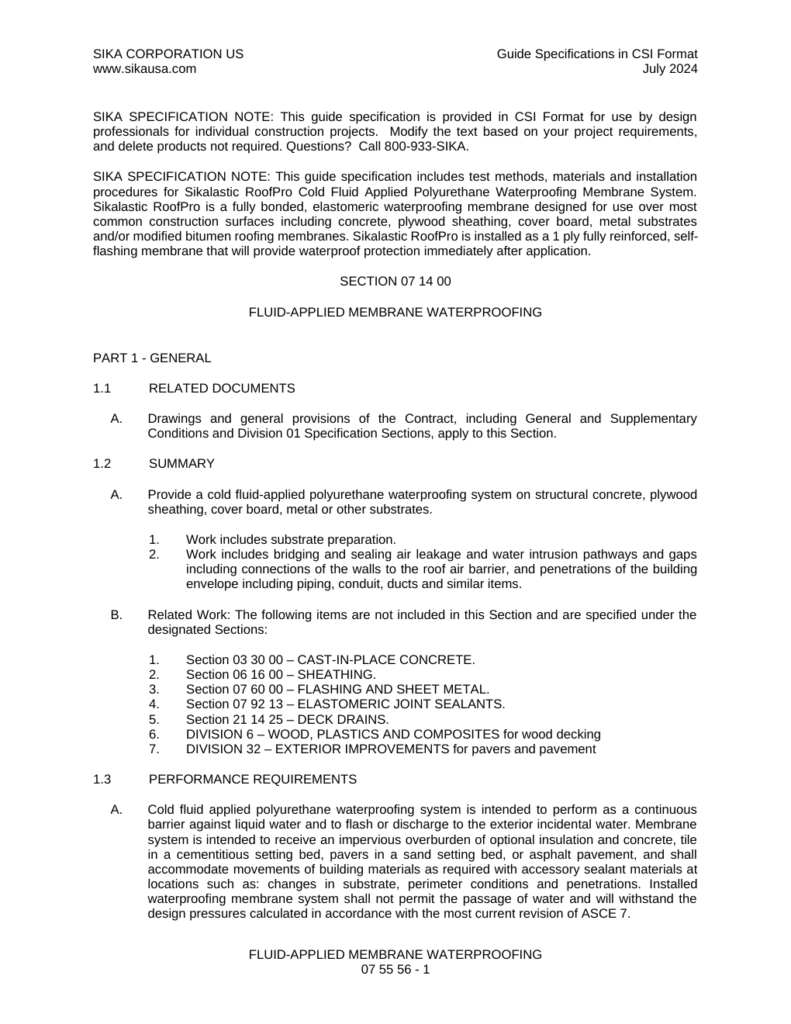
Sikalastic-644 Lo-VOC Fluid-Applied Membrane Roofing is the waterproofing build of the Sikalastic RoofPro WP family. It is written as CSI Section 07 14 00, Fluid-Applied Membrane Waterproofing, and calls for a cold fluid-applied polyurethane waterproofing system on structural concrete, plywood sheathing, cover board, metal or other substrates.
The system is intended as a continuous barrier against liquid water that flashes or discharges incidental water to the exterior. It receives an impervious overburden of optional insulation and concrete, tile in a cementitious setting bed, pavers in a sand setting bed, or asphalt pavement. Accessory sealants accommodate movement at substrate changes, perimeters and penetrations. Wood decking falls under Division 6 and pavers and pavement under Division 32, with deck drains in Section 21 14 25.
The resin is Sikalastic-644 Lo-VOC, a single component, cold applied, aliphatic, moisture-triggered polyurethane that is alkali resistant. The membrane maker is required to have been producing fluid-applied waterproofing membranes for over 30 years and to have completed a cradle-to-grave Life Cycle Analysis and Environmental Product Declaration under ISO 14025:2006. Applied over a prepared deck, it forms a reinforced waterproofing membrane with fleece or fiberglass mat embedded in the resin.
Layers and reinforcement
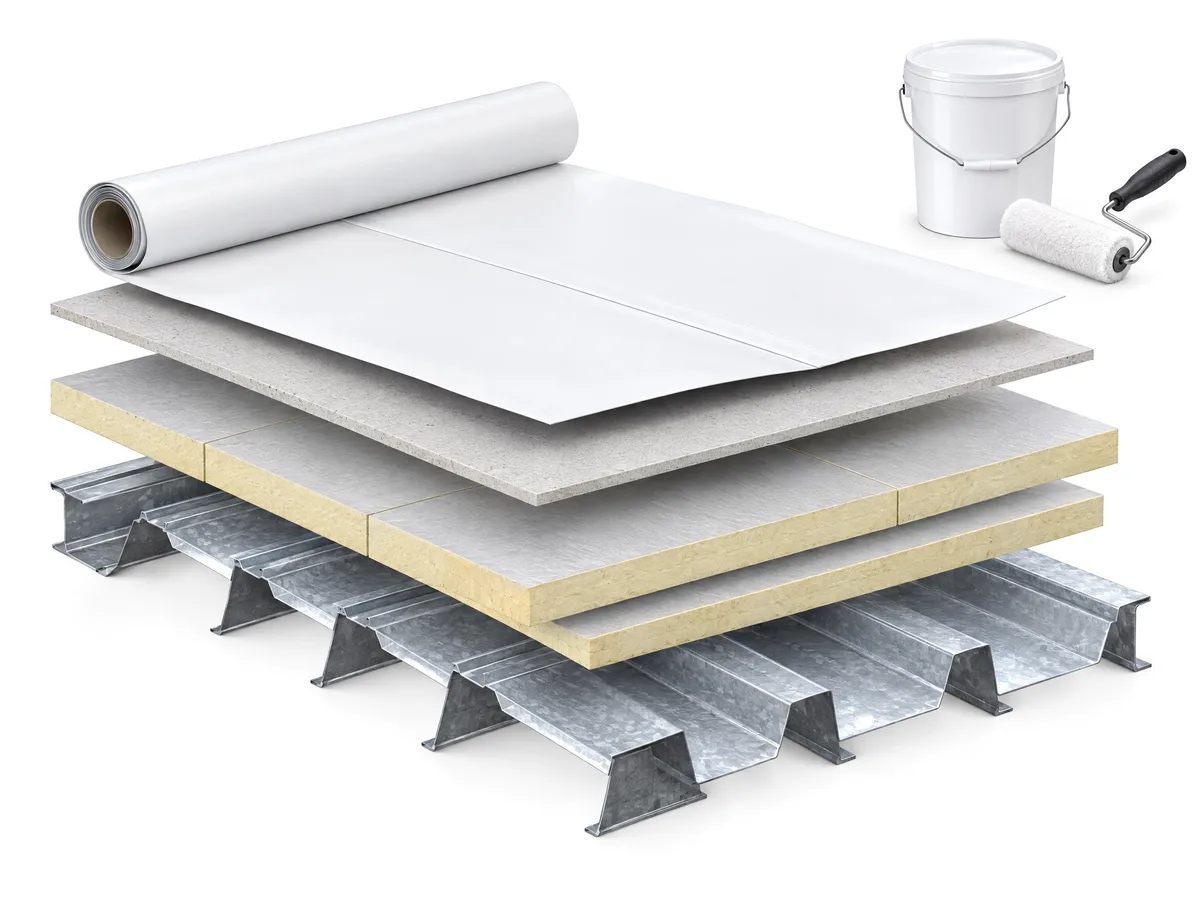
The waterproofing system has a primer, a base resin layer, a reinforcement and one or two top layers. Sika Reemat is a random strand fiberglass mat. Sika Fleece is a non-woven, needle-punched polyester fleece in 120, 140 and 170 grades. Flexitape Heavy, a nylon mesh, or Joint Tape SA, a self-adhering rubberized tape, handles local reinforcement at cracks, expansion joints and transitions between dissimilar materials.
Resin coverage depends on reinforcement. With Reemat, coverage is 53 sf/gal at 30 mils wet, 40 sf/gal at 40 mils and 35 sf/gal at 45 mils. With Fleece, coverage is 23 sf/gal at 70 mils wet, 21 sf/gal at 75 mils and 17 sf/gal at 95 mils. On a modified bitumen surface, a Fleece 140 twenty-year build could reach a full-system rate of 14–16 sf/gal, and a Reemat base coat could reach 25–28 sf/gal.
The WP 15 builds use a 45 mil base and a 25 mil top layer, the WP 20 builds use a 45 or 50 mil base with a 30 mil Reemat or 25 mil Fleece top, and the WP 25 builds use either two 25 mil Reemat top layers or a 60 mil base with a 35 mil Fleece 170 top.
Data sheets and technical documents
Current manufacturer system specifications, application guidelines and component data sheets matched to this assembly.
Current files
Archived files
No older reviewed revisions are archived for this product yet.
Application conditions
The resin is applied within these conditions:
- Ambient air temperature from 41 °F (5 °C) to 95 °F (35 °C).
- Relative humidity of 80 % or less.
- Substrate and uncured coating at least 5 °F (3 °C) above the dew point.
- Substrate temperature from 41 °F to 140 °F (60 °C), with moisture content of 4 % or less by Sika-Tramex meter.
- Film formation in opened containers after about 1–2 hours at 75 °F (24 °C) and 50 % R.H.
Cure times at 50 % R.H. are rain resistant after 1 hour at 40, 50 and 70 °F; touch dry in 12, 6 and 4 hours at those temperatures; and fully cured in 24 hours, 18–24 hours and 12–18 hours. Minimum recoat waits are 18 hours at 40 °F, 8 hours at 50 °F and 6 hours at 70 °F. Past 7 days the surface is cleaned and primed with Sika Reactivation Primer before work continues.
The membrane is applied by 1/2 in. nap phenolic resin core roller, squeegee or spray, with backrolling for squeegee or spray work. Reemat overlaps at least 2 in. at seams, with the frayed edge placed over the cut edge of the roll. After about 5 minutes the binder starts to dissolve and the strands conform to irregular surfaces. The base layer then cures for 12 hours at 70 °F and 50 % R.H., or until tack free.
Crack and joint detailing
- Non-structural cracks up to 1/16 in.: no detail application.
- Non-structural cracks from 1/16 in. to 1/4 in.: routed and sealed with Sikaflex sealant, then a 40–45 mil resin layer embedded with 3 in. Flexitape Heavy, or Joint Tape SA centered over the crack.
- Cracks and joints from 1/4 in. to 1 in.: routed and sealed, bond breaker tape spanning the width, then a 40–45 mil resin layer embedded with 6 in. Flexitape Heavy or Joint Tape SA. Reemat or Fleece ends at the crack edges and overlaps the tape by at least 2 in. each side.
- Joints wider than 1 in.: treated as expansion joints.
- Metal seams and plywood or cover board joints: 40–45 mil resin layer embedded with 3 in. or 6 in. Flexitape Heavy, or Joint Tape SA centered over the seam.
- Transitions between dissimilar materials: 40–45 mil resin layer embedded with Flexitape Heavy or Joint Tape SA centered over the edge.
Substrates and primers
Concrete is cured at least 28 days, with 20.7 MPa (3000 psi) compressive strength and 1.4 MPa (200 psi) tensile bond strength. Priming follows the substrate: Sika Concrete Primer Lo-VOC or Sikalastic EP Primer/Sealer or EP Primer Rapid for concrete, roof cover boards and cement or gypsum substrates; Sika Bonding Primer, a water-based adducted polyamide epoxy, for concrete, cover boards, masonry and previously coated surfaces; Sikalastic GDC primer for green and damp concrete and plywood; and EP Primer/Sealer for metal, modified bitumen surfaces and wood. Existing Sikalastic 600 Series membrane older than 7 days takes Sika Reactivation Primer or Sika Concrete Primer Lo-VOC, and Sika Bonding Primer is the overpainting primer.
Sikaflex-11 FC is the fillet bead and penetration sealant, and Sikaflex Hyflex 150 LM or Sikasil WS-295 finishes exposed terminations. SikaQuick 1000 and SikaQuick VOH patch concrete. Sikadur-22 Lo-Mod or Sikalastic-720 fills uneven areas and birdbaths.
Insulation, vapor retarder and board components
An optional vapor barrier system sits under cover board or base sheet. It is a cold self-adhering polyethylene barrier with rubberized SBS adhesive backing and a silicone release film, supplied with a primer for the deck. The named products are:
- Retarder SA 31 (formerly Sarnavap Self-Adhered): 31 mil (0.8 mm) self-adhesive SBS modified bitumen vapor retarder and air barrier.
- Vapor Retarder SA 106: 106 mil (2.7 mm) self-adhesive SBS modified bitumen vapor retarder.
- Vapor Retarder TA 138: 138 mil (3.5 mm) torch applied SBS modified bitumen vapor retarder.
- Ply Sheet HA 87: 87 mil (2.2 mm) hot applied SBS modified bitumen ply sheet.
- Ply Sheet TA 87: 87 mil (2.2 mm) torch applied SBS modified bitumen ply sheet.
Cover board is Dens-Deck Prime from Georgia-Pacific or Securock Cement Board from United States Gypsum, each at least 1/2 in. thick. Fasteners and plates for polyisocyanurate insulation and cover board are #12 or #14 screws for steel and wood decks, which pass through steel decks by at least 1/2 in., and #14 screws or drive spikes into predrilled concrete, each with a 3 in. diameter Galvalume plate by OMG, Inc. Sarnacol OM Board Adhesive is the low-rise urethane foam adhesive.
Performance and limits
The membrane film meets a volume solids minimum of 80 % and a weight solids minimum of 81 %, with VOC content under 50 g/l and no sag at 28 mils. Other film values match the ASTM figures for polyurethane membranes: tensile strength of 270 lb/in2 minimum, elongation of 200 % minimum, tear resistance of 33 lbf/in minimum, hardness of 82 durometer units, and static puncture resistance of 45.5 lbs.
Approvals for the resin include UL 790 Class A, Miami Dade, the Florida Building Code, ANSI A118.10 for load bearing thin-set tile and ANSI A118.12 for crack isolation. The membrane is not intended for exposure to constant temperatures below -22 °F or above 176 °F. Opening the surface to traffic before cure may cause permanent staining. Areas with heavy or frequent foot traffic need a wear coat with slip resistant aggregate. On-grade concrete decks are not covered with Sikalastic membranes, and unvented metal pans, split or sandwich slabs with encapsulated membrane or insulation, cinder fill decks and lightweight insulating concrete overlays need additional deck evaluation. The resin is not recommended over ceramic tile and is not used in continuous immersion.
Installing this in San Antonio or Austin?
We install protective coatings for metal roofs and cladding on commercial and industrial buildings from our Bulverde office.
Related products
 Illustration
SMEA-2P-6xE — Acrylic-surfaced reinforced roof system
Illustration SMEA-3P-6xE — Acrylic-surfaced reinforced roof system
Illustration SMAA-2P-10xE — All-acrylic reinforced roof system
Modified Bitumen Silicone
Illustration Sikalastic 641 Lo-VOC Vegetated Protected Membrane Roofing
Illustration Sikalastic-624 WP Fluid-Applied Protected Membrane Roofing
Contribution history
Published changes remain in this permanent record. Corrections create a new entry instead of deleting earlier history.
- September 21, 2026 at 8:48 amLibrary Record
Sikalastic-644 Lo-VOC Fluid-Applied Membrane Roofing — initial source record
Created the system record and matched the current manufacturer system specification, application guidance and component data sheets.
By Tom · Verified Primary Source
Sources: Official Sika Sikalastic-644 Lo-VOC Fluid-Applied Membrane Roofing system page