Table of Contents
- What Industrial Building Envelope Restoration Involves
- Building Envelope Inspection and Condition Assessment
- Repair, Restore, or Replace: Decision Framework
- Key Benefits of Building Envelope Restoration
- Industrial Roof Coatings and Protective Systems
- Building Envelope Maintenance and Long-Term Performance
- Lifecycle Cost Analysis and Return on Investment
- Project Planning and Operational Disruption Management
- Frequently Asked Questions
Last Updated: October 6, 2026
What Industrial Building Envelope Restoration Involves
Industrial building envelope restoration is the process of repairing, reinforcing, and protecting the exterior systems that shield a facility from weather, moisture, and environmental damage. This includes roofing, wall cladding, windows, insulation, and drainage systems working together as an integrated protective layer.
Total Cladding and Roofing LLC works with manufacturing plants, warehousing facilities, and commercial properties across Texas. The work typically involves detailed inspection, diagnostic testing, targeted repairs, protective coatings or sealants, and sometimes partial replacement of the most compromised components.
The distinction between restoration and full replacement matters because it changes both timeline and cost. Restoration can be phased to minimize disruption, a manufacturing facility doesn’t need to shut down during roof restoration, since the work can be planned around production schedules.
Building Envelope Inspection and Condition Assessment
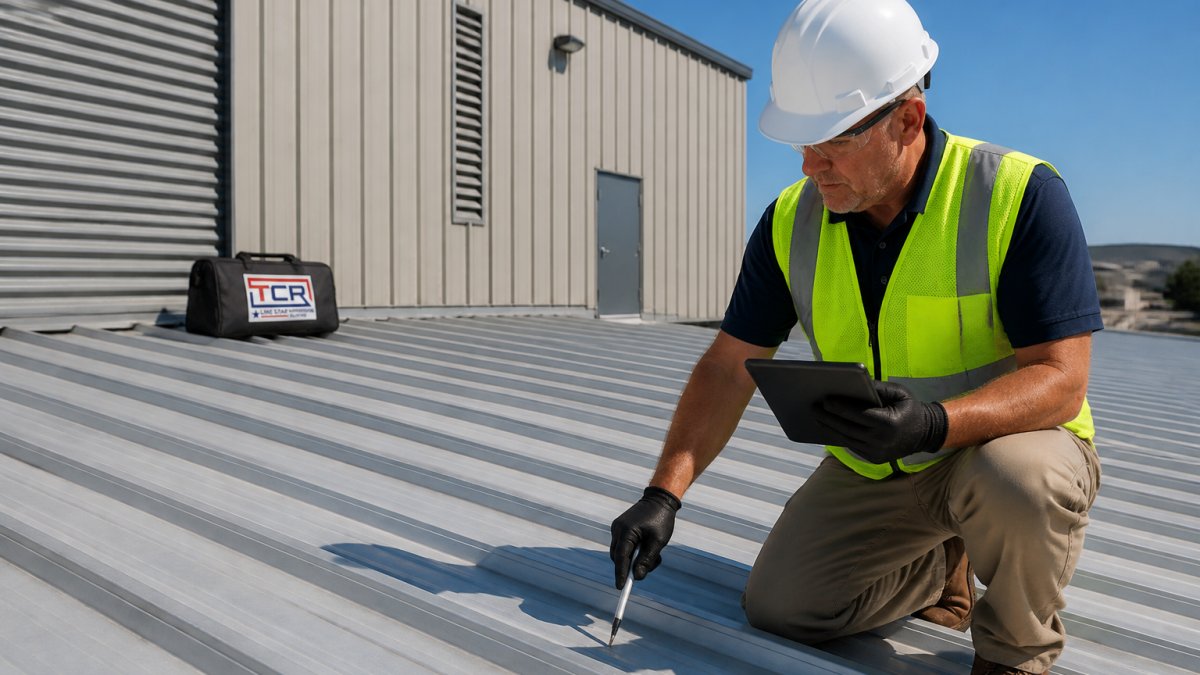
The inspection typically includes visual assessment of all exterior surfaces, identification of water stains, rust, corrosion, or coating failure, and testing of critical seals and joints.
Condition assessment goes beyond visual inspection. Water infiltration testing, thermal imaging, and core sampling reveal what’s happening inside the envelope.
The inspection report should quantify each system component: percentage of roof surface with failed coating, location and extent of corrosion, insulation R-value degradation, and seal integrity.
Repair, Restore, or Replace: Decision Framework
The choice between repair, restoration, and replacement depends on the condition assessment, remaining service life, operational requirements, and financial constraints, not a simple cost comparison.
Repair addresses isolated failures, a leak in one section, localized fastener corrosion, or weather damage. It’s appropriate when the overall system is sound but specific components have failed.
Replacement is necessary when the structure is compromised, remaining service life is measured in months rather than years, or ongoing restoration costs exceed replacement. It also allows code and performance upgrades restoration cannot achieve.
The decision framework should weigh several factors:
- Current condition: How much of the envelope has failed or is failing? Is failure localized or widespread?
- Remaining structural integrity: Can the underlying structure support additional service, or is it compromised?
- Operational requirements: How much downtime can the facility tolerate? What’s the cost of production interruption?
- Financial capacity: What capital is available now versus spread over time through phased restoration?
- Future plans: Will the facility be in use in 10 years? Is it a long-term asset or a transitional property?
Total Cladding and Roofing LLC completes a thorough condition assessment first, then presents realistic options with projected service life and cost implications for each, giving you the information to decide, not a predetermined recommendation.
Key Benefits of Building Envelope Restoration
Extended Service Life and Asset Preservation
A properly restored building envelope can extend the asset’s functional life, depending on the systems involved and the quality of the work. This is the primary financial benefit: you defer the capital expenditure of full replacement and keep an existing asset productive longer.
Asset preservation also means maintaining property value. A building with a failing envelope deteriorates rapidly: moisture intrusion causes structural rot, insulation degrades, and the facility becomes expensive to operate and eventually unusable. Restoration halts this decline.
The extended service life assumption depends on the quality of the restoration work and the maintenance plan that follows.
Waterproofing and Moisture Intrusion Prevention
Moisture intrusion is the primary driver of building envelope failure. Water that penetrates the exterior damages insulation, corrodes structural steel, promotes mold growth, and compromises structural integrity. Waterproofing-focused restoration addresses this at the source.
Effective waterproofing involves multiple layers: exterior coatings that shed water, sealed seams and joints, drainage systems that move water away from the building, and interior vapor management that lets any moisture that does enter dry out. Industrial roofing coatings create a continuous protective membrane; wall panel sealants block water at fasteners and seams; gutters and drainage direct water away from the foundation.
The benefit is immediate: no more water stains on interior walls, damp insulation, or rust spreading from seams and fasteners. For manufacturing facilities, this protects equipment and inventory and maintains the interior environment your operations depend on.
Energy Efficiency and Operating Cost Reduction
A degraded building envelope is an energy sieve. Failed insulation loses its R-value, air leaks around seams and fasteners let conditioned air escape, and damaged roofing absorbs heat in summer and loses it in winter.
Restoration that includes insulation upgrades, air-leak sealing, and reflective coatings can significantly reduce heating and cooling costs. A warehouse with failing insulation and air leaks might spend thousands per month on energy escaping through the roof; restoring insulation and sealing the envelope reduces that waste.
Payback depends on energy costs, climate, and the extent of the work. In many cases, energy savings alone can justify the restoration cost, particularly in facilities with high internal heat loads, data centers, manufacturing plants, or 24/7 operations.
Structural Safety and Building Durability
A failing envelope compromises the entire structure. Water damage weakens steel connections and promotes corrosion; fastener corrosion can cause panels to separate; roof failure can lead to collapse under snow or wind loads.
Restoration that addresses corrosion, reinforces failed fasteners, and upgrades structural connections restores the building’s ability to handle normal loads and environmental stresses. This is a safety issue, not just maintenance, a compromised envelope risks sudden failure that could injure occupants or damage equipment.
Durability also means the building can handle the climate it’s actually in. Facilities in regions with high humidity, salt air, or freeze-thaw cycles face accelerated corrosion; upgraded coatings and materials designed for that climate extend service life and slow future degradation.
Occupant Comfort and Indoor Wellbeing
A leaking roof and failing insulation create uncomfortable interior conditions. Temperature swings, drafts, moisture, and poor air quality affect worker productivity and health, manufacturing plants with failing envelopes often see 20+ degree variations across the facility, making some areas uncomfortable or unsafe in extreme weather.
Restoration that stabilizes the interior environment improves occupant comfort and productivity. Equipment operates more reliably when temperature and humidity are stable, and inventory is protected from moisture damage. These benefits are real and measurable.
Industrial Roof Coatings and Protective Systems
Industrial roof coatings are the most common restoration intervention because they’re cost-effective, non-disruptive, and deliver immediate protection. A seamless coating applied over an existing roof extends its service life by sealing the surface against weather and UV damage.
Common coating types include acrylic, polyurethane, and silicone. The choice depends on existing roof condition, climate, and budget. A coating is only effective if the underlying roof is structurally sound, if the deck is compromised or insulation saturated, coating alone won’t solve the problem.
Application involves cleaning and preparing the surface, repairing failed sections, sealing seams and fasteners, then applying the coating in multiple passes.
Coating durability depends on climate and maintenance. Regular inspection, debris clearing, fastener resealing, and touch-ups extend coating life significantly.
Building Envelope Maintenance and Long-Term Performance
Restoration is not a one-time event. Long-term performance depends on an ongoing maintenance plan that prevents new failures and catches problems early.
Effective maintenance includes regular inspection (annual or after severe weather), clearing gutters and drainage, resealing fasteners and joints, touching up coating damage, and addressing leaks immediately.
Maintenance costs a fraction of restoration or replacement. A facility that invests in regular maintenance needs restoration less often and avoids catastrophic failures requiring emergency work.
Total Cladding and Roofing LLC can establish a maintenance plan based on your building’s specific systems and climate. This plan becomes part of your facility management protocol and helps ensure the restoration investment delivers value over decades.
Lifecycle Cost Analysis and Return on Investment
A proper lifecycle cost analysis compares total cost of ownership across options: repair-only, restoration with maintenance, or replacement.
The analysis should include:
- Initial capital cost of the intervention
- Cost of ongoing maintenance and inspections
- Expected service life before the next major intervention is needed
- Operating costs (energy, water, etc.) during that service life
- Cost of downtime or disruption during the work
- Residual value of the asset at the end of the service life
Restoration typically has lower upfront capital cost than replacement but requires ongoing maintenance investment; replacement costs more upfront but may have lower maintenance costs over time. The breakeven point depends on your facility’s situation.
This analysis is specific to each building and requires actual cost data from your region and facility type. Generic benchmarks are not reliable for decision-making.
Project Planning and Operational Disruption Management
The difference between a successful restoration and a failed one often comes down to planning and execution. A large project, especially roof work or wall panel replacement, requires careful coordination to minimize disruption to operations.
Effective planning includes:
- Detailed scope of work based on the condition assessment
- Phasing strategy that allows the facility to remain operational
- Weather windows and seasonal considerations (roof work in summer, not winter)
- Coordination with facility operations to schedule around production
- Safety planning and site access management
- Quality assurance and inspection protocols during the work
A restoration project might be phased over multiple seasons, with sections completed in rotation so the facility continues operating.
Communication with your operations team is critical. They need to understand what’s happening, how long it will take, what access will be restricted, and what to expect. A well-planned project minimizes surprises and keeps operations moving forward.
Industrial building envelope restoration extends the life of your facility, protects operations from weather and moisture damage, improves energy efficiency, and restores structural safety.
Frequently Asked Questions
What are the main benefits of industrial building envelope restoration?
Industrial building envelope restoration extends asset service life by 10-20 years, prevents costly water infiltration and moisture damage, reduces energy consumption through improved insulation and sealing, and maintains structural integrity. It also improves occupant comfort, protects inventory and equipment from weather exposure, and often costs 40-60% less than full replacement while minimizing business disruption during construction.
How do you conduct a building envelope inspection to assess restoration needs?
A comprehensive building envelope inspection includes visual assessment of roof systems, exterior walls, windows, and drainage; moisture testing to detect water infiltration; drone inspection for hard-to-reach areas; and condition rating of materials and sealants. The inspector documents deterioration patterns, identifies failure points, and evaluates whether components can be restored or must be replaced. This data informs the repair versus restoration decision.
When should I choose restoration over full replacement?
Choose restoration when the building envelope structure is sound, deterioration is primarily surface-level (coatings, sealants, flashing), and the building has 10+ years of remaining useful life. Restoration works well for metal roofing, flat roof systems, and wall cladding with localized damage. Choose replacement if structural damage is widespread, water intrusion is severe, or the system has reached end-of-life. A professional condition assessment determines which path makes financial and operational sense.
How do industrial roof coatings protect a building envelope?
Industrial roof coatings create a seamless, weather-resistant barrier that prevents water infiltration, reflects solar heat to reduce cooling costs, and protects underlying materials from UV degradation and temperature extremes. Coatings extend roof service life by 10-15 years, reduce maintenance costs, and are faster and less disruptive to install than full roof replacement. They work on metal roofing, flat roof systems, and existing damaged surfaces.
What is the typical cost difference between restoration and replacement?
The final cost depends on the roof area, material type, coating system chosen, and local labor rates. Contact a qualified contractor for a detailed assessment and quote. Lifecycle cost analysis, which factors in extended service life and reduced maintenance, often shows restoration delivers better long-term value than replacement.
How long does a restored industrial building envelope last?
A properly restored industrial building envelope can extend its service life, depending on climate exposure, maintenance quality, and the restoration approach used. Regular preventive maintenance, clearing drainage, inspecting sealants, and recoating as needed, maximizes service life and prevents premature failure.
Can building envelope restoration prevent leaks and moisture damage?
Yes. Restoration addresses the root causes of water infiltration: deteriorated sealants, failed flashing, clogged drainage, and coating breakdown. Waterproofing systems, seamless coating applications, and sealed penetrations prevent moisture intrusion that damages insulation, structural components, and interior spaces. Early restoration catches problems before they spread; delayed restoration allows moisture to penetrate deeper, requiring costlier repairs and risking mold, structural rot, and equipment damage.
How does building envelope restoration affect energy efficiency?
Restoration improves energy efficiency by sealing air leaks, repairing or replacing damaged insulation, and applying reflective coatings that reduce solar heat gain. These measures can lower heating and cooling costs, depending on climate and building condition. Energy savings can make restoration financially attractive beyond the immediate asset preservation benefit.
To upload drawings, specs and plans please go to the form on our contact page.
Get in Touch