
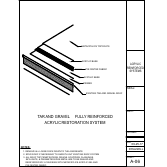
Acrylic Reinforced Coating System Tar and Gravel
- Manufacturer
- Metacrylics
- Product
- Acrylic Reinforced Coating System Tar and Gravel
- Status
- Current
- Market
- United States
- Last verified
- September 20, 2026
Overview
The Acrylic Reinforced Coating System Tar and Gravel is the Metacrylics system for existing tar-and-gravel built-up roofs. It is published as sheet A-06, titled Tar and Gravel Fully Reinforced Acrylic Restoration System, dated 09-25-17, in the Acrylic Reinforced Systems series. In the Installation Spec Book the tar and gravel section is offered as 15 to 30 year systems on pages 15 to 17.
It is a fully reinforced built-up roof coating system that places polyester fabric between two acrylic base coats.
Layers of the system
From the roof upward, the section drawing has these layers.
- Existing tar and gravel roof.
- Primer.
- Acrylic Base.
- Polyester fabric.
- Acrylic Base over the fabric.
- Metacrylics topcoats.
Three notes are printed on the sheet. Loose rock is removed down to the aggregate. The roof is spudded if necessary to smooth the existing roof system. All rooftop penetrations, drains, scuppers, flashings, skylights and perimeter edge metal are sealed and reinforced by 3-coursing with Acrylic Gel and polyester fabric.
Data sheets and technical documents
Current manufacturer system specifications, application guidelines and component data sheets matched to this assembly.
Current files
Archived files
No older reviewed revisions are archived for this product yet.
Bleed Blocker Primer
The Acrylic Bleed Blocker Primer is a water-based all-acrylic primer that resists asphalt staining. Asphalt substrates can bleed through acrylic and silicone coatings. Benefits listed for the primer include adhesion over aged built-up asphalt, modified bitumen, metal and concrete, resistance to dirt pick-up, application by spray, brush or roller, and soap and water clean-up.
- Milky white liquid; solids by weight 27.5 plus or minus 0.5 percent.
- pH 9.5 plus or minus 0.3; specific gravity 1.05; density 8.76 lbs per US gallon.
- Tg (DSC) -10 degrees C (14 degrees F); viscosity 100-400 cps.
- VOC 37.5 to 50 grams per liter.
Application is at least 4 dry mils, about 1 gallon per square, over unaged asphalt, with two 8 dry mil coats possible. It is not applied below 40 degrees F, above 90 percent relative humidity, or when rain is expected.
Gray Base
Gray Acrylic Base is the water-based elastomeric basecoat that encapsulates the fabric. It weighs 12.1 lbs per gallon, has a solids content of 67.9 percent by weight and a VOC of 11.73 grams per liter, and contains a quick-set additive giving rain resistance within 2 hours at 40 degrees F and 80 percent relative humidity. It is for use over BUR asphalt, tar and gravel, granulated cap sheet, rolled roofing, metal, concrete, wood, foam, EPDM, TPO, PVC and stucco.
- Tensile strength 156 psi at 81 mils including fabric; elongation 149 percent average.
- Low temperature flexibility: pass at 1 inch and -40 degrees F.
- Permeability: 0.016 perms at 81 mils dry film.
- Wind uplift 105 PSF; fire rating Class A.
Spray application embeds the polyester fabric in 2 to 3 gallons per 100 sq. ft. and adds 2 gallons over it, 4 to 5 gallons in all, using a .061 tip with 24 to 48 hours of drying.
Stitchbond fabric over gravel
The T272 and T325 stitchbonded fabrics are soft grades that conform to embedded gravel, irregular and smooth roof surfaces. T326 has a firm finish to reduce wrinkles on smooth surfaces, and W201 is a warp knit mat for lower coating application rates.
- T272 weighs 3 oz per sq. yd., with a tensile of 57.1 lbs and Mullen burst of 176.8 lbs.
- T325 weighs 2.75 oz per sq. yd., with a tensile of 31.6 lbs and Mullen burst of 99.6 lbs.
- T326 weighs 2.9 oz per sq. yd., with a tensile of 41 lbs and Mullen burst of 127 lbs.
- W201 weighs 2.75 oz per sq. yd., with a tensile of 75 lbs and Mullen burst of 150 lbs.
A 10 square roll is 10.8 squares gross and 10.0 net with a 3 inch overlap, 40 inches wide by 324 feet. Cut widths run from 2 to 20 inches. Metacrylics Clear Base is a transparent alternative base, white in the can and tacky when dry.
Topcoat
Extreme Performance Acrylic White finishes the system. It reaches solar reflectance 0.90, thermal emittance 0.88 and SRI 114, with an initial elongation of 592.63 percent. A single final coat is applied at 1.5 or 2 gallons per 100 sq. ft. Roller application is 2 to 3 coats at 1.33 to 1.5 gallons each.
Spec book systems and rates
The spec book lists three tar and gravel systems, each measured per square of 100 sq. ft. All begin by spudding or tearing off the gravel so that all loose gravel is removed, then removing debris and dust and pressure washing. Less primer is needed where the old roof has been completely removed. Fabric is not pulled tight, because it must mold into the uneven surface without air gaps or creases. Cure time is 24 to 48 hours after the fabric coat and between white coats.
15-year system
- Clear Base or Black Primer: 1.5 gallons per square
- Gray Base: 5 gallons per square (3 gallons under the fabric, 2 gallons over it)
- Acrylic White: 4 gallons per square, in two coats of 2 gallons
- Stitchbond fabric: 1 square per square; Acrylic Gel and fabric as needed
20-year system
- Clear Base or Black Primer: 1.5 gallons per square
- Gray Base: 5 gallons per square, split 3 and 2 around the fabric
- Acrylic White: 6 gallons per square, in three coats of 2 gallons
- Stitchbond fabric: 1 square per square
30-year system
- Clear Base or Black Primer: 1.5 gallons per square
- Gray Base: 7.5 gallons per square, in two fabric layers (3 plus 2 gallons, then 2 plus 0.5 gallon)
- Acrylic White: 8 gallons per square, in four coats of 2 gallons
- Stitchbond fabric: 2 squares per square; 48 hours of cure after the second fabric layer
Silicone path and roof conditions
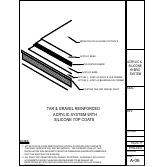
The manufacturer's tar and gravel page lists an acrylic build of specified acrylic primer, acrylic base coat, T272 polyester fabric and acrylic top coat. The silicone build is Roof & Tile Primer or Bleed Blocker Primer, Silicone Gel at details and High Solids Silicone, and a reinforced acrylic hybrid with silicone top coats is also named. Surface profile and remaining aggregate affect final appearance and coverage.
- Concerns: loose aggregate hiding splits; saturated felts below low areas; irregular texture that consumes coating
- Preparation: spud and remove every loose stone, pressure-wash and locate saturated areas, level repairs before embedding the soft polyester
- Release points: only firmly embedded aggregate remains; T272 fabric is fully saturated without fishmouths; drains and ponding areas get extra attention
Penetration and edge details
Spec book pages 49 and 50 give the detail work for gravel-surfaced roofs as follows. Drains are 3-coursed with gel and fabric into the pipe at least 2 inches, using a 20 or 40 inch square of fabric with a hole cut for the drain. HVAC duct joints are 3-coursed with gel and fabric or covered with 4 inch Peel & Coat tape, then coated with 2 gallons per square of white in two 1 gallon applications. Wood sleepers under HVAC units are lifted and a 1-ply or granulated slip sheet is laid beneath, or the area is coated and reinforced with fabric where the sleepers cannot be moved.
Related products
Contribution history
Published changes remain in this permanent record. Corrections create a new entry instead of deleting earlier history.
- September 21, 2026 at 8:48 amLibrary Record
Acrylic Reinforced Coating System Tar and Gravel — initial source record
Created the system record and matched the current manufacturer system specification, application guidance and component data sheets.
By Tom · Verified Primary Source
Sources: Official Metacrylics Acrylic Reinforced Coating System Tar and Gravel system page