
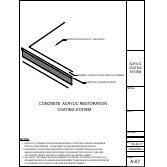
Acrylic Roof Restoration Coating System Concrete
- Manufacturer
- Metacrylics
- Product
- Acrylic Roof Restoration Coating System Concrete
- Status
- Current
- Market
- United States
- Latest file date
- September 25, 2017
- Last verified
- September 20, 2026
Overview
The Acrylic Roof Restoration Coating System Concrete is the Metacrylics system for existing concrete roof decks and surfaces. It is published as sheet A-07, titled Concrete Acrylic Restoration Coating System, dated 09-25-17.
Concrete is one of the surfaces Metacrylics coatings are applied to, and the system belongs with the water-based waterproofing coatings for roofs and decks.
Layers of the system
The section drawing has an existing concrete roof, one primer, and Metacrylics acrylic topcoats. The primer is Acrylic Roof and Tile Primer.
Three notes are printed on the sheet.
- Specialty primers are required if the existing surface needs special treatment, for example an efflorescence blocker.
- Expansion joints and horizontal or vertical transitions are sealed and reinforced either by 3-coursing with Acrylic Gel and polyester fabric or with Acrylic Base and polyester fabric.
- All rooftop penetrations, drains, scuppers, flashing, skylights and perimeter edge flashing are sealed or reinforced by 3-coursing with Acrylic Gel and polyester fabric.
Data sheets and technical documents
Current manufacturer system specifications, application guidelines and component data sheets matched to this assembly.
Current files
Archived files
No older reviewed revisions are archived for this product yet.
Primer for concrete
Roof and Tile Primer is commonly applied over concrete, stone and slate. It is a clear, water-based acrylic with penetrating characteristics, and it reduces absorbency and binds fine surface dust. New concrete must be fully cured for 30 to 60 days before it is primed.
- Application: 0.25 to 1 gallon per 100 sq. ft. by roller or by spray with a .031 tip.
- Drying: 1 to 4 hours.
- Solids 16-20; pH 7-8; viscosity 1500-6000 cps (Brookfield RV, spindle 5, 50 rpm).
- Film: elongation at break 700 percent; surface not tacky; glass transition temperature 17 degrees C.
The primer is not applied if rain or freezing weather is expected within 24 hours, during fog or drizzle, or when temperatures are consistently below 40 degrees F.
Gel at joints and penetrations
Acrylic Gel is the mastic used at the concrete joints and penetrations named on the sheet. It is a water-based acrylic elastomeric product for flashing and fabric reinforcement, usable over wood, metal, concrete, urethane, epoxies, rubber, single-ply membranes and BUR asphalt. Its adhesion to concrete was measured as a peel of 6.3 lbs per linear inch (ASTM C836).
- Cool Roof Rating Council C-1371: solar reflectance 0.87, thermal emittance 0.90, seller ID 0660.
- Title 24 compliant; LEED points available for heat island effect.
- Permeability: 0.016 perms at 81 mils dry film (ASTM D1653).
- Flash point: none at 200 degrees F.
- Chemical resistance: no effect from 1 percent sodium hydroxide, diesel, 1 percent hydrochloric acid, Stoklard solvent or salt.
Extreme Performance White on concrete
The finish coat is Extreme Performance Acrylic White. Metacrylics primer is used on all surfaces before this coating, and new concrete must be fully cured first. Break elongation is 521.12 percent (ASTM D412, Die C), and Cool Roof Rating Council figures are solar reflectance 0.90, thermal emittance 0.88 and SRI 114. The product is also used for exterior and below grade waterproofing.
Two spray coats are applied at 1.5 gallons per 100 sq. ft. each, 3 gallons in total, using a .035 to .039 tip. Sand or rubber granules can be mixed in for a non-skid finish, applied with a texture roller or texture gun. Equipment is cleaned with water while the coating is wet; cured material can be removed with amyl acetate, hand cleaner or lacquer thinner.
Related products
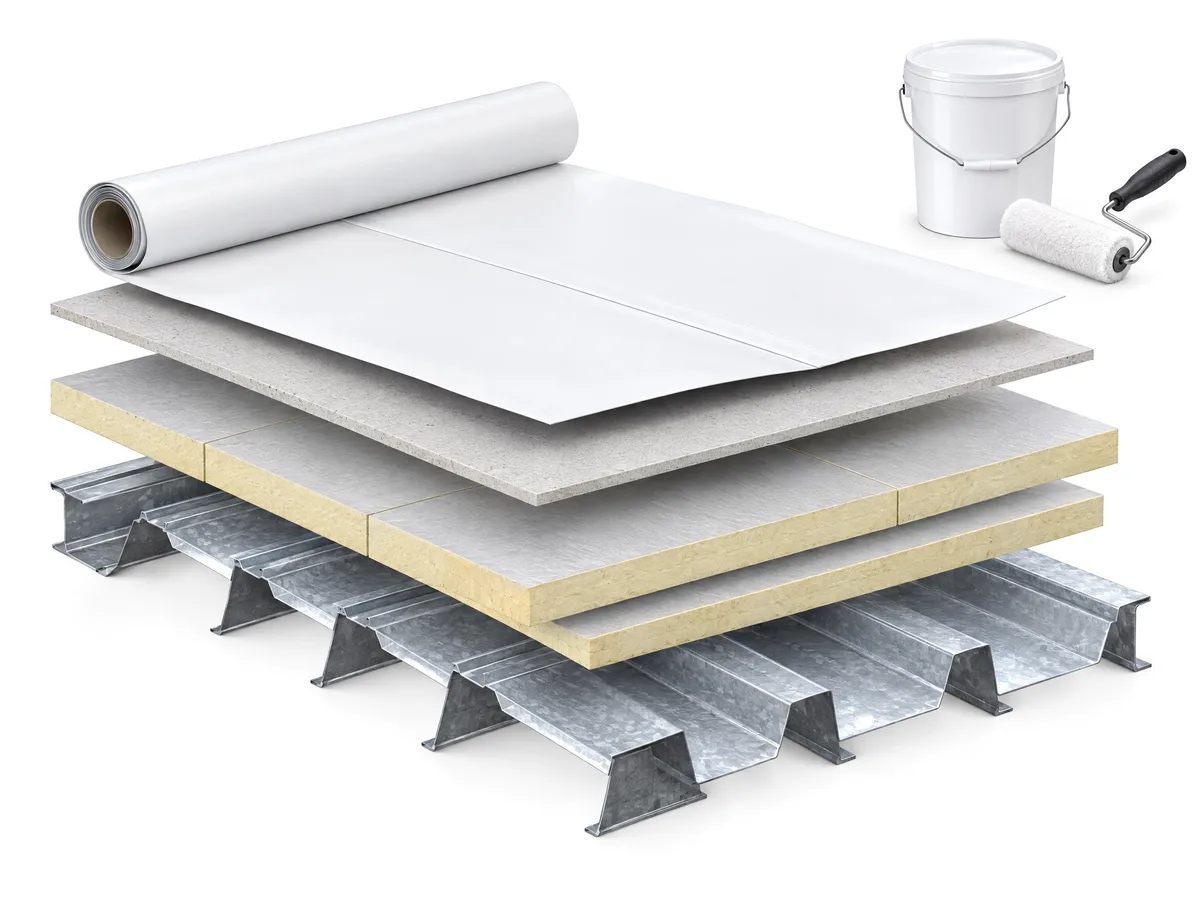 Illustration
07 56 00 Fluid-Applied Roofing Recover Sikalastic-500
Illustration Sikalastic-641 Lo VOC Fluid-Applied Roofing & Recover
TPO Silicone
Illustration GR-2P-24-XE — Gravel-roof reinforced restoration system
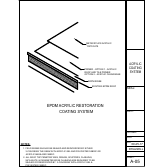
Acrylic Roof Restoration Coating System EPDM
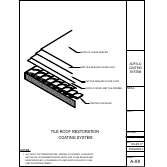
Acrylic Roof Restoration Coating System Tile Roof
Contribution history
Published changes remain in this permanent record. Corrections create a new entry instead of deleting earlier history.
- September 21, 2026 at 8:48 amLibrary Record
Acrylic Roof Restoration Coating System Concrete — initial source record
Created the system record and matched the current manufacturer system specification, application guidance and component data sheets.
By Tom · Verified Primary Source
Sources: Official Metacrylics Acrylic Roof Restoration Coating System Concrete system page