
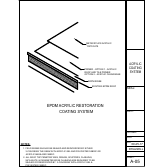
Acrylic Roof Restoration Coating System EPDM
- Manufacturer
- Metacrylics
- Product
- Acrylic Roof Restoration Coating System EPDM
- Status
- Current
- Market
- United States
- Latest file date
- September 25, 2017
- Last verified
- September 20, 2026
Overview
The Acrylic Roof Restoration Coating System EPDM is the Metacrylics system for coating existing EPDM rubber roof membranes. The Metacrylics Installation Spec Book offers it as 10, 15, 20 and 30 year systems on pages 3 to 6, and the system begins with a rinse treatment before any coating.
It is one of the Metacrylics assemblies for EPDM roofs.
The manufacturer's representative EPDM assembly runs from a prepared EPDM surface to Acrylic Clear Base, then polyester fabric, then Extreme Performance Plus Acrylic White.
EPDM Rinse
EPDM Rinse is a low viscosity, sprayable, rinseable primer technology that pretreats a black EPDM rubber membrane before power washing and coating. It is made for use with Metacrylics acrylic or silicone coatings and improves coating adhesion to EPDM. It has a neutral pH and uses APEO-free surfactants.
- Appearance: clear liquid; color pink to purple; odor mild.
- pH 6-7; specific gravity 1.01 g/cc; wet density 8.46 lbs per gallon.
- Completely soluble in water.
- Dilution during pressure washing: one part EPDM Rinse to 300 parts water.
Laboratory wet adhesion on black EPDM, tested to ASTM C794 with a two-coat application of 18 to 20 dry mils, was 0.4 pli on new EPDM and 0.5 pli on aged EPDM after a plain pressure wash, and 1.2 pli on new EPDM and 1.4 pli on aged EPDM after EPDM Rinse followed by a pressure wash. A roof trial reported adhesion pulls after 7 months of exposure on a Building 48 roof.
Data sheets and technical documents
Current manufacturer system specifications, application guidelines and component data sheets matched to this assembly.
Current files
Archived files
No older reviewed revisions are archived for this product yet.
Rinse application
EPDM Rinse is spread at 500 sq. ft. per gallon by spray bottle or by pouring and brushing, and it stays on the surface for a minimum of 20 minutes and up to 2 hours. The membrane is then cleaned with a commercial power washer between 2000 and 3500 psi, worked slowly and close to the surface to remove mica and inorganic release agents. A power washer is needed for adhesion. A faster final rinse continues until the water runs clear with no soap bubbles, and the membrane dries with no visible dampness before it is coated. In the Spec Book the quantity is 0.2 gallons per square (100 sq. ft.), left for 20 minutes before pressure washing.
The 180 degree peel adhesion test uses 3 inch by 6 inch membrane pieces, coating at 18 to 20 dry mils, 14 days of cure at 75 degrees F and 50 percent relative humidity, and a peel rate of 2 inches per minute. Wet adhesion is tested after 7 days of water immersion. A separate ponding blister test forms treated membrane into a bowl.
Aquatic toxicity data classify the rinse as of low concern to aquatic invertebrates and fish (LC/EC50 above 100 mg/L) and moderate concern to algae.
10-year system
The 10-year coating over EPDM uses these materials per square (SQ, 100 sq. ft.):
- EPDM Rinse: 0.2 gallons.
- Clear Acrylic Base: 1 gallon.
- Acrylic White: 3 gallons.
- 9 inch Stitchbond Fabric with Clear Acrylic Base for seams, and Acrylic Gel with fabric, as needed.
The roof is cleaned, rinsed and pressure washed. Clear Base goes on the whole roof, including parapet walls, flashings and HVAC ducts, and cures 4 to 12 hours. Penetrations are 3-coursed, bad seams are reinforced with polyester fabric and Clear Base, and so are waterways and ponding areas. Acrylic White follows in two applications of 1.5 gallons per square, 24 to 48 hours apart.
15, 20 and 30 year systems
Heavier systems add fabric and base. The 15-year system uses 3 gallons of Clear Base, 3.5 gallons of Acrylic White and one square of Stitchbond Fabric per square, with fabric embedded in 2 gallons of wet Clear Base, a further 1 gallon over it, and 24 hours of cure. White goes on in two coats of 1.75 gallons.
The 20-year system uses 4 gallons of Clear Base and 4 gallons of White, with 2 gallons of Clear Base under and 2 over the fabric and 24 to 48 hours of cure; White goes on as two coats of 2 gallons.
The 30-year system uses 6 gallons of Clear Base, 7 gallons of White and two squares of fabric per square. A 5-course penetration detail replaces the 3-course detail, two fabric layers are embedded in wet Clear Base, cure takes 48 hours, 2 gallons of base encapsulate the exposed fabric, and White goes on in four applications of 1.75 gallons.
Related products
 Illustration
Sikalastic-641 Lo VOC Fluid-Applied Roofing & Recover
TPO Silicone
Illustration GR-2P-24-XE — Gravel-roof reinforced restoration system
UltraPly TPO
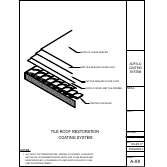
Acrylic Roof Restoration Coating System Tile Roof
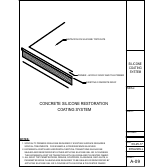
Silicone Roof Coating System Concrete
Contribution history
Published changes remain in this permanent record. Corrections create a new entry instead of deleting earlier history.
- September 21, 2026 at 8:48 amLibrary Record
Acrylic Roof Restoration Coating System EPDM — initial source record
Created the system record and matched the current manufacturer system specification, application guidance and component data sheets.
By Tom · Verified Primary Source
Sources: Official Metacrylics Acrylic Roof Restoration Coating System EPDM system page