
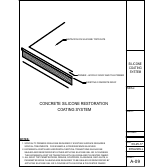
Silicone Roof Coating System Concrete
- Manufacturer
- Metacrylics
- Product
- Silicone Roof Coating System Concrete
- Status
- Current
- Market
- United States
- Latest file date
- September 25, 2017
- Last verified
- September 20, 2026
Overview
Silicone Roof Coating System Concrete is a Metacrylics system assembly for concrete roof decks and surfaces. Its restoration approach is a silicone roof coating over the concrete deck, with silicone finish coats.
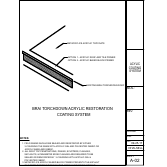
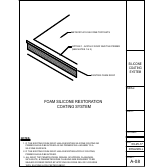
The assembly is published as drawing A-09, titled Concrete Silicone Restoration Coating System, dated 09-25-17. The drawing shows an existing concrete roof, an Acrylic Roof and Tile Primer, and Metacrylics silicone topcoats.
Assembly and notes
The drawing carries three notes. Specialty primers are required if the existing surface needs special treatments, and the example given is an efflorescence blocker. Expansion joints and horizontal and vertical transitions are sealed and reinforced either with Silicone Gel or by 3-coursing the joint or transition with silicone and polyester fabric. All roof top penetrations, drains, scuppers, flashings, skylights and perimeter edge flashing are required to be sealed or reinforced with Silicone Gel or a 3-course of silicone and polyester fabric.
A 3-course is built from alternating layers: gel or silicone, an embedded layer of fabric, and a second layer of gel or silicone over the fabric.
Data sheets and technical documents
Current manufacturer system specifications, application guidelines and component data sheets matched to this assembly.
Current files
Archived files
No older reviewed revisions are archived for this product yet.
Concrete surface preparation
Concrete is listed among the surfaces that High Solids Silicone is applied over. New concrete must be fully cured before coating, and the Roof & Tile Primer data gives a cure period of 30 to 60 days. Surfaces are clean, dry and free of dust, dirt and oily residues.
Metacrylics Silicone Gel can also be used over concrete, and the application book includes penetration instructions for the rooftop items found on a concrete deck.
For skylights, Silicone Gel with no reinforcement, or a 3-course with Acrylic Gel and fabric, goes up the curb side a minimum of 3 inches and onto the roof surface 3 inches. Weep holes in the skylight are not covered. For curbs and plumbing vents the figures are 3 inches up and 3 inches onto the roof.
For parapet coping, the coping is washed or pressure washed, rusted areas are primed with a rust inhibitor primer, and Silicone Gel is applied over the top of the cap joints and exposed screws. Peel & Coat tape on the coping joints and screws with HS Silicone or Silicone Gel over the tape is the alternative.
For nosings, edge flashings and gravel stops, the gel or 3-course reaches 2 to 3 inches onto the flashing and 2 to 3 inches onto the roofing surface.
Roof & Tile Primer
Metacrylics Roof & Tile Primer is a clear, water-based acrylic primer with penetrating characteristics that improves adhesion of elastomeric coatings to existing roof or walking surfaces. It is white as a liquid and dries clear and not tacky.
It is commonly applied over wood, asphalt-based surfaces, concrete, stone, slate, metal, tiles, fiberglass, stucco and acrylic coated surfaces, and it binds fine surface dust on composite substrates.
Specification values: solids 16–20, pH 7–8, Brookfield viscosity (spindle #5, 50 rpm) 1500–6000 cps, density at 23°C of 1.03 g/cm2, anionic dispersion, not freeze/thaw resistant. Film values: elongation at break 700%, glass transition temperature 17°C, water absorption 5%, surface not tacky. Independent testing by ICC-ES and UL found no zinc oxide in it.
Spray application is at 0.25 to 1 gallon per 100 sq. ft. with a .031 spray tip, and roller application is at the same rate. Drying time is 1 to 4 hours. Wet acrylic is extremely slippery underfoot. The primer is not thinned, is stored above 40°F, and is stirred before use. It is not applied if rain or freezing weather is imminent within 24 hours, or when temperatures are consistently below 40°F.
High Solids Silicone topcoat
The topcoat material is a one-component, 100% silicone elastomer formulated with high volume solids.
Standard colors are white, light gray and tan. Special colors carry an additional charge and a minimum order quantity, and non-standard colors add 15 days.
Unopened, the material has a 6 month shelf life.
Permeability is 2.0 U.S. perms and water absorption is 0.2 by ASTM D-570.
Tension set at 100% (ASTM D-412) is 0%, heat-aged permanent change is 0% and permanent set at break is 1.0%.
Continuous immersion service, cryogenic tanks and cold storage roofing without a vapor barrier are outside its recommended uses.
Modified bitumen, asphalt and coal tar built-up roofing need an appropriate primer beneath the coating.
Hoses are BUNA-N jacketed with a minimum inside diameter of 3/4 inch.
A 5000 psi gun with a reverse-a-clean tip, a .030 minimum orifice and a 50° fan tip is called for.
An ASTM D-903 adhesion test is run before coating to confirm that the coating will adhere.
On roofs with foot traffic, walkway pads add protection and slip resistance.
It may be used to recoat existing spray-in-place roofing systems after power scrubbing, pressure washing, chemical cleaning or an air wand, once the surface is completely dry.
Over polyurethane elastomeric base coats it is used as a topcoat for improved traffic and impact resistance.
Silicone Gel
The gel goes on by brush or trowel up to 1/4 inch thick and cures with moisture as a one-component liquid flashing membrane.
The gel is white and is packaged in 2 gallon and 3.5 gallon buckets.
One gallon covers 25 sq ft.
QUV weathering at 5,000 hours shows no degradation, and permeability is 7.9 U.S. perms.
Viscosity is 50,000 cps and flash point is 142°F by ASTM D-56.
Typical uses are spot repairs, reinforcing seams, flashings and penetrations, and sealing joint and penetration repairs for solar and air conditioning systems.
Related products
Contribution history
Published changes remain in this permanent record. Corrections create a new entry instead of deleting earlier history.
- September 21, 2026 at 8:48 amLibrary Record
Silicone Roof Coating System Concrete — initial source record
Created the system record and matched the current manufacturer system specification, application guidance and component data sheets.
By Tom · Verified Primary Source
Sources: Official Metacrylics Silicone Roof Coating System Concrete system page