
Silicone Roof Coating System Foam
- Manufacturer
- Metacrylics
- Product
- Silicone Roof Coating System Foam
- Status
- Current
- Market
- United States
- Latest file date
- September 25, 2017
- Last verified
- September 20, 2026
Overview
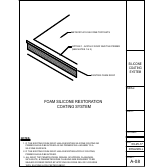
Silicone Roof Coating System Foam is a Metacrylics system assembly for spray polyurethane foam (SPF) roofing. The system is a silicone roof coating restoration assembly for existing foam roofs, topped with silicone.
The assembly is published as drawing A-08, titled Foam Silicone Restoration Coating System, dated 09-25-17. The drawing shows an existing foam roof with Option 1, Acrylic Roof and Tile Primer, beneath Metacrylics silicone topcoats.
Primer rules and layers
The drawing has two notes on primer. If the existing foam roof has an existing silicone coating, no primer is applied, because no primers adhere to a silicone surface. If the existing foam roof has an existing acrylic coating, primer is applied.
A third note requires all roof top penetrations, drains, scuppers, flashings, skylights and perimeter edge flashing to be sealed or reinforced with Silicone Gel or a 3-course of silicone and polyester fabric.
The silicone application book gives the spray polyurethane foam systems as 10-, 15- and 20-year systems. The primer is Acrylic Clear Base at 1 gallon per square (1 SQ = 100 sq. ft.). Cure time for the Clear Base is 4 to 12 hours in the 10-year system and 4 to 8 hours in the other two.
- 10-year system: HS Silicone White at 2 gallons per square, applied once.
- 15-year system: 2.5 gallons per square in two applications of 1.25 gallons per square per coat.
- 20-year system: 3 gallons per square in two applications of 1.5 gallons per square.
Data sheets and technical documents
Current manufacturer system specifications, application guidelines and component data sheets matched to this assembly.
Current files
Archived files
No older reviewed revisions are archived for this product yet.
Preparation of foam
All saturated foam areas are removed and replaced with similar materials of equal thickness. The roof is then pressure washed. If it cannot be pressure washed, the surface is washed thoroughly with TSP or a similar cleaner to remove oxidation and residue.
Penetration details follow the primer. Vertical surfaces may need multiple coats at lower application rates to prevent sagging, with 24 hours to cure between applications.
For skylights, Silicone Gel with no reinforcement, or a 3-course with Acrylic Gel and fabric, goes up the side of the curb a minimum of 3 inches and onto the roof surface 3 inches. For plumbing vents and curbs the figures are the same. Wood blocks are lifted, the area under them is coated with Silicone Gel, and the block is replaced when dry.
Roof & Tile Primer
Metacrylics Roof & Tile Primer is a clear, water-based acrylic primer with penetrating characteristics. It is white as a liquid, dries clear and is not tacky.
It is commonly applied over wood, asphalt-based surfaces, concrete, stone, slate, metal, tiles, fiberglass, stucco and acrylic coated surfaces. It binds fine surface dust on composite substrates.
Specification values: solids 16–20, pH 7–8, Brookfield viscosity 1500–6000 cps, density 1.03 g/cm2, anionic dispersion, and not resistant to freeze/thaw. Film properties: elongation at break 700%, glass transition temperature 17°C, water absorption 5%. It contains no zinc oxide.
Application is at 0.25 to 1 gallon per 100 sq. ft., by spray with a .031 tip or by roller, with 1 to 4 hours of drying time. New concrete is cured for 30 to 60 days first. The primer is not applied if rain or freezing weather is imminent within 24 hours, and it dries slowly below 55°F, where 72 hours or more may be required.
High Solids Silicone topcoat
Solids by volume and by weight are both 98%.
One gallon covers 100 ft2 (3.78 L per 9.29 m2) at the published coverage rate.
QUV weathering at 10,000 hours shows no degradation.
ASTM D-412 testing gives 200% (±15) elongation and 300 psi (±25) tensile strength on Die C.
Viscosity is 8,000–11,000 cps, specific gravity 1.20 and flash point 280°F.
VOC content measures 48 g/L, or 0.40 lbs/gal.
The membrane is not affected by ponding water, although the National Roofing Contractors Association considers ponding water on any roof undesirable and recommends positive drainage.
Application methods are airless spray, brush, roller and notched squeegee.
Hose that has carried acrylics or other waterborne coatings is not used, because the liner absorbs moisture and starts the silicone cure.
Application stops below 40°F (4.4°C), and also when precipitation is in the forecast within 48 hours.
Pails and drums are mixed with a variable speed drill and a jiffy mixer until color and consistency are uniform.
VM&P naphtha or mineral spirits flush uncured material out of spray equipment.
Surfaces are clean, dry and free of dust, dirt and oily residues, and loose rust is removed from metal.
Silicone Gel
It can be used over direct-to-metal, spray polyurethane foam, smooth built-up, smooth modified, granulated modified, concrete and a variety of single-ply surfaces, as well as flashings, fasteners, field seams, scuppers and drains.
ASTM D-2697 gives 94% (±2) solids both by volume and by weight.
Unopened shelf life is 1 year.
Tack-free time is over 3 hours and cure time is 24 hours at 75°F and 50% RH.
A single application is no thicker than 250 wet mils (6350 μ), to avoid pin holes and blistering.
Application is held off below 40°F (4.4°C) and when precipitation is in the forecast within 2 hours.
Related products
Duro-Last PVC Membrane
 Illustration
Sikalastic-621 Vegetated Protected Membrane Roofing
Illustration Sikalastic-624 WP Fluid-Applied Membrane Waterproofing
Illustration SMAA-1P-7xE — All-acrylic reinforced roof system
Acrylic Reinforced Coating System EPDM
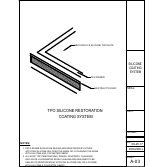
Silicone Roof Coating System TPO
Contribution history
Published changes remain in this permanent record. Corrections create a new entry instead of deleting earlier history.
- September 21, 2026 at 8:48 amLibrary Record
Silicone Roof Coating System Foam — initial source record
Created the system record and matched the current manufacturer system specification, application guidance and component data sheets.
By Tom · Verified Primary Source
Sources: Official Metacrylics Silicone Roof Coating System Foam system page