
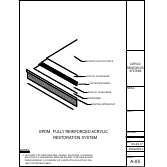
Acrylic Reinforced Coating System EPDM
- Manufacturer
- Metacrylics
- Product
- Acrylic Reinforced Coating System EPDM
- Status
- Current
- Market
- United States
- Last verified
- September 20, 2026
Overview
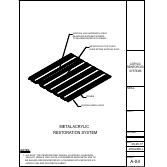
Acrylic Reinforced Coating System EPDM is a Metacrylics assembly for coating an existing EPDM roof membrane. The drawing is sheet A-05, titled EPDM Fully Reinforced Acrylic Restoration System, dated 09-25-17. Acrylic is the finish chemistry. The system belongs to the manufacturer's commercial roof coating family.
The EPDM pretreatment, EPDM Rinse, separates this assembly from the other reinforced acrylic systems in the range. EPDM Rinse is used on black EPDM rubber membranes before power washing and coating.
System layers
The drawing shows, from the existing EPDM roof upward: EPDM Rinse, acrylic clear base, polyester fabric, a second coat of acrylic clear base, and Metacrylics topcoats. The note on the drawing states that all rooftop penetrations, drains, scuppers, flashings, skylights and perimeter edge metal are sealed and reinforced by 3-coursing with Metacrylics Acrylic Gel and polyester fabric.
The manufacturer's website lists four layers for the acrylic system: a prepared EPDM surface, Acrylic Clear Base, polyester fabric and Extreme Performance Plus Acrylic White as the exposed, reflective weathering surface. The silicone alternative uses EPDM Rinse, Roof & Tile Primer, Silicone Gel at details and High Solids Silicone.
Data sheets and technical documents
Current manufacturer system specifications, application guidelines and component data sheets matched to this assembly.
Current files
Archived files
No older reviewed revisions are archived for this product yet.
EPDM Rinse
EPDM Rinse is a low-viscosity, sprayable liquid pretreatment and a rinseable primer technology for elastomeric roof coatings. It is designed for use with Metacrylics acrylic or silicone coating products and improves adhesion of the coating to an EPDM rubber membrane.
- Appearance: clear liquid; color pink to purple
- Odor: mild; pH 6 to 7
- Specific gravity 1.01 g/cc; wet density 8.46 lbs/gal
- Completely soluble in water
- Neutral pH and APEO-free surfactants
Laboratory wet adhesion testing used ASTM C794 with a two-coat application at 18 to 20 dry mil minimum. On new EPDM, a water-only pressure wash gave 0.4 pli and EPDM Rinse followed by a pressure wash gave 1.2 pli. On aged EPDM the values were 0.5 pli and 1.4 pli. The water-only wash produced an adhesive failure. The treated sample produced a cohesive failure with fabric delamination.
The laboratory procedure applies EPDM Rinse at a spread rate of 500 sq. ft. per gallon. During pressure washing of a roof, one part of EPDM Rinse is diluted with 300 parts of water. The product is classified as of low concern to aquatic invertebrates and fish under USEPA TSCA criteria, with an LC/EC50 above 100 mg/L.
Application sequences
The Acrylic Installation Spec Book lists coating over EPDM as systems of 10 to 30 years on pages 3 to 6. Three sequences are printed. All use EPDM Rinse at 0.2 gallons per square (1 SQ = 100 sq. ft.), left for 20 minutes and then pressure washed off.
- 10-year system: Clear Acrylic Base at 1 gallon per SQ over the entire roof including parapet walls, flashings and HVAC duct, with 4 to 12 hours to cure. Bad seams, waterways and ponding areas are reinforced with polyester fabric and Clear Base. Acrylic White follows at 3 gallons per SQ in two applications of 1.5 gallons, with 24 to 48 hours between applications. A 9 inch Stitchbond fabric is used at seams.
- 15-year system: Clear Acrylic Base at 2 gallons per SQ with Stitchbond Polyester Fabric embedded by brush or broom while wet, then 1 gallon per SQ over the fabric, with 24 hours to cure. Acrylic White at 3.5 gallons per SQ in two coats of 1.75 gallons. Fabric quantity is 1 SQ per 1 SQ of roof.
- 20-year system: Clear Acrylic Base at 2 gallons per SQ with fabric embedded, then 2 gallons per SQ over the fabric, with 24 to 48 hours to cure. Acrylic White at 4 gallons per SQ in two coats of 2 gallons, with at least 24 hours between coats.
In the 15-year and 20-year sequences the 3-course penetration detail comes before the base coat. In the 10-year sequence it comes after the base coat.
Clear base and topcoat data
Acrylic Clear Base is a transparent, water-based acrylic elastomeric coating used as a self-priming basecoat or as a primer, and it is protected from ultraviolet light by an acrylic topcoat. Published values include tensile strength of 276 psi at 81 mils including stitchbonded polyester fabric, elongation of 434 percent, Shore A hardness of 41, permeability of 0.016 perms at 63 mils dry film thickness, wind uplift of 105 PSF and Class A fire resistance under ASTM E-108 and UL Standard 790.
Extreme Performance Plus Acrylic White has an elongation at break of 592.63 percent by ASTM D6083-05e1. Its Cool Roof Rating Council results under C-1371 are solar reflectance 0.90 and thermal emittance 0.88, with an SRI of 114 and CRRC Seller ID 0660. It weighs 11.3 pounds per gallon.
Gel and fabric at details
Acrylic Gel is a water-based acrylic elastomeric mastic for flashing and fabric reinforcement. It is available in white, gray and clear. Cool Roof Rating Council testing under C-1371 gives solar reflectance 0.87 and thermal emittance 0.90, and it carries ICC-ES Report No. 4785. It weighs 11.5 pounds per gallon and has 67.31 percent solids by weight.
Stitchbond Polyester Fabric is supplied as T272, T325, T326 and W201. Tensile values by ASTM D 1682 are 57.1 lbs for T272, 31.6 for T325, 41 lbs for T326 and 75 lbs for W201. Mullen burst values by ASTM D 3786 are 176.8, 99.6, 127 and 150 lbs. T325 weighs 3 oz/yd2, T326 2.75 oz/yd2 and W201 2.75 oz/yd2. Narrower fabric widths from 2 to 20 inches are sold in 160 foot lengths for the T-series and 300 foot lengths for W201.
Existing membrane conditions
The system is applied over an existing membrane of the type covered under EPDM roofing. The website lists common EPDM concerns as shrunken sheets and stressed perimeters, open laps or fatigued seam tape, and chalking that weakens coating adhesion. Preparation steps listed are to map wet areas, repair the membrane, wash and condition it with EPDM Rinse, and run an adhesion test before full application.
Related products
 Illustration
Sikalastic-621 Vegetated Protected Membrane Roofing
Illustration Sikalastic-624 WP Fluid-Applied Membrane Waterproofing
Illustration SMAA-1P-7xE — All-acrylic reinforced roof system
Gravel BUR Acrylic
Silicone Roof Coating System TPO
Acrylic Reinforced Coating System Corrugated Metal Standing Seam R Panel
Contribution history
Published changes remain in this permanent record. Corrections create a new entry instead of deleting earlier history.
- September 21, 2026 at 8:48 amLibrary Record
Acrylic Reinforced Coating System EPDM — initial source record
Created the system record and matched the current manufacturer system specification, application guidance and component data sheets.
By Tom · Verified Primary Source
Sources: Official Metacrylics Acrylic Reinforced Coating System EPDM system page