
Silicone Roof Coating System TPO
- Manufacturer
- Metacrylics
- Product
- Silicone Roof Coating System TPO
- Status
- Current
- Market
- United States
- Latest file date
- September 25, 2017
- Last verified
- September 20, 2026
Overview
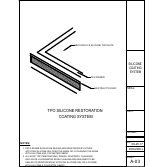
Silicone Roof Coating System TPO is a Metacrylics system assembly for TPO roof membranes, finished with silicone coats. It is a silicone roof coating restoration system for existing TPO roofs in the United States.
The assembly is published as drawing A-03, titled TPO Silicone Restoration Coating System. The drawing is dated 09-25-17 and carries the drafter initials DHALSELL. Its substrate is an existing TPO roof, and its finish chemistry is silicone.
Assembly and layers
The drawing shows three elements from the substrate upward: the existing TPO roof, a TPO primer, and Metacrylics silicone topcoats.
The silicone application book gives the TPO and PVC sections as 10-, 15- and 20-year systems. In each, the primer is either Metacrylics Clear Base or a 2-Part Epoxy Primer at 0.5 gallons per square (1 SQ = 100 sq. ft.), with 4 to 8 hours allowed to cure. The entire roof is primed, including parapet walls, flashings and HVAC ductwork.
High Solids Silicone White is the topcoat in all three systems. Seams and penetration details are completed before the topcoat goes on.
- 10-year system: 2 gallons per square in a single application. Vertical surfaces need 2 coats at 1 gallon per square per coat to prevent sagging, with 24 hours between applications.
- 15-year system: 2.5 gallons per square in two applications of 1.25 gallons per square, with 24 hours to cure between them.
- 20-year system: 3 gallons per square in two applications of 1.5 gallons per square per coat, with 24 hours to cure between them.
Data sheets and technical documents
Current manufacturer system specifications, application guidelines and component data sheets matched to this assembly.
Current files
Archived files
No older reviewed revisions are archived for this product yet.
Seams and details
Drawing A-03 requires field seams to be sealed and reinforced in one of two ways. Silicone Gel is applied over the seam, or the seam is 3-coursed with silicone and polyester fabric.
Roof top penetrations, drains, scuppers, flashings, skylights and perimeter edge flashing are required to be sealed or reinforced in the same way, with Silicone Gel or a 3-course build-up of silicone and polyester fabric.
Before the topcoat, the application book has the roof pressure washed first. Any bad seams are reinforced with polyester fabric and either HS Silicone White or Silicone Gel.
For gutters, the book has rusted areas replaced, Metacrylics Rust Inhibitor Acrylic Black Primer applied at 1 gallon per square, and Silicone Gel placed over the joints with no reinforcement. Peel & Coat is not used on any gutters.
For parapet coping, the coping is washed, rusted areas are primed with a rust inhibitor primer, and Silicone Gel is applied over the top of the cap joints and exposed screws.
TPO Primer
Metacrylics TPO Primer is an all-acrylic polymer for pigmented elastomeric roof coating basecoats. It provides adhesion to weathered thermoplastic polyolefin (TPO) membranes. Coatings based on it are intended for TPO membranes that have weathered at least four years.
For adhesion and water resistance, the primer goes on a TPO roof that has been pressure washed at 3,000 psi. The membrane is cleaned first with a liquid cleaner such as Metacrylics EPDM Rinse or trisodium phosphate (TSP) in water, followed by power washing at a minimum of 3000 psi with a wide fan tip. Residual cleaning agents are removed because they interfere with adhesion.
Published properties of the 3100 RX test coating include these values:
- Viscosity 127 KU initial and pH 10, with density of 11.83 lb/gal.
- Weight solids 66.2% and volume solids 52.0%.
- Tensile strength 147 psi initially and 237 psi after 1000 hours of weathering; elongation at break 227% initially and 181% weathered.
- Tear resistance 79 lbf/in.
- Adhesion to aged TPO of 2.5 pli dry and 1.5 pli wet.
- Permeance 7.0 perms face down, and 10% water swelling after 7 days.
- Low temperature flex passes at -15°F on a mandrel after 1000 hours of weathering.
The primer stays flexible at temperatures as low as -15°F (-26°C) and has a 50 g/L VOC content. It is compatible with the Metacrylics Contractor Grade White, Acrylic White and High Tensile White topcoats. It is applied by brush, roller or spray.
It is not applied when temperatures are at or expected to fall below 5°C (40°F), when temperatures are expected to fall below the dew point within 6 hours, at relative humidity above 90%, when rain is expected, or on roofs collecting ponded water. Zinc oxide and zinc-containing ingredients are not used in its manufacture.
High Solids Silicone topcoat
High Solids Silicone is a single-component silicone elastomer with 100% silicone content.
It carries 98% solids by volume and 98% by weight.
Shelf life is 6 months unopened.
No degradation is recorded after 10,000 hours of QUV weathering.
Permanent set at break is 1.0%, heat-aged permanent change is 0%, and tension set at 100% is 0% by ASTM D-412.
The liquid has a viscosity of 8,000–11,000 cps, a specific gravity of 1.20 and a flash point of 280°F.
Directly over modified bitumen, asphalt or coal tar built-up roofing, an appropriate primer is required.
Ponding water does not affect the membrane. The National Roofing Contractors Association recommends that all roof systems be designed and built for positive drainage.
The spray gun is a 5000 psi unit with a reverse-a-clean tip, a minimum orifice of .030 and a 50° fan.
Hose used for acrylics or other waterborne coatings is excluded, since its liner absorbs moisture and initiates the silicone cure.
Walkway pads are recommended where the roof has foot traffic, for added protection and slip resistance.
A variable speed drill with a jiffy mixer suspends settled pigments in 5 gal pails and 55 gal drums.
It can serve as a topcoat over polyurethane elastomeric base coats where improved traffic and impact resistance is required.
Surface preparation calls for clean, dry surfaces free of dust, dirt and oily residues, with loose rust removed from metal.
Silicone Gel
Silicone Gel is a single-component, moisture-cured liquid flashing membrane applied by brush, spatula or trowel at thicknesses up to 1/4 inch.
Substrates it can be used over include metal, spray polyurethane foam, smooth and granulated bitumen roofing, concrete and single-plies, along with flashings, fasteners, seams, scuppers and drains.
Coverage is 25 sq ft/gal.
The shelf life of unopened containers is 1 year.
Flash point is 142°F (ASTM D-56) and viscosity is 50,000 cps.
More than 250 wet mils (6350 μ) in one application risks pin holes and blistering.
Related products
 Illustration
Sikalastic-621 Vegetated Protected Membrane Roofing
Illustration Sikalastic-624 WP Fluid-Applied Membrane Waterproofing
Illustration SMAA-1P-7xE — All-acrylic reinforced roof system
Gravel BUR Acrylic
Acrylic Reinforced Coating System Corrugated Metal Standing Seam R Panel
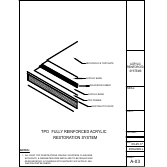
Acrylic Reinforced Coating System TPO
Contribution history
Published changes remain in this permanent record. Corrections create a new entry instead of deleting earlier history.
- September 21, 2026 at 8:48 amLibrary Record
Silicone Roof Coating System TPO — initial source record
Created the system record and matched the current manufacturer system specification, application guidance and component data sheets.
By Tom · Verified Primary Source
Sources: Official Metacrylics Silicone Roof Coating System TPO system page