
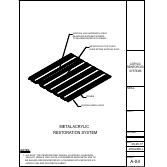
Acrylic Reinforced Coating System Corrugated Metal Standing Seam R Panel
- Manufacturer
- Metacrylics
- Product
- Acrylic Reinforced Coating System Corrugated Metal Standing Seam R Panel
- Status
- Current
- Market
- United States
- Last verified
- September 20, 2026
Overview
Acrylic Reinforced Coating System Corrugated Metal Standing Seam R Panel is a Metacrylics assembly for corrugated, standing seam and R-panel metal roofing. The drawing is sheet A-04, titled Metal Acrylic Restoration System, dated 09-25-17. The finish chemistry is acrylic and the assembly belongs to the manufacturer's commercial roof coating family.
The spec book lists coating over metal (standing seam, corrugated, R-panel) as systems of 10 to 30 years on pages 18 to 21.
System layers
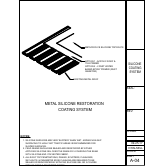
The drawing shows the existing metal roof, a primer, Metacrylics top coats over the entire existing roof, and fabric reinforcement at vertical and horizontal field seams and exposed screws. The note on the drawing states that all rooftop penetrations, drains, scuppers, flashings, valleys, ridges, skylights and perimeter edge metal are sealed and reinforced by 3-coursing with Metacrylics Acrylic Gel and polyester fabric.
The website lists the acrylic system as a prepared metal surface, Black Primer at prepared rust, Acrylic Gel with polyester fabric at details, and an acrylic top coat. The silicone alternative uses Roof & Tile Primer or a specified epoxy primer, Silicone Gel and High Solids Silicone.
Data sheets and technical documents
Current manufacturer system specifications, application guidelines and component data sheets matched to this assembly.
Current files
Archived files
No older reviewed revisions are archived for this product yet.
Black Primer
Black Primer is a black, water-based acrylic elastomeric rust inhibitor primer. It is used on BUR asphalt, tar and gravel, cap sheet, coal tar and metal surfaces, and as an asphalt pavement sealer. Fully cured, it has no surface tackiness and can be walked or driven on.
- Flexibility: pass 1/8 inch mandrel bend, FTMS 141a Method 6221
- Tensile strength 250 psi; elongation 300 percent minimum, ASTM D-412
- Hardness: Shore A 48, ASTM D-676
- Weathering: 1,000 hours accelerated, no cracking, crazing or dulling, FTMS 141a Method 6151
- Erosion: under 0.1 mils per year, FTMS 141a Method 6192
- Weight 8.5 lbs per gallon; solids 32.9 percent by weight; VOC 19.45 grams per liter
- Viscosity at 77 degrees F: 1900 seconds, AASHTO T59
Application is 1 gallon per 100 sq. ft. by spray (.031 tip) or roller. Spray drying time is 4 to 24 hours, and roller drying time is 12 to 24 hours. Loose rust is removed from metal, and new galvanized metal is wiped with an acidic solution before application.
Gel and fabric on seams and fasteners
Acrylic Gel is the mastic used for flashing and fabric reinforcement repairs. Listed uses include roof blisters, field seams, drains, scuppers, copings, splits, cracks, fishmouths, perimeter base flashings and curb flashings over wood, metal, concrete, urethane, epoxies, rubber, single plies and BUR asphalt. It is listed as UL Classified for Class A fire and wind uplift, carries ICC-ES Report No. 4785, and had a 2,000 hour weatherometer result of no cracking, crazing or erosion with slight chalking.
The website lists these metal concerns: rust or corrosion at cut edges, fasteners and damaged coatings; backed-out fasteners, failed washers and loose closures; and open horizontal seams, end laps, curbs and penetrations. Field preparation steps are to replace loose fasteners and failed closures, remove rust and prime exposed metal, and use three-course seams, laps and penetrations.
Base coat and topcoat data
Acrylic Gray Base is applied at 2 to 3 gallons per 100 sq. ft., the polyester fabric is embedded, and 2 gallons per 100 sq. ft. is applied over it, a total of 4 to 5 gallons. Its published wind uplift is 105 PSF and its fire resistance is Class A under ASTM E-108 and UL Standard 790. Peel adhesion is 6.3 pounds per linear inch on concrete, ASTM C836.
Extreme Performance Plus Acrylic White is applied in two coats of 1.5 gallons per 100 sq. ft. by spray, or as one final coat of 1.5 or 2 gallons per 100 sq. ft. Its CRRC results are solar reflectance 0.90, thermal emittance 0.88 and SRI 114. The coating is Title 24 compliant, a flash point above 200 degrees F, and a low temperature flexibility pass at minus 40 degrees F.
Fabric data
Stitchbond Polyester Fabric comes in T272, T325, T326 and W201. T326 has a firm finish. W201 is a warp knit mat for jobs with lower coating application rates. Mullen burst values are 176.8 lbs for T272, 99.6 lbs for T325, 127 lbs for T326 and 150 lbs for W201.
Spec book systems and rates
The spec book gives four metal systems for corrugated, standing seam and R-panel roofs. Gel and fabric and Peel & Coat are listed as needed on each. One square is 100 sq. ft., and for ribs the square footage is multiplied by 1.3. Between white coats, 24 to 48 hours of cure is allowed. Depending on roof pitch, topcoat rates may be reduced and more coats applied to reach the required gallons per square.
- 10-year system: Clear Base (or Black Primer on rust) at 1 gallon per square; Acrylic White 3 gallons per square in two coats of 1.5 gallons; primer cures 4 to 12 hours
- 15-year system: Primer 1 gallon per square; Acrylic White 4 gallons per square at 2 gallons per coat; primer cures 4 to 24 hours
- 20-year system: Primer 1 gallon per square; Acrylic White 5 gallons per square in three applications of 1.33 gallons
- 30-year system: Primer 1 gallon per square; Acrylic White 7 gallons per square in four applications of 1.75 gallons; 5-course penetration detail
Metal preparation sequence
- Wire brush and remove flaking rust
- Inspect for open joints, laps and holes and seal them with the 3-course method of Acrylic Gel and polyester fabric
- Pressure wash, especially oxidized areas
- Tighten or replace exposed fasteners, add fasteners to tighten loose panels, and cover fasteners with gel
- Seams: foot pressure is applied to the underlapping panel beside the joint, and if the joint opens more than 1/16 inch, fasteners are added
- Horizontal field seams and end laps are 3-coursed with alternating layers of gel and fabric
- Missing ridge cap gaskets are replaced and the ridge cap closure cavity is 3-coursed
Metal website notes
The manufacturer's metal page says standing seam, R-panel and corrugated metal move with temperature changes and commonly leak at fasteners, horizontal seams, end laps, penetrations and transitions. The silicone alternative can use a specified epoxy primer in place of Roof & Tile Primer.
Penetration and edge details
The spec book detail sequences relevant to metal roofs run as follows. Gutters are pressure washed, primed and 3-coursed with gel and fabric over all joints, and Peel & Coat is not used on any gutter. HVAC duct joints are 3-coursed with gel and fabric or covered with 4 inch Peel & Coat tape, then coated with 2 gallons per square of white in two 1 gallon applications. Skylights get a 3-course up the curb at least 3 inches and 3 inches onto the field, gel on exposed screw heads and no covering over the weep holes. Parapet coping is washed and primed, with black primer on rust, then 3-coursed with gel and fabric over joints and screws and coated with the white topcoat.
Metal roof conditions
The assembly covers the same roof types as liquid coatings over metal roofs. Release points listed on the website are rust that is stable beneath Black Primer, every fastener sealed, and movement joints that can still cycle.
Related products
Duro-Tuff PVC Membrane
 Illustration
Sikalastic-621 Metal Roof Recover
Illustration 07 56 00 Fluid-Applied Roofing Recover Sikalastic-646
Illustration SM-1P-XE — Acrylic-surfaced reinforced roof system
Acrylic Reinforced Coating System TPO
Silicone Roof Coating System Metal Corrugated Standing Seam R Panel
Contribution history
Published changes remain in this permanent record. Corrections create a new entry instead of deleting earlier history.
- September 21, 2026 at 8:48 amLibrary Record
Acrylic Reinforced Coating System Corrugated Metal Standing Seam R Panel — initial source record
Created the system record and matched the current manufacturer system specification, application guidance and component data sheets.
By Tom · Verified Primary Source