
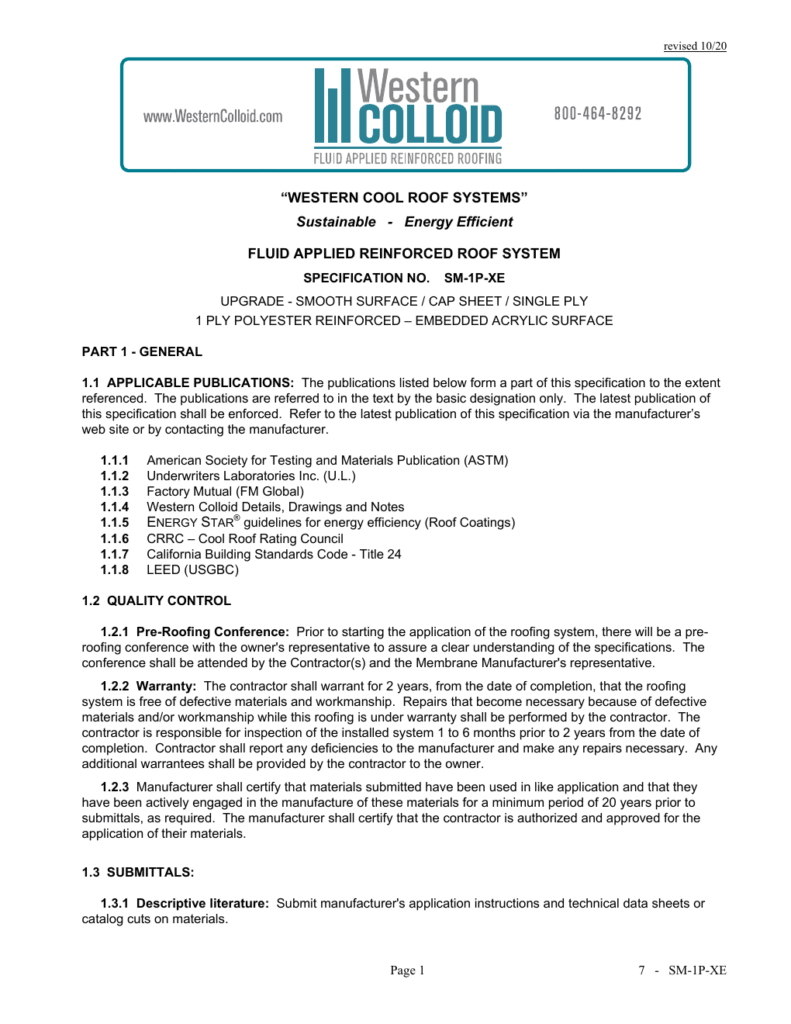
SM-1P-XE — Acrylic-surfaced reinforced roof system
- Manufacturer
- Western Colloid
- Product
- SM-1P-XE — Acrylic-surfaced reinforced roof system
- Status
- Current
- Market
- United States
- Latest revision
- 1105b
- Last verified
- September 20, 2026
Overview
SM-1P-XE is a Western Colloid fluid-applied reinforced roof system specification, revised 10/20, titled Upgrade, Smooth Surface, Cap Sheet or Single Ply, with one polyester ply and an embedded acrylic surface. The specification is issued under the Western Cool Roof Systems heading. The manufacturer's specification index describes it as a single-ply cap, smooth system using #298 Emulsion and ElastaHyde Acrylic White, and marks it U.L. Classified.
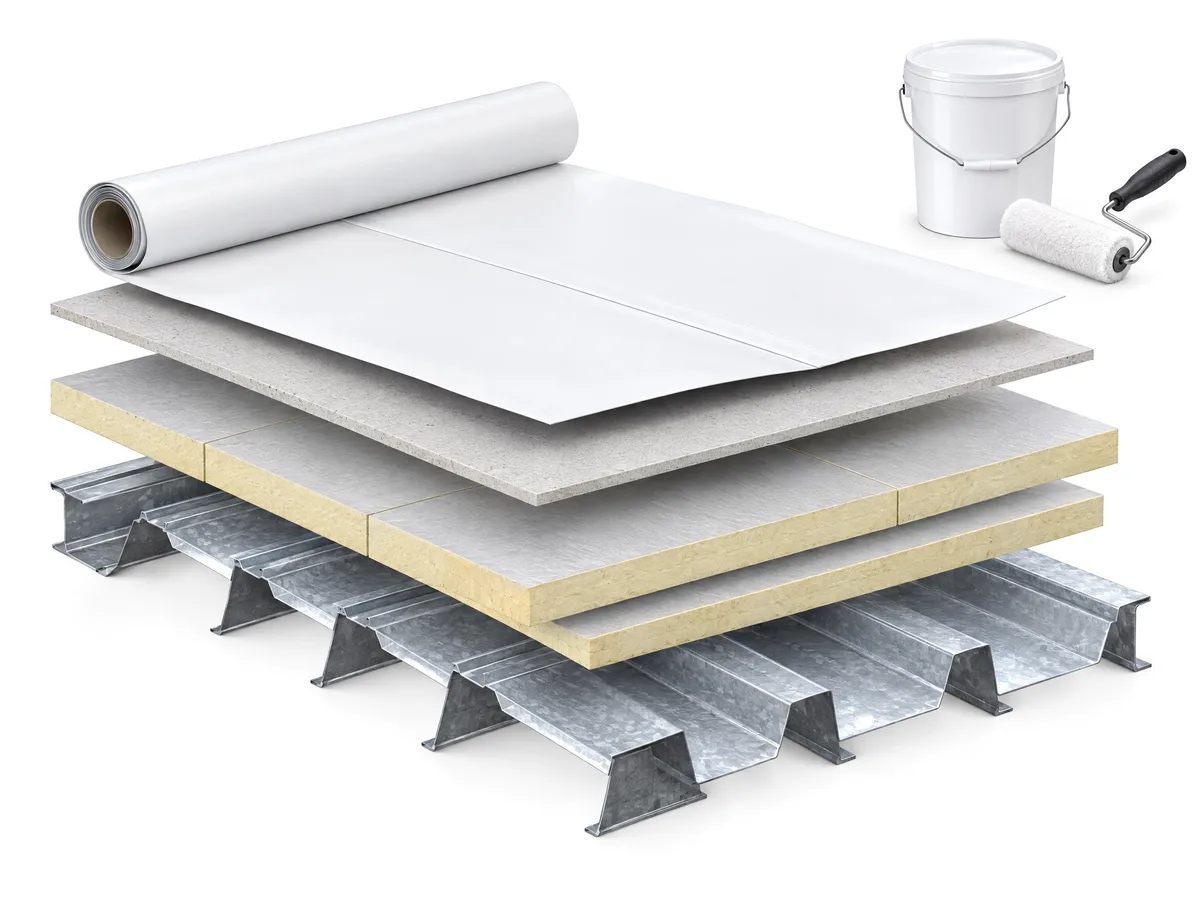
One polyester ply sits under 3 gallons of ElastaHyde. The method is a cold process to upgrade existing built-up, modified bitumen, EPDM, TPO and Hypalon roofing. It is water based, with very low odor. Single-ply membranes of this kind are one of the flat roofing systems used on commercial buildings with a smooth-surfaced roof.
Components and weights
Three layers make up the system, with approximate dry weights per 100 square feet.
- #298 emulsion base coat at 6 gallons (23 lb).
- Polyester fabric, one ply, 2.5 lb.
- Surface and reflective coating of white acrylic ElastaHyde, 3 gallons, 21 lb.
Total system dry weight is approximately 46.5 lb. Total dry thickness is approximately 80 mils.
Data sheets and technical documents
Current manufacturer system specifications, application guidelines and component data sheets matched to this assembly.
Current files
Archived files
No older reviewed revisions are archived for this product yet.
Criteria
Criteria named for the assembly are UL Class A, Factory Mutual Standard 4470 Class 1, California Title 24, LEED (USGBC) and ENERGY STAR. The system is intended to extend the life of the existing roof membrane, and it eliminates or indefinitely delays the need to remove it.
Materials
- Stitchbonded polyester fabric, 2.75 ounce firm or 3.0 ounce soft, reinforces asphalt emulsion, acrylic coating and flashing materials.
- #298 Asphalt Emulsion is a clay-stabilized emulsion made in a continuous colloid mill process without added surfactants or additives. It is available in an elastomeric 298E blend.
- #800 Elastic Cement is a heavy-bodied, water-based, acrylic rubber resin compound that is non-flammable and low odor and contains no asbestos fibers. Tack-free time is 1 hour and cure takes 1 to 2 days.
- #8000 All Weather Elastic Cement is a solvent-based white sealant that suits asphalt built-up, modified bitumen, metal and single-ply roofs.
- #970 A2A Bonding Primer is a clear acrylic primer for smooth built-up roofing, emulsion and non-granulated modified bitumen.
- #850 SWS walkway coating adds an aggregate for a non-slip, abrasion-resistant walking surface.
Preparation
The membrane is made sound and watertight and checked for proper fastening or adhesion before the new membrane. Debris is removed by vacuum, washing, sweeping or power blower, using the strongest cleaning method the surface needs. Valleys and ponding areas are washed, may be primed with #298 diluted 20 to 30 percent, and receive an extra polyester ply in #298.
Blisters are removed and repaired with a floating patch of modified cap sheet in asphalt flashing compound, the sheet reaching at least 6 inches past the widest point. Large splits get the same repair; small splits are repaired by a three-course #800 method at about 1/8 inch thickness, followed by a coat at 4 gallons per 100 square feet.
Emulsion and cement data
- #298 emulsion: 45 to 50% solids, 8.2 to 8.7 lb per gallon, permeability from 0.0 to 2.0 depending on thickness, and flexible without cracking at 32 degrees F.
- #298 may be diluted with up to 10% water for spraying, with the application amount raised by the same percentage.
- #800 cement: 65 to 70% solids by weight, elongation above 500%, minimum application temperature 50 degrees F, and a limit of 3/16 inch in one application.
- #800 three-course rate: 1/8 inch for the first coat and 1/16 inch for the second, about 8 gallons per 100 square feet total, for a cured membrane of about 1/8 inch.
ElastaHyde surface coat
White ElastaHyde #720 ARC: elongation above 250% initially and above 175% after weathering (ASTM D2370), tensile strength above 250 psi, permeance below 15 (ASTM D1653), and 1000 hours of xenon arc exposure passed (ASTM D4798). Low-temperature flexibility passes 15 degrees F (ASTM D522). Solids are 53% by volume and 66% by weight. Dirt pick-up resistance is rated very good.
It is a heavy paint for airless spray, brush or roller, with a viscosity of 100 to 110 KU (ASTM D562). Dry time is 1 hour at 100 square feet per gallon, and total coating for a specification runs 2 1/2 to 6 gallons per 100 square feet. The coating is not recommended over wood shingles or untreated wood. Colors besides white include Gray and Tan.
Membrane application
The membrane starts with a coat of #298 Asphalt Emulsion at 6 gallons per 100 square feet. Full-width polyester is embedded immediately, from the low edge of the roof upward. Plies overlap by a minimum of 3 inches and end laps by a minimum of 4 inches. Each ply is lightly broomed so the fabric is embedded and still visible on the surface, with no wrinkles or voids. The polyester ends at the base of the wall or cant and overlaps the wall flashings by at least 3 inches.
The wet fabric is not walked on, and no top coat of #298 is applied to the polyester. When excess emulsion or a top coat does end up on the fabric, #970 A2A primer goes on at one half gallon per 100 square feet and dries thoroughly before ElastaHyde. Exposed polyester does not need that primer.
Flashings and details
- Base flashing: one ply of 6 inch (or wider) polyester set in #298 at 5 gallons per 100 square feet over the cant strip, ending at least 2 inches above the cant and at least 2 inches onto the deck.
- Wall flashing: one full ply of polyester in #298 at 5 gallons per 100 square feet, ending under counter flashing, reglet or wall cap flashing and reaching at least 3 inches onto the deck beyond the base flashing.
- Edge metal: new edge with low or no rise is nailed at 4 inches on center and stripped in with polyester and #800. Existing edge flashing that stays has the roofing cut back 2 inches from the rise first.
- Vent and pipe flanges: set in #8000 All Weather Elastic Cement and nailed, with #800 kept out from under a new flange.
- Projections: sign anchors and equipment supports are sealed with a cone of #800.
- Surface treatment: #800 and polyester in a three course method over pipe flashings, cones, exposed metal joints and flanges before the reflective coating.
Drains and ponding areas
Clamping-type drains have the ring removed, the sump cleaned and then three-coursed with #800 or #8000, reaching at least 18 inches from the drain center. The membrane overlaps the reinforced cement by at least 3 inches. The optional detail embeds modified cap sheet in modified asphalt flashing compound.
Drains, scuppers, valleys, waterways and spots where water ponds for more than 48 hours get an extra polyester ply set in #720 ARC at 3 gallons per 100 square feet. It extends 12 inches past the ponding area and goes on before the final ElastaHyde coats.
Reflective coating schedule
The ElastaHyde surface goes on in two coats of 1.5 gallons per 100 square feet each, the second at a right angle to the first, with 24 hours of drying between them. It is mixed well, strained for spray and not thinned. Application happens early in the day, before the emulsion surface softens, and stops if the surface sticks to equipment or feet.
Walkway coating
#850 SWS walkway coating goes on by short nap or smooth roller in two coats of 2 gallons per 100 square feet, at least 24 hours apart. At roof doors, hatches and equipment service doors, a polyester ply is first embedded in a 2 gallon coat of #850 SWS and left to dry at least 24 hours.
Installing this in San Antonio or Austin?
We install protective coatings for metal roofs and cladding on commercial and industrial buildings from our Bulverde office.
Related products
 Illustration
Pro-Grade 988 Silicone Roof Coating
UltraPly TPO Coated Metal
TPO RubberThane
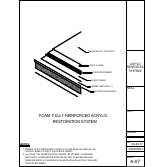
Acrylic Reinforced Coating System Foam
Illustration CTG-3-1.5A — Aluminum-surfaced roof restoration system
Illustration SMEA-2P-14-3G-6xE — Acrylic-surfaced reinforced roof system
Contribution history
Published changes remain in this permanent record. Corrections create a new entry instead of deleting earlier history.
- September 21, 2026 at 8:48 amLibrary Record
SM-1P-XE — Acrylic-surfaced reinforced roof system — initial source record
Created the system record and matched the current manufacturer system specification, application guidance and component data sheets.
By Tom · Verified Primary Source
Sources: Official Western Colloid SM-1P-XE — Acrylic-surfaced reinforced roof system system page