
CTG-3-1.5A — Aluminum-surfaced roof restoration system
- Manufacturer
- Western Colloid
- Product
- CTG-3-1.5A — Aluminum-surfaced roof restoration system
- Status
- Current
- Market
- United States
- Latest revision
- 1105b
- Last verified
- September 20, 2026
Overview
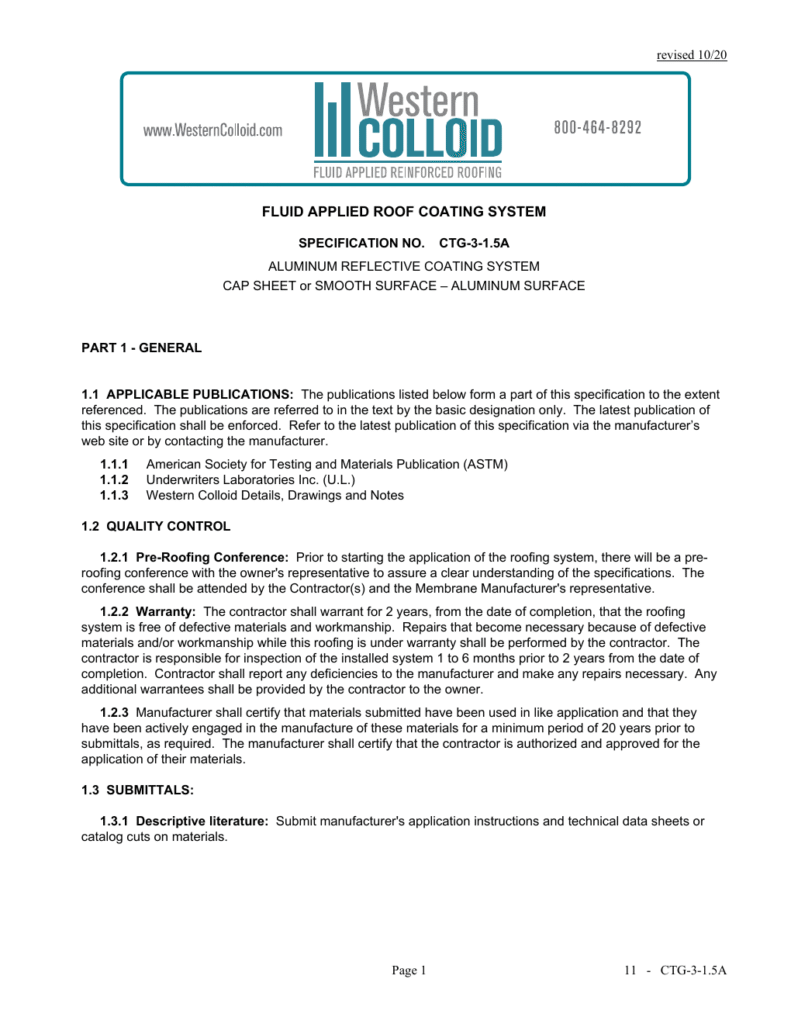
CTG-3-1.5A is Western Colloid specification CTG-3-1.5A, an aluminum reflective coating system for a cap sheet or smooth surface with an aluminum surface. The specification was revised 10/20. It is a fluid-applied roof coating system in the commercial roof coating family, used in commercial roof restoration.
The code reads from the two coats: 3 gallons of #298 emulsion as primer and base coat, and 1.5 gallons of SilverWhite aluminum coating, both per 100 square feet. The method is a cold process for putting a reflective aluminum surface on existing or new smooth-surface built-up or modified bitumen roofing. It is water based with very low odor, and the surface is a reflective elastomeric aluminum coating.
Unlike the ElastaHyde-surfaced CTG systems, this one has no acrylic layer. Built-up and modified bitumen roofs that come under flat roofing systems take the aluminum finish over an asphalt emulsion base.
Components and weights
Two layers make up the system, with approximate dry weights per 100 square feet.
- Primer and base coat of #298 emulsion, 3 gallons, 12 lb.
- Reflective surface coating of SilverWhite aluminum, 1.5 gallons, 4.5 lb.
Total system dry weight is approximately 16.5 lb, and total dry thickness is approximately 29 mils.
Data sheets and technical documents
Current manufacturer system specifications, application guidelines and component data sheets matched to this assembly.
Current files
Archived files
No older reviewed revisions are archived for this product yet.
Materials
- Polyester fabric is stitchbonded, 2.75 ounce firm or 3.0 ounce soft, for reinforcing asphalt emulsion, acrylic coating and flashing materials, in several widths.
- #298 Asphalt Emulsion is a clay-stabilized emulsion, ASTM D 1227 Type III, made by a continuous colloid mill process with no added surfactants or additives. It is also known as Glas-Shield Waterproofing Compound for cold process roofing.
- #800 Elastic Cement is a water-based acrylic resinous plastic emulsion, white or black, for exposed terminations, metal joints and drain sumps.
- #8000 All Weather Elastic Cement is a solvent-based white sealant for use in wet conditions and for setting metal flanges and sheets.
- SilverWhite #525 is an aluminum asphaltic emulsion made from #298 emulsion, special resins and polished aluminum flake. SilverWhite #530 is the grade named for roller or brush touch-up.
SilverWhite #525 data
#525 SilverWhite is a water-based aluminum asphaltic emulsion with a base of ASTM D1227 Type III asphalt emulsion and a pigment of highly polished aluminum flake. It dries to a flexible, slightly textured metallic film.
- Reflectivity: up to 76% of sun rays, initial 76% by ASTM E97.
- Elongation 166% and tensile strength 31 psi, both ASTM D412.
- Flammability: non-flammable wet, Class A dry.
- Weight per gallon: approximately 8.5 lb.
- Consistency: heavy paint for heavy-duty spray or brush.
- Application temperature: 50 to 100 degrees F ambient. Drying time is 1 hour at 100 square feet per gallon, 70 degrees F and 50% relative humidity.
- Container sizes: 5 gallon, 55 gallon drums and bulk.
- Coverage: 100 square feet per gallon.
It is recommended for metal, smooth built-up, mineral surface, emulsion and Glas-Shield roof systems.
Preparation
The existing membrane is made sound and watertight and properly fastened or adhered, loose gravel and debris are removed by vacuum, sweeping or power blower, and the roof is washed. Valleys and ponding areas are washed and may be primed with #298 diluted 20 to 30 percent with water, scrubbed in with a brush and dried.
Small splits and irregularities get a three-course repair with #800: 5 gallons per 100 square feet (about 1/8 inch), an embedded ply of polyester brushed in until saturated, and another coat at 4 gallons per 100 square feet. Pipe flashings, cones, exposed metal joints and flanges receive the same treatment before the base coat, as do corners at curbs, skylight flashings and areas patched with roofing mastic.
Base coat and reflective coat
The primer and base coat is #298 Asphalt Emulsion at 3 gallons per 100 square feet, left to cure. SilverWhite is intended for new emulsion that is thoroughly dry and cured, and emulsion cure takes 3 to 10 days in warm, dry weather. New, smooth, glazed asphalt is left to age for 1 to 3 months before the emulsion coat.
After the roof has cured, the roof is washed to remove asphaltic residue that can cause poor adhesion or tobacco staining. SilverWhite #525 then goes over the entire roof at 1.5 gallons per 100 square feet, preferably by spray. The coating is applied early in the day, before the emulsion heats and softens, and stops if the surface sticks to equipment or feet.
Around drains and scuppers, and in valleys, waterways and spots where water ponds for more than 48 hours, an extra application of SilverWhite at 1.5 gallons per 100 square feet extends 12 inches past the ponding area or drain sump. It goes on after the membrane and before the final coat.
Application limits
SilverWhite is not applied below 55 degrees F, or when cold weather, rain or fog is expected within 72 hours. Late-afternoon and evening application can cause premature graying, browning or eggshell crazing, and application over uncured emulsion can turn the coating gray, dark gray or brown. It is not recommended over asphalt or wood shingles, in areas with inadequate drainage, or on surfaces that pond water for extended periods. An existing SilverWhite surface is recoated after cleaning, preferably after 2 to 3 gallons per 100 square feet of #298 or #298E emulsion.
Installing this in San Antonio or Austin?
We install protective coatings for metal roofs and cladding on commercial and industrial buildings from our Bulverde office.
Related products
UltraPly TPO Coated Metal
TPO RubberThane
Acrylic Reinforced Coating System Foam
Silicone Roof Coating System Tar and Gravel Hybrid System Reinforced Acrylic with Silicone Top Coat
 Illustration
SMEA-2P-14-3G-6xE — Acrylic-surfaced reinforced roof system
Illustration SM-12-3G-3E — Acrylic-surfaced reinforced roof system
Contribution history
Published changes remain in this permanent record. Corrections create a new entry instead of deleting earlier history.
- September 21, 2026 at 8:48 amLibrary Record
CTG-3-1.5A — Aluminum-surfaced roof restoration system — initial source record
Created the system record and matched the current manufacturer system specification, application guidance and component data sheets.
By Tom · Verified Primary Source
Sources: Official Western Colloid CTG-3-1.5A — Aluminum-surfaced roof restoration system system page