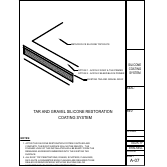
Silicone Roof Coating System Tar and Gravel Hybrid System Reinforced Acrylic with Silicone Top Coat
- Manufacturer
- Metacrylics
- Product
- Silicone Roof Coating System Tar and Gravel Hybrid System Reinforced Acrylic with Silicone Top Coat
- Status
- Current
- Market
- United States
- Latest file date
- September 25, 2017
- Last verified
- September 20, 2026
Overview
Silicone Roof Coating System Tar and Gravel Hybrid System Reinforced Acrylic with Silicone Top Coat is a Metacrylics system assembly for tar-and-gravel roofing. It combines a reinforced acrylic base with silicone topcoats,.
The assembly is a silicone roof coating restoration variant that uses polyester reinforcement embedded between acrylic base-coat applications. The finish chemistry is silicone.
The system drawing is dated 09-25-17. It states that after the system is complete the roof surface will not be smooth, and that the finished look will be bumpy from the aggregate that remains embedded in the existing tar surface.
Assembly and layers
From the existing tar-and-gravel roof upward, the build-up is a primer, an acrylic base coat, polyester fabric, a second acrylic base coat, and the silicone topcoats. The primer has two options: Metacrylics Acrylic Roof & Tile Primer or Metacrylics Acrylic Bleed Block Primer.
The silicone application book gives the tar-and-gravel silicone systems as 15- and 20-year systems. The two sets of rates are these:
- 15-year system: Acrylic Bleed Block Primer at 1.5 gallons per square (1 gallon per square if the old roof has been completely removed and the surface is smooth), then HS Silicone at 3.5 gallons per square in two applications of 1.75 gallons per square per coat.
- 20-year system: Acrylic Bleed Block Primer at 1.5 gallons per square, then HS Silicone White at 4.5 gallons per square in two applications of 2.25 gallons per square per coat.
In both, gravel is spudded or torn off so that all loose gravel is removed, and the roof is cleaned of debris and dust and pressure washed. Acrylic Clear Base may be used as the primer in place of Bleed Block Primer. Silicone Gel and polyester fabric are used as needed. Vertical surfaces may need additional coats at lower application rates to prevent sagging, with 24 hours to cure between applications.
Data sheets and technical documents
Current manufacturer system specifications, application guidelines and component data sheets matched to this assembly.
Current files
Archived files
No older reviewed revisions are archived for this product yet.
Details and penetrations
All roof top penetrations, drains, scuppers, flashings, skylights and perimeter edge flashing are required to be sealed or reinforced with Silicone Gel or a 3-course build-up of silicone and polyester fabric.
For nosings, edge flashings and gravel stops, primer goes on all edge flashings and new metal is wiped with vinegar or a suitable cleaning agent. Silicone Gel is applied without fabric over the top of the flashing, or a 3-course with alternating layers of Acrylic Gel and 4 inch or 6 inch fabric is used. The gel or 3-course extends 2 to 3 inches onto the flashing and 2 to 3 inches onto the roofing surface.
For wood blocks, the block is lifted, Silicone Gel is applied where it sat, and the block is replaced when dry. For wood sleepers under HVAC supports, the unit is jacked up and the sleeper removed, HS Silicone is applied at 2 gallons per square in the area, and the sleepers are replaced after cure. Sleepers that cannot be moved are completely encapsulated with HS Silicone.
Acrylic base coats and fabric
Metacrylics Clear Base is a transparent, water-based acrylic elastomeric coating that is protected from sunlight by an acrylic or silicone topcoat. Its published values include a wind uplift rating of 105 psf (Section 6 of ANSI A58.1), a Class A fire resistance rating under ASTM E-108 and UL Standard 790, a peel adhesion to concrete of 6.3 pounds per linear inch (ASTM C836), and permeability of 0.016 perms (ASTM D1653).
Metacrylics Acrylic Base is the gray version, a water-based acrylic elastomeric coating that is covered by Acrylic White or a color coat. A quick-set additive premixed by Metacrylics gives rain resistance at 40°F and 80% relative humidity within 2 hours or less. It carries the same 105 psf wind uplift figure and Class A fire resistance listing.
Metacrylics Stitchbond Polyester Fabric is supplied as T272, T325, T326 and W201. T272 is the standard fabric and a soft stitchbonded polyester. T326 has a firm finish to reduce wrinkles on smooth surfaces. W201 is a warp knit mat for lower coating application rates.
- Weight: T272 3 oz/yd2, T325 2.75 oz/yd2, T326 2.9 oz/yd2 and W201 2.75 oz/yd2.
- Tensile strength by ASTM D 1682: T272 57.1 lbs, T325 31.6, T326 41 lbs and W201 75 lbs.
- Mullen burst by ASTM D 3786: T272 176.8 lbs, T325 99.6 lbs, T326 127 lbs and W201 150 lbs.
Acrylic Bleed Blocker Primer
Metacrylics Acrylic Bleed Blocker Primer is an all-acrylic primer that resists asphalt staining and adds adhesion to the roof substrate. It is water-based and blocks asphalt bleed-through into acrylic and silicone coatings.
It is a milky white liquid with total solids of 27.5 ±0.5% by weight (ASTM D-2369), pH 9.5 ±0.3, specific gravity 1.05, density 8.76 lbs/US gal, Brookfield viscosity of 100–400 cps and Tg of -10°C (14°F). VOC content is 37.5 to 50 g/liter, and it remains flexible at temperatures as low as 0°C (32°F).
Over unaged asphalt, it is applied at a minimum of 4 dry mil, about 1 gallon per square. Two coats of 8 dry mil each may be needed on unaged asphalt. The wet coating can discolor right away on aged asphalt, and this water-soluble discoloration disappears after a few rainfalls.
It is not applied below 5°C (40°F), at relative humidity above 90%, when rain is expected, or when temperatures are expected to fall below the dew point in the next 6 hours.
High Solids Silicone topcoat
The topcoat material is a one-component, 100% silicone elastomer formulated with high volume solids.
Standard colors are white, light gray and tan. Special colors carry an additional charge and a minimum order quantity, and non-standard colors add 15 days.
Unopened, the material has a 6 month shelf life.
Permeability is 2.0 U.S. perms and water absorption is 0.2 by ASTM D-570.
Tension set at 100% (ASTM D-412) is 0%, heat-aged permanent change is 0% and permanent set at break is 1.0%.
Continuous immersion service, cryogenic tanks and cold storage roofing without a vapor barrier are outside its recommended uses.
Modified bitumen, asphalt and coal tar built-up roofing need an appropriate primer beneath the coating.
Hoses are BUNA-N jacketed with a minimum inside diameter of 3/4 inch.
A 5000 psi gun with a reverse-a-clean tip, a .030 minimum orifice and a 50° fan tip is called for.
An ASTM D-903 adhesion test is run before coating to confirm that the coating will adhere.
On roofs with foot traffic, walkway pads add protection and slip resistance.
It may be used to recoat existing spray-in-place roofing systems after power scrubbing, pressure washing, chemical cleaning or an air wand, once the surface is completely dry.
Over polyurethane elastomeric base coats it is used as a topcoat for improved traffic and impact resistance.
Silicone Gel
The gel goes on by brush or trowel up to 1/4 inch thick and cures with moisture as a one-component liquid flashing membrane.
The gel is white and is packaged in 2 gallon and 3.5 gallon buckets.
One gallon covers 25 sq ft.
QUV weathering at 5,000 hours shows no degradation, and permeability is 7.9 U.S. perms.
Viscosity is 50,000 cps and flash point is 142°F by ASTM D-56.
Typical uses are spot repairs, reinforcing seams, flashings and penetrations, and sealing joint and penetration repairs for solar and air conditioning systems.
Related products
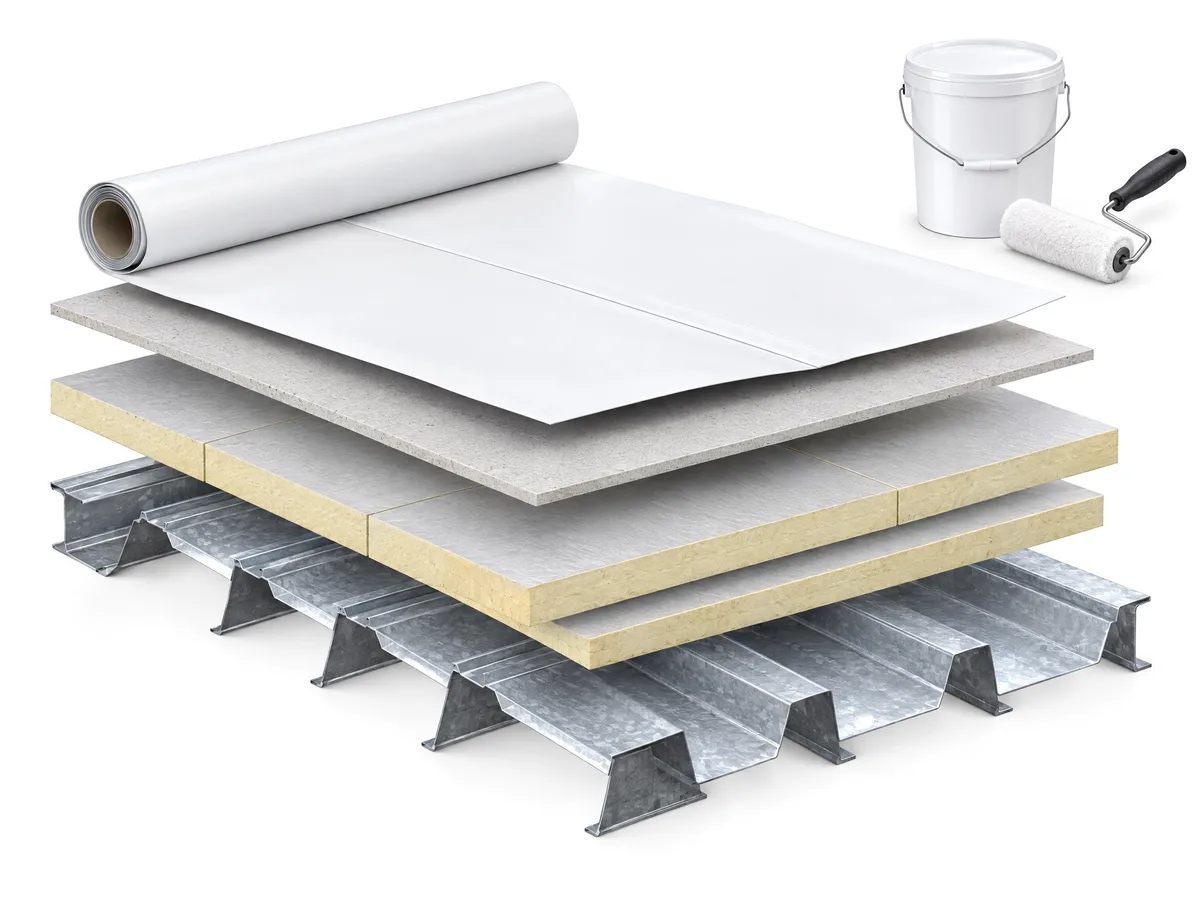 Illustration
SMEA-2P-14-3G-6xE — Acrylic-surfaced reinforced roof system
884 Tropi-Cool Silicone Roof Sealant
Duro-Last EV Fleece PVC Membrane
Illustration SM-12-3G-3E — Acrylic-surfaced reinforced roof system
Acrylic Reinforced Coating System BUR Capsheet
Acrylic Roof Restoration Coating System BUR Capsheet
Contribution history
Published changes remain in this permanent record. Corrections create a new entry instead of deleting earlier history.
- September 21, 2026 at 8:48 amLibrary Record
Silicone Roof Coating System Tar and Gravel Hybrid System Reinforced Acrylic with Silicone Top Coat — initial source record
Created the system record and matched the current manufacturer system specification, application guidance and component data sheets.
By Tom · Verified Primary Source